The Earth's illness
Leave the World BehindThe Earth's illness names a crisis that is at once ecological, infrastructural, and difficult to know. As the blackout spreads beyond the characters’ immediate understanding, climate change, disrupted systems, and unusual animal behavior appear not as separate problems but as connected signs of a world already altered. The novel gives those signs weight before its characters can assemble them into an explanation: the environment is changing, human systems are vulnerable, and the old confidence that ordinary life will continue has become untenable.
A planetary crisis without a settled name
The illness first takes shape through the contrast between public information and private uncertainty. In the dark hallway, Amanda’s phone lights up with an alert from The New York Times reporting a major blackout on the East Coast of the United States. Yet the app will not open, and the device offers no usable explanation. The alert identifies the scale of the outage while its failure leaves Amanda unable to learn what it means. Information has arrived, but not understanding.
The adults reach for familiar explanations. Ruth considers whether a hurricane might be connected to the power outage, recalls Hurricane Sandy, and reflects that storms once described as exceptional are becoming more frequent. She connects the changing language of storms to human alteration of the ocean, but cannot establish that a particular storm caused the present emergency. That uncertainty matters: the crisis is not made legible by a single cause that the characters can point to and resolve.
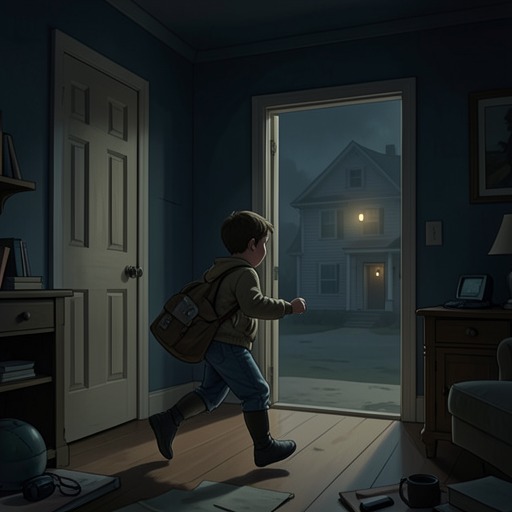
Rose, by contrast, senses a change before she has language that others would accept. In the early morning, she registers heat that seems out of place, an unnatural quiet, and an atmosphere she cannot explain. She anticipates that adults might dismiss her because she is a child, even as she trusts her own perception. Her attention makes environmental change a matter of experience as well as argument: what cannot yet be named can still be felt.
Nature as witness and actor
When Rose and Archie enter the woods, the landscape is more than a backdrop to their excursion. Rose imagines the trees as aware, connected to one another, and capable of registering distant seismic disturbance. The narration widens this perception into a long environmental timescale: trees affected by the sea may take years to become pale, dead wood, while mangroves may adapt by lifting their roots and filtering salt from the ground. The contrast is between slow ecological change and the short horizon of human attention.
The woods also place the children inside a transformation they do not fully understand. Rose and Archie discover a brick house, lawn, pool, and swing set beyond the trees, but the familiar signs of domestic life do not cancel the surrounding unease. The children move through a world whose underlying logic, the narration suggests, has been changing for some time. What they previously understood has not simply become false; it has become insufficient for the conditions they now face.
Animal behavior makes that altered world visible on a larger scale. More than a thousand deer move through gardens without respecting human property boundaries, and the noise sends them into a stampede. Later, another herd joins them and travels according to its own instinct. These movements are not presented as decorative wildlife scenes: they make the limits of human control over land newly apparent. The deer’s collective motion offers a striking contrast to people who remain unsure what is happening or whether it is safe to leave.
Systems made visible by failure
The blackout exposes how much everyday life depends on systems that usually remain unnoticed. The emergency broadcast screen appears on the television, but it supplies only repeated beeps and hiss rather than news. The signal’s formal promise of an official account is thus separated from the practical ability to inform anyone. Amanda’s phone and Ruth’s television both register the emergency while failing to make it comprehensible.
Water reveals a more immediate dependency. G. H. explains that an electric pump fills the reservoir supplying upper-floor apartments in Manhattan; if power fails, water can fail as well. The Washingtons’ countryside house still has electricity, and G. H. credits the building even though he recognizes that its construction cannot explain the continuing supply. The house feels secure in the moment, but its functioning depends on a larger network and conditions beyond the residents’ control.
That dependence becomes more consequential as the outage’s effects accumulate. The narration describes failures in air-traffic control, a plane lost during the disruption, a pipeline spill, and life-supporting equipment ceasing to function after backup generators fail in several cities. These details make the crisis neither an abstract environmental forecast nor a single broken appliance: failures in connected systems translate disruption into practical danger. Even the scheduled cycle of the pool’s filtration system, which tells G. H. that it is ten in the morning, carries an uneasy double meaning. A household mechanism continues its routine while the broader reliability of power and essential services is in doubt.
Knowledge, denial, and unequal consequences
Danny’s account shows the distance between receiving a warning and knowing how to respond. He has read that there is a blackout, has no phone service or cable, and still has electricity. After finding a quiet store, he returns home and hears the noise; he decides to stay put until he learns otherwise. His choice is a practical response to fragmentary information, not proof that the countryside is safe or that the danger has been understood. Across the novel, people act on whatever limited evidence reaches them, while the systems that might coordinate a response are failing.
The narration broadens that uncertainty into a panorama of consequences. Some places have not yet experienced obvious disruption, while people cannot communicate reliably with satellites; others face flooding, emergencies, disrupted travel, and failing services. Governments may declare emergencies without being able to communicate them effectively. The scale and variety of these outcomes resist the comforting idea that one announcement or one local explanation could contain the crisis. They also show that its burdens fall unevenly: people dependent on transport, communications, medical equipment, or vulnerable infrastructure face immediate consequences where others may initially see little change.
Rose’s continuing walk gives this theme a human point of focus. She understands the noise as evidence of change that adults have tried not to acknowledge, though she cannot know the full range of events unfolding elsewhere. The contrast between her instinctive recognition and the wider failure to understand does not make the child omniscient; it shows how attention can register a reality that official language and familiar habits have not caught up with. The Earth's illness is therefore both a condition of the world and a crisis of perception: damage can be present before it is publicly recognized, and the failure to name it does not make its consequences less real.