The Illusion of Safety
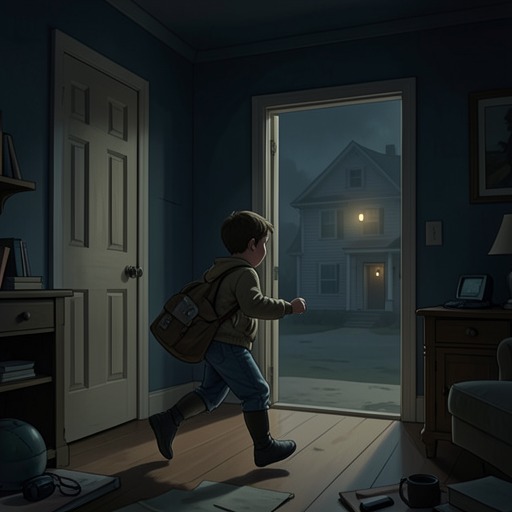
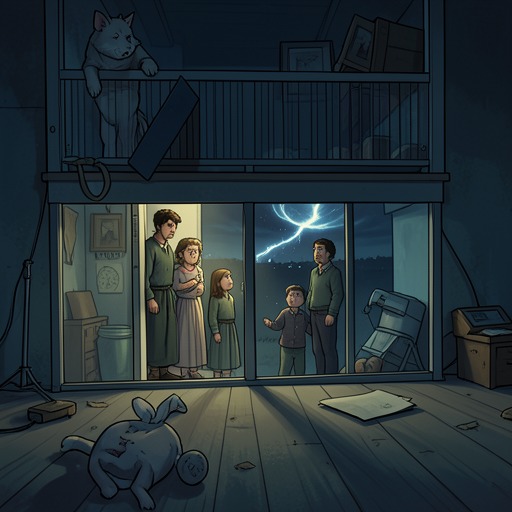
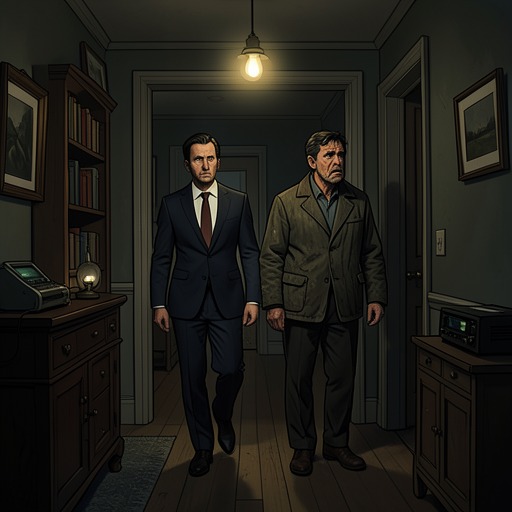
Leave the World BehindThe Illusion of Safety is the fragile belief that a house, its provisions, and the people gathered inside can secure them against a crisis whose scale and dangers remain unknown. During the blackout, the Washingtons’ home supplies genuine shelter, power, and water, but those comforts cannot establish what is happening outside or promise that help will arrive. Safety becomes both a practical need and a repeated reassurance, revealing the distance between having a refuge and knowing that one is safe.
The House as Refuge
G. H. gives the group’s first firm declaration of safety while standing at the Vermont stone countertops, his brown hands resting on the stone. He calls the situation an emergency, then insists that they are prepared and safe. Yet the evidence he offers is strikingly modest: energy bars and a case of wine. The supplies are real, but they do not answer the questions pressing on the household. Amanda wonders about a generator, a bomb shelter, a hand-crank radio, and a way to make dirty water drinkable. Elsewhere in the conversation, she asks about filling the bathtubs, batteries, medicine, food, and whether to seek out the neighbors. The contrast is not between preparation and its total absence, but between a few useful provisions and the many unknowns they cannot control.
The house nonetheless has material advantages. Later, Clay argues for staying because it has power and water; he adds that there is food, a roof, G. H.’s money, and the company of the others. Each item supports a different part of his case: utilities and supplies answer immediate needs, while shelter and companionship make remaining together seem preferable to facing the crisis alone. His wish to stay is not abstract. He is frightened, has a sick teenage son, and is also counting how many cigarettes he has left. The home’s comforts offer a basis for action, but they do not resolve the larger uncertainty.
Reassurance and Uncertainty
Safety is sustained partly through repetition. G. H. says they will stay and are safe; Clay tells Ruth that she will not die there and repeats that they are safe. The narration likens their conversation to the childhood game of telephone: as the people speak among themselves, they have lost track of things. The repeated claim travels more easily than reliable information. G. H. tries to be reassuring and rational, proposing that they drive to the neighbors or that someone will come by, and treating the arrival of news as a matter of time. But those are expectations, not knowledge.
Ruth directly exposes the limit of that certainty. Calmly, she asks how Clay can know what will happen and points out that none of them knows whether she will hear her favorite passages from Swan Lake again. Her concern makes the uncertain future personal: even the music she can summon in her mind may be the last she hears. G. H. answers that they are not on Mars, that people live only a few miles away, and that they have already heard something. The nearby neighbors and the earlier sound offer possible signs of connection, but neither proves that assistance is coming. In this exchange, reassurance does not defeat uncertainty; it shows how urgently the group needs reassurance in its presence.
The Offer of Shelter and Its Limits
The house becomes a proposed refuge for Amanda as well as for the people who live there. Ruth invites her to stay, and the narration describes the house as a life raft. But the image carries unease: Amanda does not experience the offer as an uncomplicated rescue. She wonders whether it might be a con or a delusion and experiences the prospect of remaining with the others as confinement. The possibility of shelter therefore has a cost as well as an appeal. Amanda’s nearest potential ally is Ruth, yet trust and relief do not erase Amanda’s independent reason for leaving: Archie needs a doctor.
Ruth’s own admission makes clear that safety is not only a question of walls or supplies. She says she feels safe there and wants only to feel safe, while recognizing that this family’s safety is not truly her problem. Her words distinguish an emotional need from a guarantee the house cannot provide. Clay’s desire to stay and Amanda’s refusal to treat the refuge as sufficient are not simple opposites: one emphasizes the resources and companionship already available, while the other keeps the sick child’s need for medical care in view. Ruth offers shelter, but the offer cannot make those needs disappear.
Meaning in the Crisis
The illusion lies not in claiming that the house offers nothing. It has power, water, food, a roof, and people who are willing to shelter one another. The illusion arises when those immediate protections are made to stand for knowledge of what comes next. G. H.’s provisions give substance to his confidence, and Clay’s list gives his wish to remain a practical shape; neither list can establish that the house is secure against every danger or that the crisis will soon pass.
The characters’ competing responses show how refuge can be both necessary and incomplete. G. H. tries to keep the group together through confident assurances, Ruth names the limits of what anyone can know, Clay reaches for the concrete advantages of staying, and Amanda weighs those advantages against Archie’s need for a doctor. Their different judgments do not cancel the house’s usefulness. They show instead that a place can provide temporary shelter without becoming certainty: the people inside may be less alone, but they remain unable to know whether they are safe.