The Market Curve
Leave the World BehindThe Market Curve is G. H. (George Washington)’s name for a financial pattern that, read closely, can disclose what is coming. He credits information with making his fortune and says he saw the market’s warning before the lights went out. But the crisis tests the limits of that confidence: a curve may register change without explaining it, while the larger failure is the human tendency to overlook information already at hand.
The Curve as a Reading Method
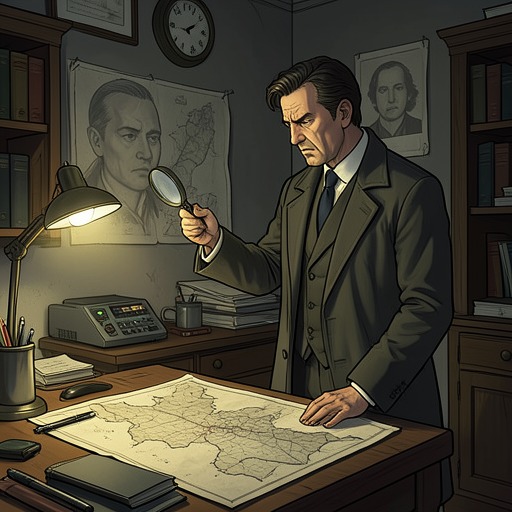
G. H. describes the curve as a legible movement rather than a source of certain, immediate answers. When it holds steady, it seems to promise harmony; when it inches upward or downward, the movement means something, though the reader must look more closely to determine what. Skill lies in interpreting the direction and significance of those small changes. A successful reader can get rich; a poor one can lose everything. The method depends not just on possessing information but on noticing patterns and making a consequential judgment from them.
That account gives the curve an almost prophetic force. G. H. tells Amanda that he owes his fortune, modest as it is, to information, and that he looked at the market before the lights went out and knew something was coming. The narrative does not specify which movement he saw or show that the curve identified the blackout in particular. His confidence is therefore real but bounded: he sensed an approaching change, not a fully explained sequence of events. When Clay lists the outage, Amanda’s news alerts, and the loud noise, G. H. calls the situation a market event rather than the end of the world. The label offers a framework, but not an account of everything happening around them.
Signals Without an Explanation
The crisis repeatedly separates receiving a signal from being able to understand or act on it. In the dark hall, Amanda’s phone briefly lights up and displays a report of the Major Blackout on the U.S. East Coast. She cannot open the alert; the app remains a white screen. The warning reaches her in fragments, and the device that delivers it cannot provide the fuller information she seeks. Later, the Emergency Broadcast System television offers no report at all, only steady beeps that do not reassure the people watching.
Basic services make the same dependence on hidden systems tangible. G. H. explains that water in the apartments at the top of Manhattan depends on an electric pump filling a reservoir: when the power goes, the water does too. The narrator anticipates that some residents will soon become delirious from dehydration. Meanwhile, the power at the house still holds, and G. H. credits the well-made building, though he knows its construction has nothing to do with continued service. His mistaken explanation exposes a gap between the visible sign that something is still working and knowledge of why it works.
A different kind of signal survives in the house’s scheduled pool filtration cycle. When Archie becomes gravely ill, the adults carry him inside and lay him on the sofa; the pool system starts its routine cycle, and G. H. recognizes the sound as evidence that it is 10:00 a.m. The machine provides a precise reading of time while doing nothing to explain Archie’s condition. Information remains available in isolated forms, but its usefulness depends on what question it can answer.
The Limits of Expertise
G. H. himself acknowledges that the curve cannot make all knowledge available. He says he could work out a relationship between the curve and the birds, but doing so would require days, a pencil, a newspaper, and quiet. His ordinary instruments of analysis are missing just as the crisis produces phenomena demanding interpretation. The adults do not know whether the birds migrate across the ocean or why flamingos are pink; they also cannot explain noises loud enough to crack glass or the blackout in New York City, and they cannot get a cell-phone signal or make the television work.
This admission qualifies the earlier image of the curve as something that tells the future. G. H. may be practiced at reading a market, but expertise in one system does not automatically extend to animals, infrastructure, or an unexplained catastrophe. His need for time and materials also matters: pattern recognition is not magical insight, but a process requiring conditions that the emergency has stripped away. The curve might indicate that something is changing; it cannot by itself supply the missing evidence, tools, or interpretive context.
Information, Denial, and Collapse
The deepest limit is not simply that people lack data. The narrative describes the adults’ failure of imagination as a pair of private, overlapping delusions, then insists that warning signs had long been available: the gradual death of Lebanon’s cedars, the disappearance of the river dolphin, revived Cold War hostility, the discovery of fission, and vessels capsizing while crowded with Africans. Phones had repeatedly reminded people how bad conditions had become. The curve is therefore not the only possible means of recognizing danger, nor is ignorance presented as inevitable. People could know without studying markets or even reading newspapers, yet still pretend not to know.
As the crisis widens, that distinction between information and comprehension becomes more consequential. In places where nothing has yet happened, people still cannot seem to communicate with satellites; elsewhere, people flee, attempt to preserve familiar systems, or continue jobs whose usefulness will later disappear. The scale and unevenness of these consequences exceed any single observer’s view. Set against them, the curve represents a powerful but partial form of knowledge: it trains attention on changes that can be read, while the surrounding emergency reveals how much remains unseen, disconnected, or deliberately unacknowledged. The book’s irony is that the warning was not wholly absent. What failed was the assumption that a signal, once present, would be understood in time.