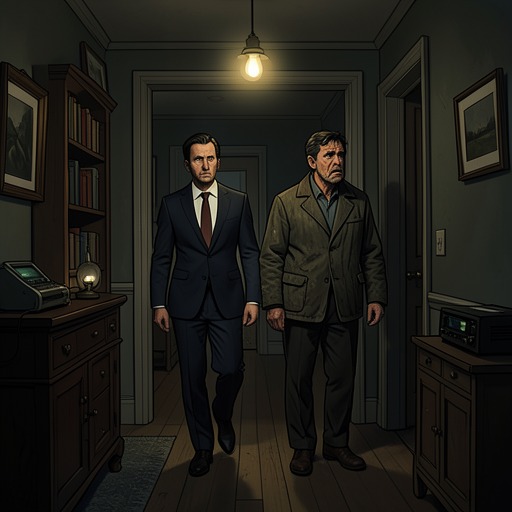
The Washingtons return to the vacation house late at night
Leave the World BehindThe Washingtons return to the vacation house late at night after a blackout leaves them unable to reach the city or contact Clay and Amanda by phone. Their arrival transforms an invisible failure of electrical power and communications into a face-to-face encounter: the homeowners need shelter, while their unexpected guests must decide whether to let them in. The scene’s tension lies in the distance between the couple’s practical need and the strangers’ reasonable alarm.
The Knock and the First Impressions
The encounter begins with an ordinary domestic question made newly uncertain. Amanda has gone into the kitchen, where a desk and cordless telephone offer the possibility of calling for help; she hesitates over whether to press the button and dial nine and then one. The phone is itself a small marker of changing habits: once an innovation, it has become nearly obsolete, and the family still has one at home that nobody uses. Before Amanda can turn it into a means of action, Clay unbolts the door.
On the porch, the man presents a carefully legible image of reassurance: in his sixties, handsome, well proportioned, silver-haired, and dressed in a rumpled blazer, loosened knit tie, striped shirt, and brown pants. His raised hands might signal conciliation or warn against shooting. The narration notes the social calculation carried by that gesture for a Black man of his generation. His appearance seems reassuring to the eye, but appearance cannot establish whether he is safe; the scene keeps that uncertainty alive rather than resolving it at the threshold.
The visitors apologize repeatedly for disturbing the household. The man says they are sorry to bother the family, acknowledges the lateness and remoteness of the house, and appears to have rehearsed how he would explain the knock. Ruth joins in, saying they had debated whether to use the front or side door and laughing at the awkwardness. Her voice suggests old elocution lessons and a trace of Katharine Hepburn, a cultivated manner that contrasts with the vulnerability of arriving uninvited. Clay says the visit is surprising rather than frightening, but his politeness does not mean Amanda shares his ease.
Amanda watches from behind a column, considering whether an emergency call is needed and worrying that she has not locked the children’s bedroom doors. Although she prides herself on remembering the people who pay her and their families, she cannot recognize the man. He, by contrast, knows her name and repeats it, then asks whether the couple can come inside. That asymmetry sharpens the encounter: he has arrived with information about the household, while Amanda sees only a stranger and has no reliable way to verify his intentions.
Explaining the Journey
Once the visitors and hosts are gathered in the kitchen, G. H. takes on the explanation as a responsibility he imagines another husband might understand. He says he would have called, and that they had tried, but there is no service. Clay answers that reception had been poor when his family stayed nearby in previous summers. G. H. agrees that the area can lack a signal, but cautions that this may not explain what is happening now. The distinction matters: what had seemed like a familiar rural inconvenience may be part of a wider breakdown.
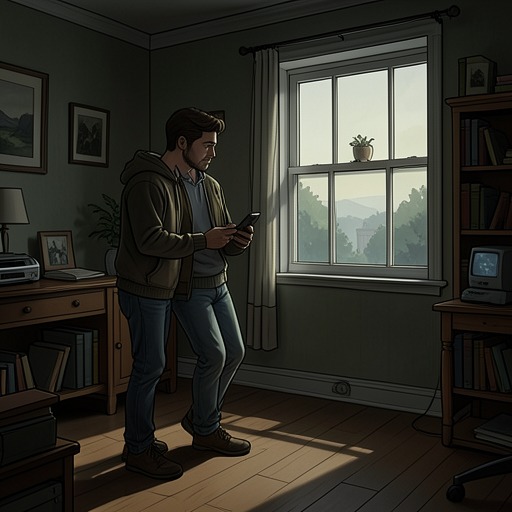
G. H. and Ruth had been at a symphony in the Bronx. Ruth explains that he serves on the New York Philharmonic’s board, a point of pride connected to their effort to encourage interest in classical music. While Amanda listens from the dark hall, she uses her phone as a light and checks that Archie and Rose are asleep. Her phone’s screen briefly displays a New York Times alert reporting a major blackout on the East Coast of the United States. She tries to open it, but the application fails to load, leaving the warning visible without supplying a fuller account.
The couple’s account is direct but incomplete. G. H. says they saw the lights go out and that the roads were familiar; he had barely thought about the drive. Ruth says they thought they might stay at the house. Amanda struggles to understand why they had driven so far from Manhattan, and immediately points out that her own family is staying there. G. H. explains that they could not drive into the city and could not walk up fourteen flights to their home, so they came out to the country hoping the hosts would understand. The choice is presented as an improvised response to a crisis, not as a plan they can fully justify.
Shelter, Money, and Uneasy Hospitality
The proposal unsettles the boundaries of the vacation. Amanda hears that the couple thought they might stay and wonders what they want; the guests are also the people whose house the family has rented. Clay responds that he understands, while Amanda hastens to clarify that he means they understand the predicament. Her qualification exposes the gap between recognizing someone’s need and agreeing to share a house with them. The late hour, the sleeping children, and the absence of dependable communication make hospitality a decision with immediate stakes.
G. H. offers to refund the money the family paid. When Amanda objects to the prospect of being asked to leave in the middle of the night and reaches for her computer to check the booking terms, he clarifies that he is not asking them to go. Instead, he proposes refunding fifty percent and says that he and Ruth can stay in the in-law suite downstairs. Clay is attracted by the prospect of a less expensive vacation. Amanda tries to turn the offer into a matter of formal conditions, but her laptop will not work and she wonders whether the Wi-Fi needs resetting. The tools she reaches for—telephone, news application, website, wireless connection—each fail or prove uncertain just as the household must make a decision in person.
Significance of the Return
The return changes the meaning of the house before the evidence establishes what arrangements will follow. It is at once a paid vacation rental, a home to which its owners have come for refuge, and a place where both couples must negotiate the consequences of a blackout. G. H. and Ruth arrive with a concrete explanation for their need, but neither explanation nor the refund offer erases Amanda’s suspicion. Conversely, the family’s initial wariness does not prevent Clay from responding to the couple’s predicament with sympathy.
The scene also makes the communications outage palpable through small, failed acts rather than a broad account of the crisis: a cordless phone whose use feels unfamiliar, a cell phone that cannot open the news, and a laptop that cannot reach the booking terms. Against these absent connections, the knock becomes the event that carries information. The couple’s arrival is therefore both a request for shelter and the first direct evidence, for the hosts, that the blackout has made ordinary plans and ordinary distances unreliable.