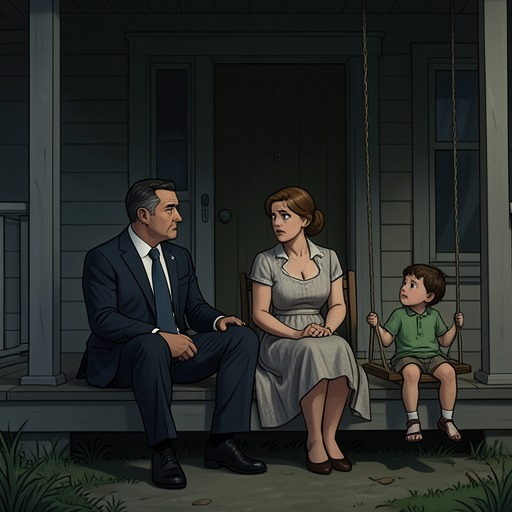
The family decides to shelter at the Washingtons’ house
Leave the World BehindThe family’s decision to shelter at the Washingtons’ house is a reluctant, temporary answer to a crisis with no reliable route out. The choice turns on competing needs: Archie may need a doctor, travel promises no dependable access to necessities, and the house offers immediate protection without resolving what the family should do next. Their refuge is real but conditional, and the chapter leaves the larger dilemma open.
Immediate Choice and Competing Risks
G. H. tells the family they are lucky to be home already, recasting the house as a place of shelter rather than merely someone else’s home. Ruth resists making that reassurance into a promise. She cannot see a bright side and warns that the events around them may be a sign not to leave; at the same time, she says the Washingtons cannot go with the family. Her reluctance is not indifference to their danger: she is candid that she wants to feel safe, while recognizing that the visiting family’s safety is not truly her responsibility.
George Herman Washington makes the offer directly: the family could stay. Amanda answers decisively that they cannot. Clay, however, is already testing a practical alternative, suggesting that they could go downstairs and that Amanda could have the bedroom. His proposal makes the offer concrete: remaining would mean accepting space in the house and relying on the Washingtons, rather than continuing as if the family could simply resume its journey.
The Noise and the Urgency of Departure
Before the decision settles, the group falls quiet, seemingly aware that another noise is coming. It comes repeatedly, and the window over the sink and the pendant light above the counter crack. The electricity does not go out. The narration identifies the sounds as American planes overhead, but the people in the house do not know that; to them, the noises are unexplained. This mismatch between what the reader is told and what the family can understand intensifies the uncertainty surrounding their choice without giving them usable information.
Afterward, Amanda asks Clay whether they should still go. He acts as if he is considering it, though the dilemma is already plain to him: they should not leave, yet they must find help. He cannot give a firm answer. Amanda insists that Archie needs a doctor, while the possibility that Rose might also be affected remains difficult for her to voice. Clay believes Rose seems all right and has faith in her, but that confidence does not make the family’s wider situation seem safe. To Amanda, appearances are unreliable: everyone may seem okay even as the circumstances resemble a disaster and the end of the world.
A Practical Case for Staying
Amanda does not accept indefinite refuge as a solution. She says they need a plan and cannot stay forever, keeping the need to act in view even as the immediate impulse to leave loses force. Clay answers with a narrower proposition: they can stay there for now. He has heard the offer, and the distinction matters. He is not claiming the house will solve the crisis or that departure is permanently abandoned; he is arguing for shelter while the family lacks a workable alternative.
His reasoning is material as well as emotional. He counts the cigarettes he has left and acknowledges that he does want to stay, despite Archie’s illness, his own nicotine withdrawal, and the fact that this is not their beautiful house. The Washingtons’ home has electricity, water, food, and a roof. Amanda had earlier told him to fill the bathtub, a practical precaution that gives their reliance on water a specific, immediate dimension. Clay also points to G. H.’s money and to the fact that the families have one another. These are limited resources, but together they make staying appear safer than setting out without assurance of traffic, food, water, or trustworthy people.
Provisional Refuge
The decision emerges through disagreement rather than shared certainty. Ruth’s wish for safety, Amanda’s refusal to remain indefinitely, Clay’s fear, and his willingness to accept the offer do not collapse into a single confident judgment. Even when Clay says that they are not alone, the narration qualifies the comfort: the people are both alone and not alone, since collective fate does not erase individual vulnerability.
The family stays for the present, with Archie’s need for medical care still unresolved and no permanent plan in place. The scene closes not with a declaration that the house is secure, but with the parents lying together without further discussion while the children sleep. Their refuge buys time and gathers the families under one roof; it cannot answer what the crisis will demand next.