U.S. East Coast Infrastructure Crisis
Leave the World BehindThe U.S. East Coast Infrastructure Crisis is a cascading failure whose defining feature is not a confirmed cause but the growing dependence of ordinary life on systems that have stopped working. A blackout first appears as a distant news alert; soon, power loss is entangled with failing communications, disrupted transport, water supply, and emergency services. In the country, a household can still have electricity while the wider world becomes harder to reach and understand.
Outage and Uncertainty
Amanda learns of the blackout through a news alert on her phone: the New York Times headline reports a major blackout on the East Coast of the United States. The alert is legible only in part, and the application will not open. The device can deliver a fragment of information but cannot provide the fuller account she wants, making the failure of communication tangible inside the house.
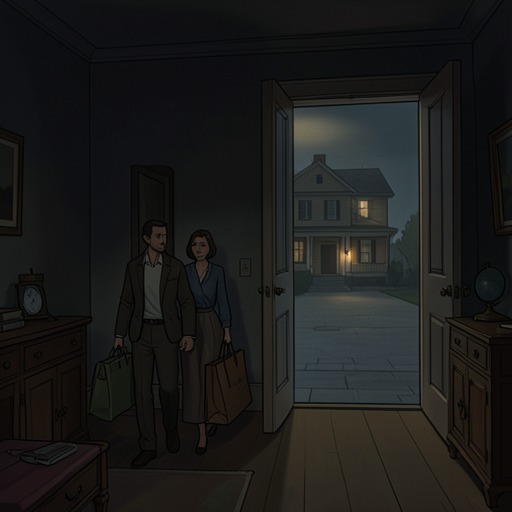
The Washingtons have driven from Manhattan after seeing the lights go out. G. H. says the roads were familiar and that he barely considered the decision to leave; Ruth is direct that they intend to stay. To Amanda, the journey makes little sense because Manhattan is so far away. Their arrival turns a remote outage into an immediate question of shelter, but does not explain what has happened.
Ruth considers whether the blackout might be a symptom of something larger, including fallout, terrorism, or a bomb. Clay urges restraint, and Amanda reacts with disbelief to the possibility of a bomb. These are fears and conjectures, not established explanations. The account leaves open whether the crisis began with a storm, an attack, or some other cause, and later suggests that even assigning responsibility through the networks may be impossible.
Information and Communication
At the house, Ruth turns on the television. The screen displays the Emergency Broadcast System, but instead of a report it produces a sequence of beeps and a quiet hiss. The signal continues without offering reassurance or usable news. Amanda suggests it may be a test; nothing in the broadcast confirms that interpretation.
The contrast between available electricity and unavailable information recurs. Danny says his home has power, but he has no phone service or cable. He drives into town for supplies expecting a crowded store, only to find it quiet and with no indication that people know what is happening. After hearing the mysterious noise, he decides to stay put. His account illustrates how local access to power does not restore communication or give residents a reliable picture of events beyond their immediate surroundings.
The disruption reaches systems that might ordinarily explain or coordinate a response. In some towns in New Mexico and Idaho, little has happened locally, yet people cannot seem to communicate with satellites overhead. Governors declare states of emergency but cannot work out how to tell residents. Within roughly a day, most people stop relying on old radios or expecting them to make events intelligible. Information is not simply scarce: the channels meant to carry it are themselves compromised.
Power and Interdependent Services
The blackout exposes how services depend on electricity in ways that are usually easy to overlook. G. H. explains that Manhattan’s water supply relies on an electric pump to fill its reservoirs. If the power fails, water stops as well. He anticipates that residents in the uppermost apartments will eventually become dangerously dehydrated, while marveling that the house still has power. He credits the small, well-built house, though he knows its construction has nothing to do with the electricity remaining on.
The continuing power at the house is therefore an exception, not proof that the wider system is secure. When Archie becomes unwell, the pool filtration system begins its scheduled cycle and tells G. H. that it is 10:00 a.m. Its familiar, timed operation persists even as the adults lack an explanation for the crisis. The ordinary mechanism is useful as a clock, but it says nothing about the condition of the systems on which people elsewhere depend.
Across the affected region, backup power also fails to protect essential services. Machines intended to support life stop doing so after generators fail in Miami, Atlanta, Charlotte, and Annapolis. In New York, a subway train is stalled beneath the Hudson River; disruption to air-traffic control leads to the loss of a Delta flight traveling between Dallas and Minneapolis. A pipeline spills crude in an unpopulated part of Wyoming. These are not isolated inconveniences but failures in systems that connect distant places and sustain everyday activity.
Consequences and Uneven Exposure
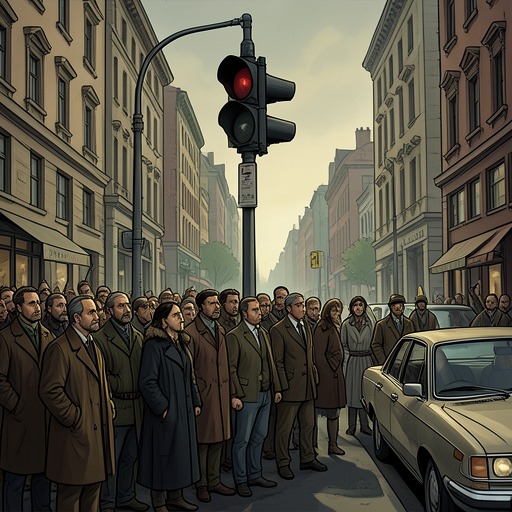
The failure of transport and emergency response makes routine crises more dangerous. A major television star dies after being struck by a car at the intersection of Seventy-Ninth and Amsterdam because ambulances cannot get through. In the same account, people in the city experience a silence that feels threatening rather than restful: the streets are hot and still, while the usual signals of urban activity have fallen away. The country house offers temporary distance from that scene, not evidence that the disruption is confined to the city.
The effects are uneven. Some people begin packing cars in hopes of reaching safety; others continue going to work, including workers selling plants or making hotel beds, jobs that will later seem useless. Some residents stockpile supplies, while others try to preserve existing routines. A Salvadoran restaurant in Harlem cooks food outdoors and gives it away. By contrast, some people lock doors and windows and play board games with their families. The crisis produces no single social response: uncertainty prompts mutual aid, preparation, denial, and attempts to carry on.
Rose’s journey through the woods is set against a much wider account of consequences that she cannot know. The narrative describes coastal flooding, deaths in a care home, a hospital losing power, and newborns in a neonatal intensive care unit dying within hours. It also describes people in cities becoming stranded or unreachable as transport and communications fail. These distant outcomes show the human stakes of infrastructure loss without giving the family a comprehensive report of events; the scale of the crisis exceeds what the characters can learn from their immediate surroundings.
The Crisis as a State of Uncertainty
The infrastructure crisis develops through partial signals rather than a definitive public explanation: a phone alert that will not open, an emergency broadcast that only beeps, a powered house, and reports from a neighbor with no service or cable. Each piece of evidence answers one small question while leaving the larger one unresolved. Even the cause remains uncertain, and the inability to verify responsibility is itself part of the breakdown.
That mismatch between local normality and wider failure gives the crisis its distinctive shape. The pool system continues its routine cycle; the store is quiet; people in places with little local damage cannot reach satellites or reliably hear from authorities. Meanwhile, essential services fail elsewhere, and the consequences accumulate beyond the family’s view. The blackout is thus not merely an absence of electricity but a test of the hidden connections among power, water, transport, communication, and care—and of how fragile people’s knowledge becomes when those connections no longer hold.