Unexplained Abnormal Tooth Loss
Leave the World BehindArchie’s unexplained abnormal tooth loss is a sudden bodily crisis that exposes the limits of the family’s ability to interpret or protect against what is happening. After he becomes feverish and vomits, teeth begin coming loose and falling out. Neither Archie nor the adults can identify a cause; when Clay later reports the loss to Danny, Danny wonders whether it is connected to the unexplained noise, but that remains a suspicion rather than an answer.
Illness Before the Tooth Loss
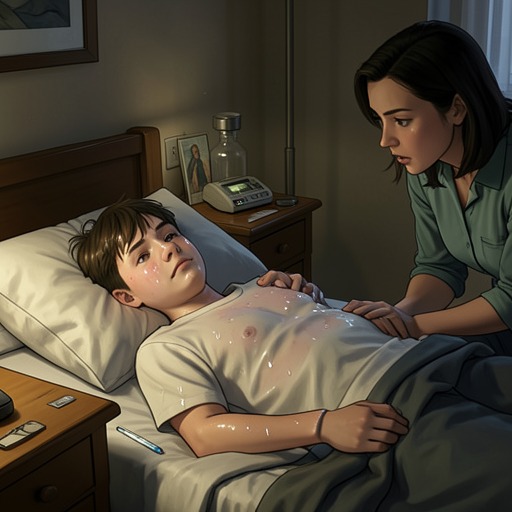
When Amanda asks whether Archie feels all right, he cannot say where he is or understand what is happening. He sits up abruptly and reports that his jaw feels different or wrong. Amanda notices the heat coming from his body, and he soon vomits onto his lap. These signs establish that the tooth loss is not an isolated household mishap: it follows a disorienting illness whose cause is already unclear.
Amanda responds through practical care. She calls Clay and washes her son, drawing on the familiarity of having cared for him when he was a boy. Her response frames the crisis in the terms available to a parent: attend to the body, assess what can be assessed, and continue caring for him even when the symptoms exceed understanding. The ordinary act of tending to a sick child offers a brief procedure, not an explanation.
The Teeth Fall Out
Later, while Amanda checks his mouth, Archie tests a tooth with his tongue. It yields under a slight touch and comes away; he then examines his mouth in a mirror and finds that more teeth are loose. The episode records five lost teeth in total, as G. H. later tells Danny. The sequence turns a familiar part of the body into an alarming object of attention: Archie had once left small childhood teeth beneath his pillow, but these are larger teeth from his sixteen-year-old mouth.
Archie insists that he is not sick and holds a tooth out for Amanda to see. The distinction matters to him: whatever is happening, the teeth are visible proof of a change he cannot explain, not merely a feeling of illness. Amanda, meanwhile, cannot make sense of what she is seeing. Her uncertainty parallels Archie’s; the family can witness and count the loss, but cannot place it within a known cause or remedy.
Family Response and Uncertainty
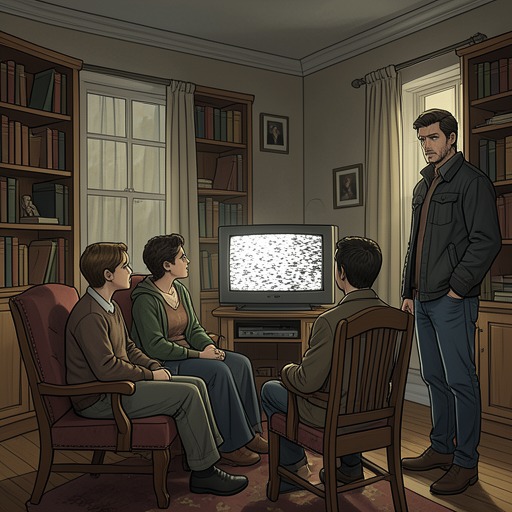
When Clay later explains the situation, he says Archie had been vomiting and now seems all right, preserving a measure of hope even as he admits that something has knocked teeth from his son’s mouth. G. H. supplies the count—five—and confirms that the family has no explanation. Their report makes the condition a shared problem rather than Archie’s private experience, yet the adults’ account adds no medical or causal certainty.
Danny connects the report to the mysterious noise by asking whether the two might be related. He also mentions damage at home: the shower door in the master bathroom has been affected. Danny speculates that a plane may have caused the noise and, in the absence of information, assumes that a war may have begun. These are conjectures, not established explanations for Archie’s condition. The conversation places the tooth loss among several disturbances that invite a common cause while leaving that cause out of reach.
Significance of the Unexplained Change
The episode’s force lies in the contrast between precise physical evidence and absent knowledge. The family can identify the affected body part, count five teeth, and connect the onset to Archie’s illness; none of those facts tells them why it is happening. Care remains possible, but control and diagnosis do not follow from it.
The teeth also make the crisis tangible without making it comprehensible. A child’s lost tooth once belonged to a recognizable stage of growing up and a familiar pillow ritual. Archie’s loss, by contrast, occurs at sixteen and is treated by those around him as abnormal. Danny’s question about the noise extends the uncertainty beyond one household, while the available evidence stops short of confirming a connection. The event therefore registers both a personal threat to Archie and a wider breakdown in the assumptions that ordinary bodily changes can be explained.