United States government
Leave the World BehindThe United States government is presented as both an actor in consequential military decisions and an authority whose ability to communicate with the public falters as the crisis spreads. The contrast is stark: decisions made by a small number of people can have far-reaching effects, while ordinary residents and even officials are left without dependable information or means of response.
Military Decisions and Their Consequences
The narrative links the crisis to aircraft dispatched from Rome, New York, to meet another plane approaching from western Africa. Bad intelligence led to the deaths of roughly four hundred people before the aircraft came near the United States’ borders. The account offers no detailed chain of command or explanation of the intelligence failure; instead, it stresses the human consequences of decisions made at a distance, before those involved could fully understand what was unfolding.
Later, the unexplained noises are identified by the narrator as the sound of American planes in American airspace, including a plane designed to carry out devastating actions. The passage places these aircraft within a wider sequence of governmental choices and reactions, describing public policy as the work of a handful of men whose actions can set off consequences beyond their control. The United States government is not given a single, comprehensible plan. Its activity remains largely unseen even as the consequences reach ordinary people.
Warnings Without Reliable Communication
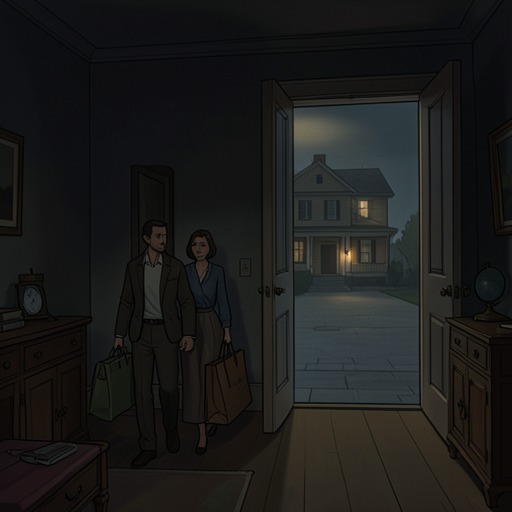
At the Washingtons’ house, Amanda’s phone briefly displays a news alert from The New York Times reporting a major blackout on the East Coast of the United States. The headline offers a fragment of confirmation, but the application will not open, leaving her with no fuller account. Information is present, but access to it is already breaking down.
The Emergency Broadcast System provides no more reassurance. Ruth switches on the television and sees the system’s screen, but its beeps continue without a spoken update. The alert mechanism remains active in form while failing to deliver useful news. These small domestic encounters show how quickly a public warning system can become an empty signal when the communication network behind it is impaired.
That failure widens beyond the household. Governors declare states of emergency, yet cannot work out how to tell people. In towns in New Mexico and Idaho, residents have not yet experienced the crisis, but people cannot seem to communicate with the satellites overhead. The problem is therefore not simply a lack of official decisions: the means of distributing information and coordinating a response are also compromised.
Infrastructure and the Limits of Authority
The blackout exposes how everyday services depend on systems that usually go unnoticed. G. H. explains that an electric pump fills a water reservoir, so a power failure also threatens the water supply. The novel anticipates dehydration among residents of upper Manhattan apartment buildings when that supply is lost. The detail makes the crisis more than an interruption of electricity: one failure can disable another essential service, with consequences that public declarations alone cannot prevent.
At the Washingtons’ house, the pool filtration system still begins its scheduled cycle and marks ten o’clock. Its routine operation offers a brief sign that automated systems continue to function, but it does not explain the larger emergency or restore communication. Even the household’s surviving infrastructure is local and limited; it cannot substitute for reliable public information.
A Distant Leader and a Dispersed Crisis
As the breakdown advances, the leader of the free world is sequestered beneath the White House, but the passage emphasizes that his location has little meaning to people trying to manage immediate disruption. Officials declare emergencies without reaching the population, while residents continue ordinary work, seek safety, or attempt to preserve familiar routines. The government remains symbolically present, yet increasingly remote from the experience of the people it governs.
The novel’s portrayal does not establish a complete account of government policy or a functioning response structure. Instead, it sets the scale of centralized decisions against the fragility of the systems through which authority would have to act. Military choices can reach across borders; warnings, water, and practical guidance cannot reliably reach people at home. The resulting gap between power and public protection makes institutional authority appear both consequential and insufficient.