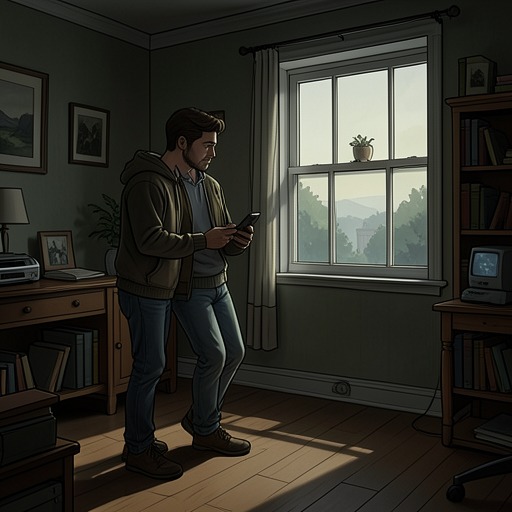
Washingtons' Long Island residence
Leave the World BehindThe Washingtons' Long Island residence is a temporary shelter whose ordinary comforts acquire new importance as a mysterious noise reaches the household. Amanda and the children return from the woods to a reunion marked by relief, and the house offers walls, provisions, and the presence of others. Yet the noise seems to cross the boundary between outdoors and indoors: even with a roof overhead, the people gathered there cannot be sure that the building makes them safe.
Return and Refuge
Amanda and the children emerge from the woods and reunite with the people at the residence. Ruth puts an arm around the boy’s bare shoulders, while G. H. takes Amanda’s forearm in a gesture of paternal relief. The reunion brings genuine joy among people who had been strangers to one another, making the house a place of connection as well as shelter. Amanda suggests that they go inside, giving shape to the group’s shared unease even as the sky remains blue and pretty.
The return does not restore a settled sense of safety. A hum and vibration seem to persist after the noise, difficult to locate and difficult to dismiss. The threat feels associated with nature, but the house’s bricks have not kept its sound away. At the residence, the distinction between a protected interior and an exposed outdoors begins to fail: the house can gather the group together, but it cannot explain what has happened or prevent the sound from reaching them.
Preparations and Material Security
Inside, G. H. places his hands on the Vermont stone countertops and tells the group that there is an emergency, that they are prepared, and that they are safe. The concrete inventory behind that reassurance is modest and domestic: energy bars and a case of wine. These supplies make preparedness tangible, but they do not amount to an explanation of the emergency. The confidence of G. H.’s declaration rests on what the household possesses, not on knowledge of what is happening beyond it.
Amanda calls for the bathtubs to be filled, although she does not know what might be required and is guessing. The action turns uncertainty into a practical household task. Filling tubs is preparation without a confirmed plan: the residence gives its occupants familiar fixtures and routines to act upon when reliable information is absent. The scene therefore holds together two different ideas of safety, one asserted by G. H. and one sought through Amanda’s improvised precautions.
The Noise Inside the House
The noises recur while the group is quiet, as though they expect them. They come once, then again, then a third time; the window over the sink cracks, and the pendant light above the counter cracks as well. The electricity probably should have gone off, yet it remains on, an unexplained contrast between visible damage and an amenity that continues to function. The house registers the event in its fixtures, but those signs do not give the occupants a way to understand it.
The narration supplies information unavailable to the people inside: the overlapping, distinct sounds come from American planes in the American sky, heading toward a future whose consequences are beyond the household’s view. The occupants do not know this. Their residence is thus presented from two levels at once: as a confined domestic scene in which glass cracks and electricity persists, and as a point within a much larger chain of actions and reactions. The contrast makes the house’s limited perspective part of its meaning; those within it can observe what happens to their surroundings but cannot identify the forces behind it.
Shelter and Its Limits
Later reassurance is grounded in the things and relationships the group can name: food, a roof, G. H.’s money, and one another. The residence is not represented as self-sufficient or invulnerable; rather, it provides a place where available resources and mutual presence can be counted. The list answers fear with practical facts, echoing G. H.’s earlier emphasis on preparation while leaving the emergency itself unresolved.
The house’s significance lies in that tension. Its countertops, tubs, roof, food, and working electricity offer real forms of support, and the returned children can be welcomed inside. But the sound has already crossed the walls, and cracks appear in the window and light without clarifying what is happening. The residence can shelter the group and give them tasks and company; it cannot guarantee that they are safe or make the larger crisis legible.