Washingtons' countryside home
Leave the World BehindWashingtons' countryside home is both a polished vacation rental and a real family home, a distinction that becomes urgent when its owners arrive during a blackout. Amanda and Clay had chosen it as an escape from city life, but the house’s promise of effortless comfort cannot keep the larger crisis outside—or prevent strangers who are also its owners from needing refuge within it.
Setting and Arrival
The house is a white-painted brick building, old-looking yet new, solid yet light. Its appearance gathers opposing qualities into a single ideal: a home that seems substantial without feeling heavy, traditional without losing its modern finish. Amanda found it on Airbnb under the inviting title “The Ultimate Escape.” The listing’s promise to let guests leave the world behind suited the vacation she had insisted upon after receiving a promotion and raise. With Rose nearing high school and Archie already approaching six feet tall, Amanda was conscious that this stage of family life would not last. The rental offered a brief interval in which the children were still mostly children, and she imagined the ordinary pleasure of being together at the pool.
The final approach establishes how far the house sits from familiar urban routines. A gooseneck trailer slows the car on the road; after it turns toward its homestead, the family’s GPS loses its position. They rely instead on directions Amanda had copied into a notebook, following a sequence of turns without being quite lost or quite certain of their route. At the property, a sculpted hedgerow partly conceals the house. A white picket fence encloses the front yard, while a separate wood-and-wire fence surrounds the pool. The barrier has a practical purpose: it helps reduce insurance costs and keeps wandering deer from entering a pool that could become a lethal trap.
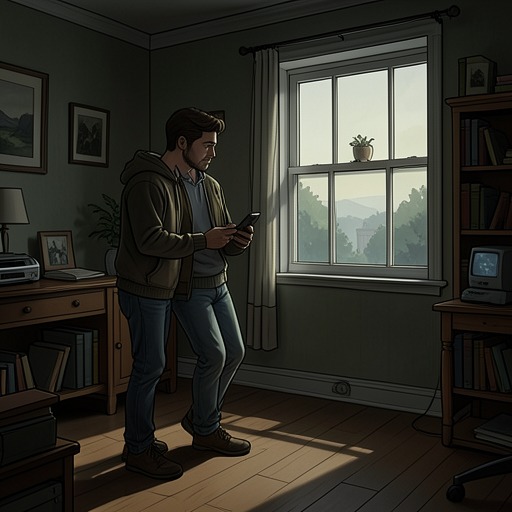
Access to this secluded rental depends on information saved in advance. When Amanda checks her phone, there is no service and no signal appears even when she holds it overhead. She retrieves the instructions from memory: a lockbox by the pool heater contains a key, and its code is six two nine two. The house is therefore remote enough to defeat the family’s connection to GPS and cellular service, yet its entry still depends on an owner’s orderly arrangement of codes, keys, and written directions.
Designed Comfort
Inside, the house initially seems to make its own quiet. Its hush signals, to Amanda, the smooth functioning of an expensive property: central air-conditioning breathes through the rooms, the refrigerator keeps watch, digital displays mark time in near-unison, and exterior lights are set to turn on automatically at a programmed hour. The wide-plank floors, made from wood taken from an old cotton mill in Utica, lie so evenly that they scarcely creak. The windows are cleaned so thoroughly that birds sometimes fail to recognize the glass and die after striking it. Careful preparation is visible in the work done before the guests arrive: blinds raised, thermostat lowered, surfaces polished, and even crumbs and a stray dime removed from the sofa.
The interior’s amenities turn hospitality into a sequence of anticipated domestic actions. Pendant lamps hang above an oak table suitable for a nighttime jigsaw puzzle; a gray marble island suggests kneading dough; and a double sink faces the pool. A copper faucet beside the stove lets someone fill a pot without moving it. Amanda imagines herself washing dishes at the sink while Clay grills outside with a beer and watches the children play Marco Polo. The rental supplies not only equipment but a picture of family life, arranged in advance as part of the vacation’s appeal.
Thoughtfulness extends into small objects and the house’s layout. A wooden box hides the plastic laundry-soap bottle, a large seashell holds a wrapped cake of soap, and a closet contains beach towels beside a stacked washer and dryer. The great room opens through French doors onto the deck. Two smaller bedrooms, decorated in aqua and navy, share a Jack-and-Jill bathroom; a long hall lined with unremarkable black-and-white beach scenes leads to the master bedroom. Its king-size bed is so large that it could not have been maneuvered up the stairs of Amanda and Clay’s third-floor apartment. The en suite bathroom is almost entirely white—tile, sink, towels, soap, and a dish of white seashells—an immaculate fantasy set against the bodily messiness that a home ordinarily contains.
This order is both comfort and performance. The house appears to need little from its occupants: its systems regulate temperature and light, its surfaces have been made nearly immaculate, and its objects discreetly anticipate use. Yet the ideal depends on maintenance by unseen hands and on electricity, appliances, and routines continuing to work. The apparent ease is not the absence of labor or infrastructure; it is their concealment.
A Rental Becomes a Shared Home
The house’s ownership is initially obscured by the very anonymity that makes it easy to rent. Amanda had exchanged emails with the owner but had not tried to picture who lived there. When a Black man and an elderly woman arrive, he addresses her by name and asks whether they can come inside. Amanda recognizes neither visitor. The man introduces himself as George and tells her that this is their house; he has to repeat the point before Amanda recovers the email address associated with the rental. She realizes that she had been treating the property as though it belonged to her, even though she and Clay had only rented it.
That recognition unsettles Amanda’s assumptions as well as her claim to the space. She reflects that she had not imagined Black people living in a house like this, then questions what she meant by that expectation. The owners had been easy to leave unpictured while the listing’s rooms and amenities became vivid. Their arrival makes the home’s actual residents impossible to overlook and turns the seemingly neutral vacation arrangement into a confrontation over who belongs there.
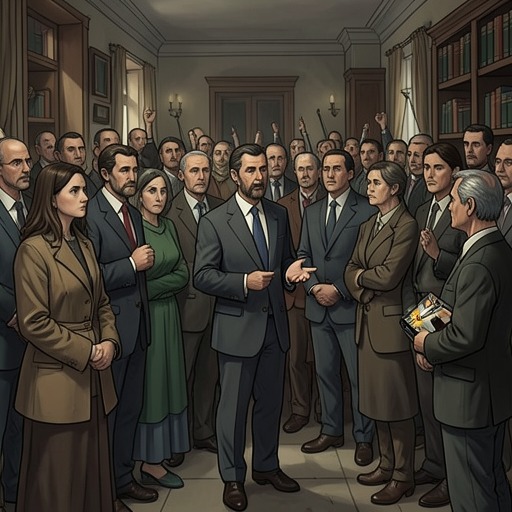
The conflict is sharpened by the blackout. George and Ruth have driven out from the city because they cannot drive back in and cannot climb fourteen flights to their city home. They had hoped Amanda and Clay would understand their need to stay. Amanda replies that her own family is staying there, and her question makes clear that she expects the owners to want something from her. George, however, understands the practical claim on both sides: Amanda and Clay have paid for the rental, and he cannot simply throw them out. The house is legally and personally his, but possession in the moment is divided between its owners and its paying guests.
Ruth insists on the emotional reality of that ownership when G. H. leads the way downstairs and switches on the lights. Holding the railing, she says that the house is hers. Her assertion answers the displacement implicit in having to return to a property occupied by vacationers, while the lights give the descent a newly felt association with safety. The house can shelter both couples, but sharing it does not erase the difference between a temporary claim purchased through a booking and a home rooted in the owners’ lives.
Refuge and Foreboding
George’s reluctance to make the guests leave is not simply courtesy. He knows that something is seriously wrong, though he cannot fully explain it, and his work has taught him to read warning in the market’s yield curve. He had distrusted its shape and taken it as a promise that something was coming. The house thus becomes a place of refuge for people who have reached it for different reasons: Amanda and Clay sought a country retreat, while George and Ruth have come because returning to the city is no longer possible. Its welcoming comforts are tested by a crisis its title seemed to promise could be left behind.
The house’s significance lies in that reversal, not in any failure of its amenities. The carefully arranged rooms still offer shelter, and its interior systems still make domestic life appear orderly. But the blackout changes what those comforts mean. A programmed exterior light, a working refrigerator, a code at a lockbox, and a secure barrier around the pool all belong to a dependable world of plans and maintenance. Now the house must serve as shared refuge amid uncertainty, and even George’s private home cannot resolve the larger danger. The supposed escape is less a sealed-off sanctuary than a temporary structure within the crisis: beautiful, useful, and unable to keep the world outside from arriving at its door.