Aloisius Dupree
Legado en los huesosAloisius Dupree is a homicide agent with the Federal Bureau of Investigation whose importance to Amaia Salazar lies as much in his way of thinking as in his investigative expertise. He has experienced victims appearing in his dreams and treats those visitations neither as proof of ghosts nor as meaningless nightmares, but as the mind's attempt to assemble evidence it has not yet consciously understood. By sharing that approach with Amaia, he becomes a trusted intellectual and emotional ally: someone who takes her unusual perceptions seriously without insisting that they are supernatural.
Identity and Investigative Method
Dupree is an experienced homicide investigator who has spent years trying to understand how killers think, what they want, and how they feel. He describes the detective's work as a sustained effort to make sense of a crime from both sides: studying the offender, then facing the victim's body and asking what it can disclose about the motive. In his view, investigators can become too absorbed in the criminal's psychology, treating the murdered person as the final product of a crime rather than as a person whose selection carries information.
That emphasis leads him to victimology. The choice of a victim, he tells Amaia, is not simply random; even an offender who intends to choose arbitrarily reveals a pattern through that very choice. Dupree's method therefore asks detectives to investigate the victim's circumstances and the logic of selection alongside the perpetrator's behavior. His thinking gives a disciplined investigative frame to intuitions that might otherwise be dismissed as private anxiety or professional overinvolvement.
The Dreams of the Victims
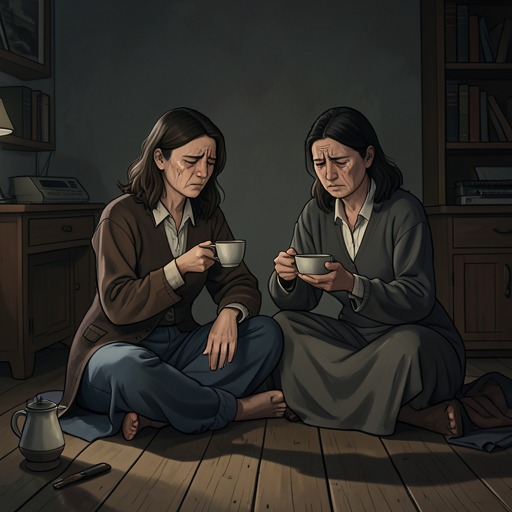
Dupree first discusses his experience with Amaia in New Orleans, over beer in a bar. He asks whether victims from her cases appear beside her bed, then reveals that he has had such experiences himself for years. His seriousness unsettles her: when she denies that ghosts exist, he does not demand that she adopt a supernatural explanation. Instead, he describes the dreams as projections of the investigator's subconscious, a form of mental processing that can matter precisely because it brings forward information the conscious mind has failed to notice.
He recalls that, as a young agent, the dreams frightened him. He woke sweating and anxious, worried that their intensity meant his mental health was deteriorating. During a long surveillance, he once jolted awake from such a nightmare. A veteran colleague joked that he should listen to what the ghost said rather than resist it. Dupree took the remark as practical advice: over time, he learned that a victim in a dream could represent knowledge already available to him but not yet recognized. The experience need not be literally paranormal to have investigative value.
This explanation does not erase the disturbing quality of the visions. It instead gives them a place within the work of homicide investigation, where the detective continually absorbs details and tries to infer what they mean. When Amaia asks whether the figures are ghosts or projections of the investigator's mind, Dupree answers in favor of the latter while leaving room for an unfinished qualification. His position is thus pragmatic rather than dismissive: he avoids claiming supernatural certainty, but he also refuses to treat the experience as irrelevant.
A Trusted Adviser to Amaia
Amaia turns to Dupree when the Baztán investigation begins to feel larger and stranger than the case she was officially assigned. In an early-morning call, she admits that she is confused and suspects that the crimes may connect to the valley. She explains that the killers appear to be low-level offenders with histories of violence against women, while their victims have ties to Baztán. She also senses that the person behind the pattern may be trying to establish a connection with her. Dupree's role is not to supply an instant solution, but to hear the parts of her reasoning that she does not yet know how to organize.
He responds to her unease as a fellow investigator rather than reducing it to stress. When she recalls the woman connected to a cave and the report of a one-eyed man leaving with a package, Dupree recognizes the clue's importance and urges her to return to Baztán. His advice reinforces a pattern in their exchanges: Amaia brings him observations that seem difficult to reconcile, and he helps her treat their very incongruity as something worth pursuing.
Dupree also helps shape the questions Amaia asks of a case. As she reviews forensic reports, she hears his reasoning about victim selection and the need to find the beginning of a pattern. His influence persists even when he is not present: she has absorbed his insistence that an investigation should test how the victim was chosen and where the chain of events originated, not merely collect similarities among the offenders.
Practical Support and Professional Trust
Their relationship extends beyond discussions of dreams and theory. Amaia regards Dupree as a friend and as the best agent she has known, valuing his intuition, intelligence, and perceptiveness. Although her aunt Engrasi has objected to how much Amaia relies on him, Amaia calls when she believes the investigation has exceeded the limits of ordinary police work and that she needs guidance through a confusing set of leads.
That trust also has practical consequences. When Amaia needs technical help with poor-quality images of a suspect, she contacts an American agent whose number Dupree has given her. The agent remembers her from an earlier visit and agrees to help because Dupree recommended her. Dupree is therefore not only a source of ideas: he has helped connect her to professional assistance when her own team cannot improve the images.
Amaia's calls to him take place across a difficult distance. From Baztán, she calculates the time in Louisiana before dialing; in one later episode, she calls at 00:03, when it is six in the evening there. The repeated nighttime contact makes Dupree a private sounding board for thoughts Amaia cannot readily discuss with her colleagues. She can bring him uncertainty before it has hardened into a theory, and he can ask the difficult question that moves her back toward the case's origin.
The Sister and the Limits of His Counsel
As Amaia's investigation becomes entangled with the terror of her childhood, Dupree's remembered questions acquire a more personal weight. She recalls his prompting her to reset the inquiry and ask when the sentence she associates with her mother's threat began. The question directs her toward the possibility that the source of her fear reaches back to her birth and to the identical girl who has recurred in her dreams. In this moment, his investigative habit of searching for an origin becomes a tool Amaia uses to approach a family secret.
During another call, Amaia struggles to establish what is real and asks whether her twin sister is alive. Dupree tells her that the sister is dead. The answer brings no easy relief: Amaia breaks into tears and asks how he can know. The exchange marks the limit as well as the force of his role. He is a trusted guide, but the knowledge she seeks concerns a profound personal loss, not simply a case pattern that can be solved by method.
Dupree's importance rests on this double function. He helps Amaia read dreams, victims, and anomalies as possible forms of information, while offering the professional trust that lets her speak openly when she is uncertain. His influence does not replace her judgment; it sharpens her attention to what she has not yet understood. In a story where victims seem to return and the past presses into present investigations, his insistence on taking the mind seriously—without pretending to know more than it can prove—gives Amaia a way to listen.