Amaia Salazar
Legado en los huesosAmaia Salazar’s work as a homicide inspector becomes inseparable from the Baztán Valley and from a series of crimes designed to reach her personally. In the final stretch of pregnancy, she is already pursuing investigations that appear separate: desecrations of a church in Arizkun and murders in which women were killed by intimate partners and their forearms removed after death. As the evidence converges, her task shifts from managing cases to confronting the possibility that someone has arranged their connections around her.
Identity and Investigative Role
Amaia is an experienced homicide inspector, recognized by her superiors for her investigative ability and knowledge of the region where she was born. That expertise brings her back to the valley when the church desecrations raise concerns about historical grievances and the use of human bones. Although she initially senses that her appointment is driven partly by political obligation, she accepts command of the inquiry and prepares to work from Elizondo, asking that the parish priest and the Arizkun chaplain be interviewed separately. She cautions her colleagues against leaping from the historical and religious elements to elaborate theories before investigating the people involved.
Her pregnancy is visible in the courthouse, where Lieutenant Padua greets her with concern about whether she can attend. It does not remove her from the work: she studies the evidence, presses for clarity, and takes responsibility for the investigation. The image of the inspector with one hand resting on her pregnant belly places the demands of her job beside the approaching demands of motherhood, a tension that will become increasingly personal as the case develops.
Reading the Pattern
The church desecrations initially seemed to belong to one investigation and the murders to another. Lieutenant Padua drew Amaia’s attention to a note left for her by Jasón Medina, who had confessed to raping and killing his stepdaughter Johana Márquez before attempting to imitate a mythic crime; after his suicide, the note’s reference to Tarttalo made the case harder to dismiss as closed. Padua did not doubt Medina’s guilt, but the missing forearms and the bones recovered from the Arri Zahar cave raised a different question: whether someone else was shaping the crimes around him. Amaia carried that question into her review of the evidence.
At a meeting with the judge, she set out the concrete links between Johana’s murder and the killing of Lucía Aguirre: both victims’ forearms had been severed at the elbow, and both confessed killers had died by suicide after leaving similar messages. In the Logroño case, the same unusual word had appeared on a cell wall, written with the same distinctive extra letter. The amputations were not public knowledge in every case, and Amaia argued that the precision of the shared detail made casual imitation unlikely. Across the cases she could review, the perpetrators were men close to their victims, with histories of domestic abuse, violence, or substance misuse; the post-mortem removal of the same arm, which then disappeared, was what failed to fit the ordinary pattern of intimate-partner murder.
The institutional gaps mattered as much as the similarities. The cases had been handled by different police forces, and confessions followed by the perpetrators’ suicides had allowed investigations to close without the records being compared. Amaia learned of two further women born in the valley who had been killed by their partners, one in Bilbao and one in Burgos; funeral notices in Baztán had preserved traces of their connection to home, but the available accounts did not establish whether their arms had also been removed. She did not turn that missing information into proof. Instead, the unverified cases widened the investigation while making its limits plain.
As Amaia explained to Aloisius Dupree, she had begun to suspect a deliberate link between the crimes and the valley. The killers themselves appeared to be ordinary, often violent men rather than masterminds, while an unseen organizer might be choosing or directing them and making subtle contact with the police. At the Arri Zahar cave, forensic light revealed the word Tarttalo written in blood on the rock. The discovery gave her a new investigative lead, but also sharpened the sense that the message was meant to be found—and that its intended recipient was her.
The Bones and the Buried Twin
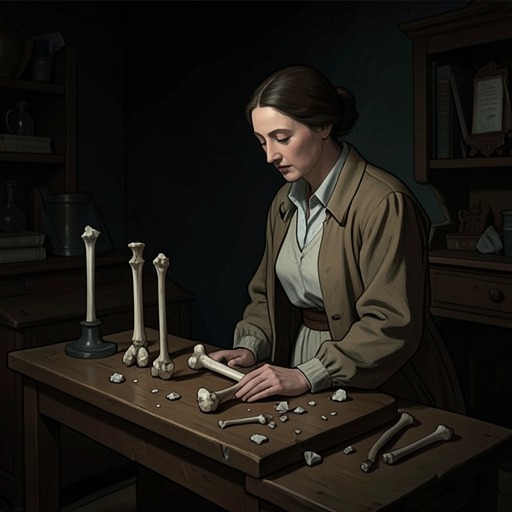
The investigation’s most intimate turn came through forensic evidence that seemed to defy its own chronology. Doctor San Martín reported that the bones found at Arizkun were well preserved, though burned at one end, and belonged to a boy who had been about nine months in the womb or one month old. Their estimated age was approximately 150 years, with a margin of error of five. Yet the routine DNA comparison produced a match with Amaia. She was stunned, and first considered whether she could somehow have contaminated the sample, although she had not touched the bones.
When the result was explained as a complete match, Amaia rejected the implication that she had a twin sister. But the denial opened onto memories that had already been returning in her dreams: a second child with her face, silent beside her, its shoulder ending in an amputated arm. In one recurring image, the child warned her against their mother. The dreams had made the double feel at once familiar and separate—another version of Amaia, marked not by her own struggle to survive but by an unrelieved, passive sorrow. The DNA result did not simply add a relative to the case; it gave a bodily and familial dimension to the disturbing figure that had been haunting her sleep.
The revelation also changed how Amaia read the valley’s older traces. After encountering a woman who brought back a childhood protection against witches, she remembered her grandmother Juanita’s instruction to cross her fingers and use the phrase Sola vayas. The recollection sent her to the Elizondo cemetery to consult its burial records. Later, with Engrasi and Jonan Etxaide, she descended into a family tomb and found the small white casket Engrasi remembered. Its lid still bore the outline where a cross had been removed. Amaia hesitated before opening it: until only days earlier, the dead child inside had been unknown to her, and the face that came to mind was the grieving double from her dreams.
The family mystery unfolded alongside the homicide inquiry rather than replacing it. In a later briefing, Amaia connected the church desecrations to Beñat Zaldúa, who admitted that an adult had encouraged him through email to act on his historical grievances. Zaldúa identified Antonio Garrido as that adult, while denying involvement in the final attack, in which an electric cart had been driven into the church wall. Garrido was also the former husband of Nuria Otaño, whom he had held captive for two years and later tried to kill. Amaia placed this line of inquiry beside the murders: at least four additional cases were linked to the pattern first noticed after Johana Márquez’s death, with victims killed by partners and their arms removed after death. The cases appeared connected, but not every apparent match was equivalent. Amaia stressed that Jasón Medina differed from the other perpetrators: he lacked their established violent history and did not fit the same profile, even though his crime shared important features with theirs. Her investigation depended on preserving both sides of that distinction—the accumulating pattern and the discordant details that might expose who was directing it.
Motherhood, Duty, and the Final Confrontation
Amaia’s growing understanding of the crimes did not lessen the competing claims on her attention as a mother and partner. At home, she watched Engrasi and other women laughing together, and saw in their gathering an echo of the Baztán women who had once met to sew wedding clothes and baby layettes, exchange advice, pray, and tell stories of witches. The image turned darker when she remembered Elena speaking of the Sacrifice: the valley’s domestic traditions and inherited stories were not simply picturesque background, but part of the history through which Amaia was learning to interpret the danger around her.
That history pressed against the life she was building with James. When he was due to travel for an important occasion they had long anticipated, Amaia told him she could not go. The man arrested the previous day was suspected of the Arizkun desecrations, of trying to kill a woman in Elizondo whom he had held for two years, and of disturbing the Juanitaenea graves; Amaia had to remain for his statement. James understood, but had expected her to be with him. Her choice makes the cost of her investigative responsibility concrete: the case did not merely occupy her working hours but repeatedly took precedence over shared plans.
The danger became immediate when Amaia followed the trail to the cave where Rosario and Doctor Berasategui had taken Ibai. She advanced after Jonan Etxaide was no longer beside her, entered with her Glock drawn, and heard the small sounds Ibai made before she saw him. He lay in the middle of a complicated design traced in what appeared to be salt or ash, surrounded by candles and wearing only a diaper. A wooden bowl, a glass vessel, and a metal funnel stood nearby. Rosario knelt over him with a dagger, while Doctor Berasategui watched with fascination and recited something like a song. Amaia’s relief that her son was alive collided with the scene’s ritual threat; she mastered her tears and continued forward despite knowing that her old terror would return.
In confronting Doctor Berasategui, Amaia named him as Doctor Yáñez and traced the identity he had concealed to its family origin. She identified him as the son of Esteban Yáñez and Margarita Berasategui: Esteban, who tended the garden around Amaia’s home and had found the family’s itxusuria, had supplied bones to Antonio Garrido. Garrido had said he thought the bones were a macabre joke suited to angering people he regarded as trespassers on his land, and denied knowing they would be used to desecrate a church. Amaia also connected the doctor’s borrowed surname to Margarita, whose lifelong depression had shaped the bleak, silent household in which he grew up. Her account went further, accusing him of staging Margarita’s apparent suicide by completing it with his father’s shotgun and explaining that Esteban had sent him away because he recognized what had happened. In that confrontation, the investigation’s scattered strands—the bones, Garrido’s actions, the concealed identity, and the family history—became a single chain of explanation.
The Inducer and the Investigator
In the blood-marked room, Amaia Salazar sees the crimes as more than a set of disconnected displays. She reads the wall as a work made for her, one that joins apparently chaotic killers to an unseen organizer—and, with a jolt of disbelief, to her mother. Her short, startled laugh breaks into something closer to a howl. The reaction registers the personal force of the pattern before she can settle what it means: the case has reached beyond her professional judgment into the history she least wants to confront.
Amaia resists the simple explanation that the organizer must be insane. The training she received at Quantico gives her another way to frame the problem: an inducer killer, a rare and poorly understood kind of offender who does not necessarily carry out every murder but can prompt other people to do so. The distinction matters to her. The men who committed the killings appear to have their own histories and recognizable vulnerabilities; the central figure’s apparent power lies in directing them, not in sharing their ordinary profiles.
She imagines that power as a carefully maintained relation of dependence. The inducer controls his own needs and exerts an almost godlike command over those who serve him, presenting himself to followers as benefactor even as he dominates them. In Amaia’s reading, seduction and submission are made to resemble care: the followers are persuaded to love and serve the figure who rules them from the shadows. The profile therefore turns on questions of selection and influence—how he finds potential servants, wins their trust, and makes obedience feel necessary. What looks like a procession of separate crimes may instead be the outward pattern of an invisible authority, and recognizing that structure becomes part of Amaia’s effort to understand why the case has been arranged to speak to her.
A Case Addressed to the Investigator
Amaia’s suspicion that the crimes were meant to reach her developed before she could explain how. Speaking candidly to Aloisius Dupree, she described two investigations that had begun to converge on the Baztán Valley and an offender who seemed to be establishing a connection with the police through subtle contact. The men who carried out the murders looked like minor criminals, while the victims shared ties to the valley; she could sense a larger design but did not yet know where to begin. Her unease was an investigative judgment, not a solved theory.
The DNA result gave that suspicion a sharper focus. Amaia reasoned that even if the church desecrations had not brought her into the case, the match between the bones and her DNA would have done so. She believed the person behind the attacks had chosen her because she headed homicide and had become well known through the basajaun case. In her view, the crimes were a calculated invitation to a contest, a cat-and-mouse game with an investigator the hidden organizer considered worthy. She drew on documented cases of criminals who had tried to communicate with police leaders or influence who led an investigation, but kept her interpretation provisional while she absorbed the new evidence and prepared to build a profile.
Forensic Discipline Under Pressure
At the blood-marked room, Amaia’s fear does not prevent her from working through the scene. In a sterile suit, she steadies herself with the feel of her Glock at her waist, then checks the small bathroom and the wardrobe, touches the bed’s metal bars through her gloves, and studies the furniture for traces left behind. She rejects the chair as a possible source of evidence, moves the folded bedding away from herself, and keeps a handkerchief over her mouth and nose so she will not breathe in the room’s smell. Only after arranging the chair opposite the blood on the wall does she sit to examine it. The sequence makes her composure an action rather than an absence of fear: she narrows her attention to what the room can show, while taking care not to disturb what remains.
Dreams, Recognition, and the Body
The DNA revelation gives a physical explanation to an image Amaia has carried through her dreams, but recognition arrives first as a bodily collapse of the familiar world. As she denies having a twin, the surroundings seem to liquefy into black oil that runs down the walls, swallows the light, and covers her open hands. In the vision that follows, a child with an arm missing from the shoulder lifts the stump and warns Amaia against their mother. The scene binds the case’s recurring severed arm to a private memory she had misread: the silent, sorrowing child beside her in dreams was not simply another version of herself, but the sister whose existence she had not known.
The children in Amaia’s remembered image are alike, yet not interchangeable. The dream double bears an unending, dark grief and seems resigned to it; Amaia understands herself as carrying pain too, but also a stubborn impulse to survive. Their resemblance makes the difference between them more unsettling, while the child’s repeated crying gives form to a loss that had no place in Amaia’s conscious account of her family. The match between the ancient bones and her DNA does not erase that uncertainty at once. Instead, it makes the dream’s images newly legible and forces her to reconsider what she had taken for memories of herself.
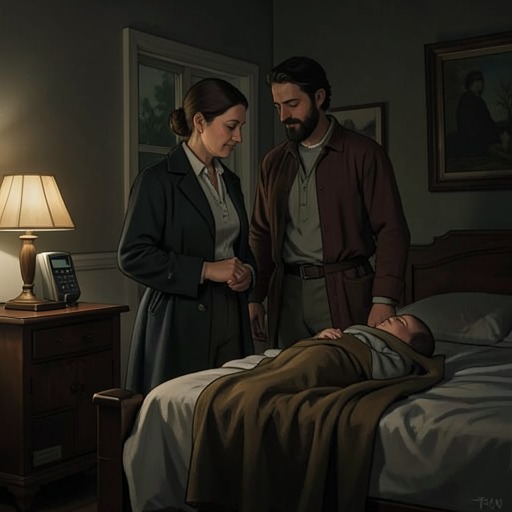
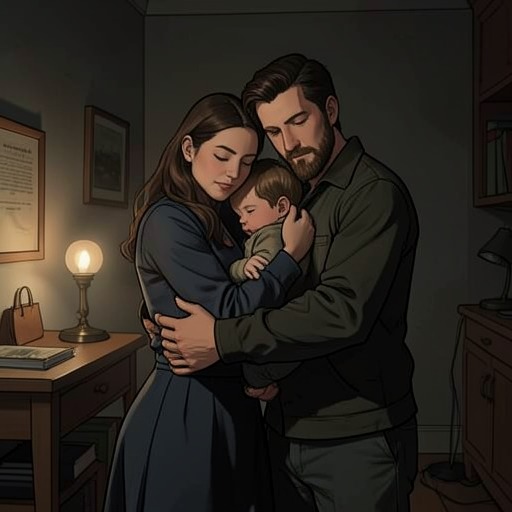
The following morning, this revelation sits beside the ordinary, intimate work of caring for Ibai. Amaia drives through dense fog after waking from a night of indistinct voices, crying, and urgent words she cannot make out. She had fallen asleep on a sofa beneath a blanket and a cushion Engrasi had placed there; later, she found Ibai stretched across the bed, leaving James only a small part of the mattress. Amaia lies beside her son for a few minutes and murmurs that he sleeps like his father. The quiet domestic scene contrasts with the disorienting night, but does not resolve it: Amaia is at once a mother tending to her living child and a daughter newly confronted with the dead twin who had been present, unnamed, in her dreams.