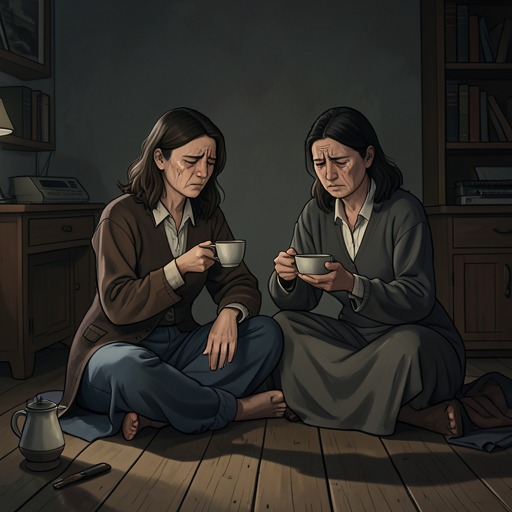
Amaia Salazar—Engrasi: aunt and niece
Legado en los huesosAmaia Salazar and Engrasi’s aunt-and-niece relationship is defined by a rare combination of intimacy and steadiness: Engrasi offers counsel without dismissing Amaia’s uncertainty, while her home is remembered as the one place where Amaia could sleep. Their bond becomes especially visible around the birth of Amaia’s first child, when pregnancy anxieties, tarot readings, and the demands of new motherhood converge. Engrasi’s care is both practical and ritualized, grounded in close attention to Amaia and in the household traditions of the Baztán Valley.
A refuge remembered
As an adult, Amaia recalls that she rested only in Engrasi’s house when she was little. At home, she says, she could barely sleep: she had to keep watch, and when exhaustion overcame her, sleep remained shallow and fearful, like waiting for an executioner. The contrast makes Engrasi’s house more than a comfortable family setting. It had been a place where Amaia could lower her guard, even when the security she found there could not erase what made her vigilant elsewhere.
The memory surfaces in a quiet exchange by the fire. Engrasi says she is well where she is, and Amaia answers that everyone is well there; then Amaia’s voice shifts into the softness of a child’s as she remembers. Engrasi responds by calling her gently. The scene conveys their closeness through the movement between adult conversation and childhood recollection: Amaia can name the fear she carried, and Engrasi receives the disclosure without pressing it into explanation.
Counsel during a first pregnancy
When Amaia worries about the reality of becoming a mother, she turns to Engrasi. Amaia has read about the subject and has been troubled enough to ask her aunt, particularly as she struggles to engage with preparations for the baby. Engrasi is careful about the limits of her own authority: she has not had children and does not claim firsthand experience. Instead, she offers a clinical explanation, telling Amaia that first-time parents commonly find it difficult to connect bodily changes with the reality of a child on the way.
Engrasi distinguishes the uncertainties of a first pregnancy from the familiarity that can follow having a child. Modern scans and the ability to hear a fetal heartbeat or learn the baby’s sex can make the anticipated child feel more real, she observes, whereas in the past some parents did not fully grasp that they had a child until they could hold and see the baby. Her point is not that Amaia’s feelings are trivial, but that they are recognizable and do not prove she is unprepared for love or responsibility. Engrasi even places a hand on her own belly as she reassures her niece, making the explanation physically intimate despite her explicit lack of personal experience as a mother.
The support continues after the birth in the ordinary labor of family life. During a visit, Engrasi sings a lullaby while Amaia listens, remembering its last notes just before her aunt sings them. The room holds the smells of cooking, burning wood, and furniture wax; James has fallen asleep on the sofa, and Amaia covers him with a red blanket. When he briefly wakes to blow her a kiss and falls asleep again, Engrasi offers the baby to Amaia. Amaia kisses Ibai’s head and settles him in his carriage. These small acts place Engrasi beside Amaia not as an adviser at a distance but as part of the intimate care surrounding the new family.
Tarot, uncertainty, and the birth
Engrasi’s guidance also draws on tarot. At the beginning of Amaia’s pregnancy, she lays the cards to check that all is well and reads them as indicating a girl. She consults them again during the following months but does not revisit the baby’s sex, which she believes has already been established. When Amaia later becomes unusually reluctant to choose a name or buy clothes, Engrasi first gives the behavior a psychologically plausible explanation. She also consults the cards and fears that Amaia’s reserve may be a premonition that the child will not be born.
The cards’ refusal to reveal the baby’s sex becomes part of Engrasi’s understanding of what cannot yet be known. She believes that withheld answers may concern things that should not be known, or matters whose answer will only appear when the time comes. When James phones in the early hours, she says, the cards show a boy clearly. Amaia answers with skepticism, asking whether Engrasi means that the baby changed from a girl to a boy during the final month and noting that such a claim lacks a scientific basis. Their disagreement does not cancel the trust between them: the scene sets Engrasi’s divinatory interpretation beside Amaia’s rational challenge, while keeping both within a conversation shaped by concern for the child.
Motherhood, work, and inherited custom
After Ibai’s birth, Amaia tells Engrasi that returning to work is harder than returning from a holiday or honeymoon because she feels it is too soon to leave him. Engrasi acknowledges her concern and answers with a story about the Baztán Valley’s postpartum custom. Traditionally, mothers did not leave home for a month after a birth; the interval was understood as a way to ensure that the baby was healthy and would survive. Baptism came after that period, and only then could the mother go out to take the child to church.
Engrasi also describes how women adapted the rule to lives that could not simply stop. They had work, other children, and animals to tend, so some sent their husbands onto the roof to fetch a tile, placed it on their own heads, and tied it in place with a scarf. Under the custom’s logic, they could go about their duties while remaining beneath their roof. Engrasi presents this not as a rigid command but as an example of women finding a way to meet obligations while preserving the tradition’s meaning. For Amaia, who is struggling to imagine leaving Ibai, the story gives her present anxiety a long family and local context.
Across these scenes, Engrasi’s care takes several forms: she normalizes Amaia’s fears, shares the interpretive world of her tarot readings, passes on local knowledge, and makes room for the memories Amaia has carried since childhood. The relationship’s significance lies in that continuity. The aunt who once provided Amaia’s only remembered place of rest becomes the person with whom she can face the uncertainty of becoming a mother, without having to pretend that uncertainty has disappeared.