Amaia Salazar—I Ibai: mother and son
Legado en los huesosAmaia Salazar’s relationship with her son Ibai begins in surprise and becomes visible through the intimate routines of early parenthood: naming him, feeding him, soothing him, and holding him close. Their tenderness unfolds within a family history marked by maternal secrecy and childhood fear, but the scenes of care remain concrete and mutual, shared with James and supported by Engrasi.
Birth and Naming
At Ibai’s birth, Amaia is astonished to discover that her child is a boy. James reaches out to touch the baby’s cheek; his voice breaks, and he kisses Amaia as tears run down his face. The midwife is surprised that the couple did not know the baby’s sex, since Amaia had repeated the name Ibai throughout labor. The name, she explains, means river. After looking at James and then at her son, Amaia confirms that it is his name and bursts into laughter. The moment gives the relationship its first defining gesture: a name that has already accompanied the birth becomes a deliberate welcome to the child in her arms.
The scene presents their attachment as immediate but not abstract. Amaia’s astonishment is followed by recognition and choice; James’s touch and tears place him beside her in the first encounter. The name links Ibai to the river, while the couple’s shared response makes the naming a family act. From the beginning, the relationship is shown through small physical gestures and the words and decisions surrounding the newborn, rather than through claims about what parenthood will mean later.
Feeding, Soothing, and Shared Care
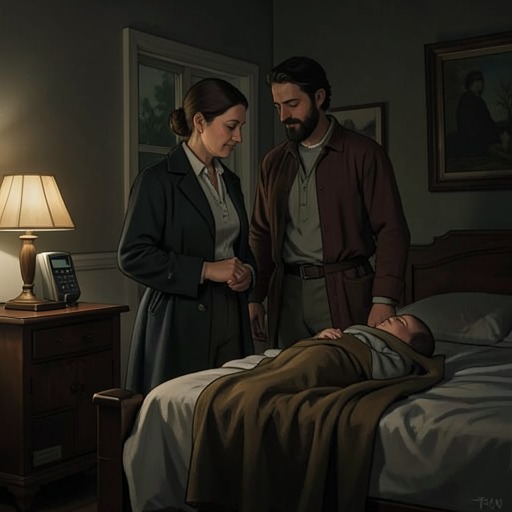
The early days are also defined by fatigue and practical care. In one domestic scene, Engrasi finishes singing a lullaby while Amaia remembers its final notes just before her aunt sings them. James has fallen asleep on the sofa. Amaia covers him with a red blanket; he briefly opens his eyes, blows her a kiss, and goes back to sleep. Engrasi, still absorbed in the sleeping baby’s face, passes him to Amaia, who kisses his head gently and settles him in his carriage. The scene places the new mother and child within a quiet household where care moves between generations, while James’s exhaustion is visible alongside his affection.
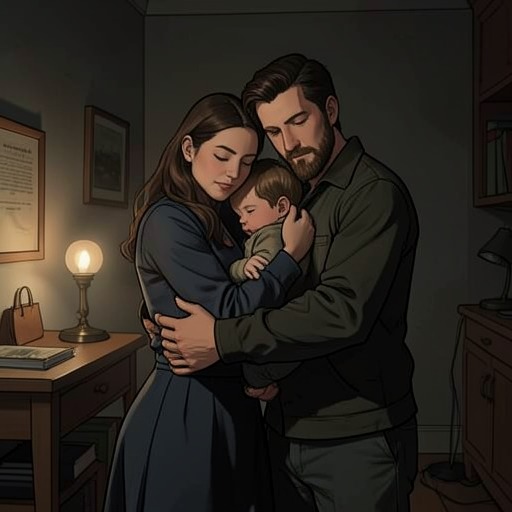
That exhaustion has a specific cause: Ibai suffers from colic during some feeds, especially at night, and James has spent the night walking around the house with him in his arms. On another occasion, James is trying to feed the crying baby from a bottle. Ibai alternates between sobs, gasps, and small cries of protest while sucking furiously; after twenty minutes, he has taken only twenty centiliters. When Amaia arrives, she opens her arms and takes him from James. Her return is late, and she apologizes to the baby as she kisses his face. He sucks at her chin, and she sits with him for the next half hour. As his initial distress settles, he grows calm in her arms while she strokes his head and traces his small features with a finger.
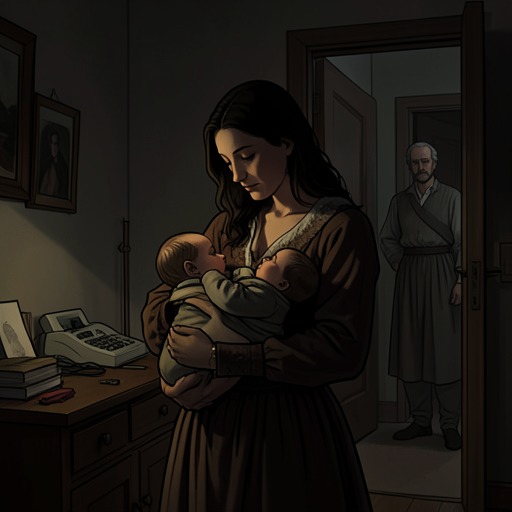
After nursing him, Amaia takes Ibai to the room Clarice designed for him, changes his diaper, and holds him while singing softly until he falls asleep. The furniture is comfortable and functional, though Ibai still sleeps with his parents in their bedroom. These details distinguish the prepared room from the family’s actual routine: the baby’s care is organized around closeness, feeding, and sleep, not simply around having a room of his own.
A Bond Within a Family History
The scenes with Ibai show Amaia giving attention through touch and time: taking him from James, nursing him, soothing him, and staying with him until he sleeps. They also show care as shared work. James persists with the difficult bottle feed and walks with Ibai through the night; Engrasi sings to him and watches over him. Amaia’s return does not cancel their efforts but joins them, shifting the baby from a strained feed into a prolonged period of calm in her arms.
The wider family history offers a painful contrast to this visible care. In a conversation with Ros, Amaia listens as her sister recounts a night when their mother came to the wrong bed, believing Ros was Amaia. Ros remembers hearing their mother tell the child she thought was Amaia to sleep, adding that she would not be eaten that night. Ros says that she then returned to Amaia’s bed, frightened, and kept the secret. Amaia takes Ros’s hand and tells her that the children were too young to have been able to act. She places responsibility on their father, whom she says should have protected her, and recalls being sent away from home at nine. This conversation does not describe an incident involving Ibai; it reveals the childhood history against which Amaia’s acts of protection and closeness acquire particular weight.
Another discussion exposes the incompleteness of Rosario’s account of a dead baby: she had said that one girl was stillborn but had not told the family there was another girl. The explanation offered is that Rosario had to disclose the death in order to bury the child there. The exchange makes concealment part of Amaia’s maternal family history, though it does not establish a direct consequence for Ibai. Taken together, these disclosures place the mother-son bond beside a past in which a child’s safety and a mother’s account of events could not be taken for granted. The novel’s evidence for Amaia and Ibai’s relationship, by contrast, rests on repeated acts of presence: she takes him into her arms, attends to his distress, and stays with him until he sleeps.