Engrasi’s tarot cards
Legado en los huesosEngrasi’s tarot cards turn a family conversation into a ritual of interpretation, giving Engrasi a way to describe Amaia Salazar’s changed life and the forces she believes now threaten to draw her in opposing directions. Their significance lies not in a solved mystery but in the reading they make possible: a portrait of Amaia as both protected and summoned toward danger, followed by a firm warning against intervention in an FBI case.
The deck and its preparation
When Amaia says she needs answers, Engrasi retrieves a small packet wrapped in black silk from a cupboard. Amaia replies that she does not even know what questions to ask; speaking with an expert in behavioral disorders and criminal behavior, she says, helps her find them. Engrasi rebukes her for playing with things beyond her reach. The deck therefore enters the conversation amid a difference in approach: Amaia appeals to professional analysis, while Engrasi offers a form of knowledge that depends on ritual and interpretation.
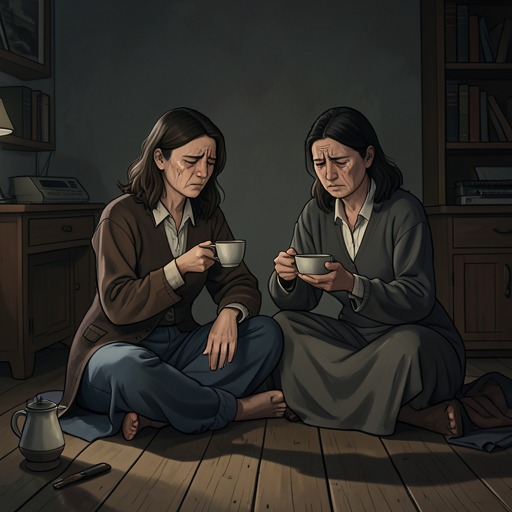
The reading takes place only after Ros and James have gone. Engrasi and Amaia sit opposite one another in silence as Engrasi slowly unwraps the silk and shuffles the cards between her pale, bony fingers. She tells Amaia that for weeks she has sensed energy flowing toward her whenever she takes up the deck, and that she is glad Amaia has finally decided to face what is happening. Amaia, however, has used a request to Ros as an excuse to speak with her aunt about events in the bakery. The mismatch between Amaia’s stated pretext and Engrasi’s sense of a larger summons makes the reading feel like a disclosure neither has fully arranged in advance.
The spread and its reading
Engrasi places the deck before Amaia and waits for her to cut it. She then takes the two piles, shuffles them together, and lays out the cards for Amaia to choose. Amaia does not touch the cards: she holds a finger just above each one, as if leaving a fingerprint without making contact, and waits for Engrasi to remove it before selecting the next. She chooses twelve cards, which Engrasi arranges in a wheel, like the digits of a clock or the points of a compass. As the cards are turned over, Engrasi’s expression shifts from initial surprise to reverence.
The Empress dominates the spread. Engrasi reads her as an image of the woman Amaia has become: strong, shaped by ordeals, and changed by a new aspect of herself that opened during the previous year. She describes that change as a door Amaia opened in desperation, beyond which lay something extraordinary that altered the way she sees. Amaia’s response is inward and involuntary: the reading brings her back to the amber eyes that looked at her from the forest undergrowth, and she smiles. The cards thus connect a present reading to an earlier encounter without explaining it away.
Engrasi insists that events are not happening by chance. When she touches one card, she pulls her finger away as if it has given her a small electric shock, then admits that she has never seen what it shows. This reaction preserves an important uncertainty: the spread is not presented as a complete or familiar message even to its reader. Its revelation is partial, and Engrasi’s surprise makes the limits of her knowledge part of the scene.
Protection, summons, and danger
Engrasi interprets the spread as showing great forces bearing down on Amaia and pulling her in different directions. One card represents a guardian who loves her purely, protects her, and will not leave her. Another represents a demanding priestess who drives her toward battle, admires her, and intends to use her as a battering ram against her enemies. In this reading, Amaia is not simply the recipient of protection: she is also imagined as a soldier, an instrument in a struggle to restore an ancient balance.
Engrasi links that struggle to an abominable act that has awakened beasts and powers long dormant in the depths of the valley. She says Amaia must help subdue them. When Amaia asks whether the priestess is good, Engrasi refuses the moral division: she describes the force as nature’s balance, capable of cruelty and mercilessness. The cards therefore do not offer reassurance in the form of a clean distinction between benevolent and hostile powers. Their imagery places care beside coercion and protection beside an immense, potentially ruthless natural force.
The warning beyond the spread
The reading’s symbolic account of Amaia’s entanglement is followed by a practical demand. Amaia defends an analyst connected with the FBI, describing him as an exceptionally capable and principled police officer who has supported her and always answers when she calls. Engrasi listens seriously, then makes Amaia promise not to intervene in his investigation in any way. Amaia points out that it is an FBI case on the other side of the world and that she does not see how she could interfere; Engrasi repeats the prohibition.
The cards do not themselves supply the details of that investigation, and the scene does not identify the guardian or priestess. Instead, the reading establishes a pattern of competing claims on Amaia, while Engrasi’s final insistence turns that pattern into an immediate boundary. The deck’s role is consequently both interpretive and dramatic: it gives form to dangers that remain unnamed, and its ritual ends not with certainty but with a warning against answering another call.