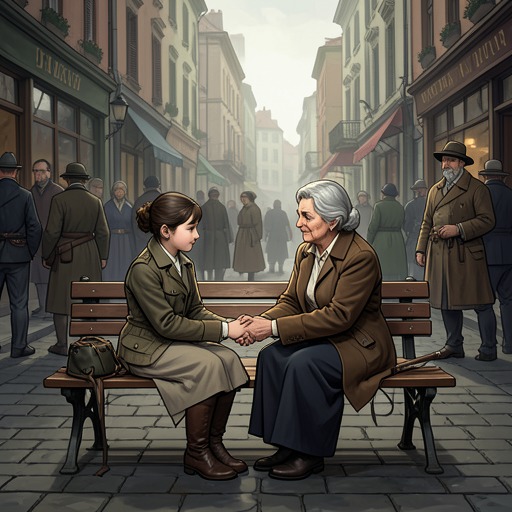
Fina Hidalgo
Legado en los huesosFina Hidalgo is a nurse and the younger sister of Manuel Hidalgo, the village doctor who attended births in the Baztán Valley. Her knowledge of local medical records helps Amaia Salazar uncover a twin sister whose birth and death were concealed; Fina’s own account then reveals that she helped families kill newborns with disabilities and disguise the deaths as natural. She occupies an unsettling space between caregiver, witness, and accomplice: the person who can retrieve an old certificate is also someone who helped make such records conceal what happened.
Family and Medical Work
Manuel delivered babies at home in the valley, as was common at the time, and Fina, considerably younger than her brother, assisted him as a nurse. Her familiarity with the records extends beyond general recollection: she can locate a family’s obstetric file and explain what it does and does not record. She recalls that her brother signed death certificates for people who died in the valley, rather than in a hospital in Pamplona. In Amaia’s investigation, this makes Fina a crucial source for reconstructing births that left little trace elsewhere.
Fina lives in a substantial stone house in central Irurita, the second-largest settlement in Baztán. The two-storey home has a glassed-in bay window and an unusually elaborate garden: red paving stones lead between primroses and clipped lavender, with a weeping willow on either side of the entrance. A large glass greenhouse attached to the house measures about twelve metres by twelve. Its dense plants, warmth, and humid air contrast with the records Amaia comes to inspect: within this cultivated setting, Fina can make the past legible, but the documents do not by themselves make it truthful.
The Records and the Hidden Twin
Fina finds the obstetric file for Rosario Iturzaeta. It lists a natural, uncomplicated birth in 1973, resulting in a girl named Flora; another in 1975, resulting in a girl named Rosaura; and a third in 1980, recorded as an uncomplicated twin birth. Both infants were described as apparently healthy, but neither was named in the entry. The record gives Amaia documentary confirmation that she was born with a sister, while its omissions leave the newborns’ subsequent fates unresolved.
When Amaia asks whether the file would note a baby’s death, Fina explains that she should have a copy of any death certificate for a child who died in the valley, since Manuel signed those certificates. She searches and finds a certificate for a newborn daughter of Juan Salazar and Rosario Iturzaeta. Its recorded cause is crib death, the common term for sudden infant death syndrome. Fina suggests that the baby had probably been born with a defect, but the certificate itself does not establish that. The record’s apparent certainty therefore sits uneasily beside the unexplained absence of names from the twin-birth entry and the irregularities Amaia identifies in the documents.
Amaia later tells her family that the baby’s birth had been hidden from them, that the records conflict over the cause of death, and that human remains found in unusual circumstances may belong to the dead sister. Her relatives say they saw a burial, though the coffin had been closed and they had not insisted on seeing the infant. The concealed birth and the uncertain identity of the buried body make Fina’s access to the paperwork especially consequential: she supplies a vital clue, but her professional authority is also entangled with the practices that allowed the death to be recorded as ordinary.
Admission and Moral Conflict
When Amaia confronts Fina about whether she and Manuel killed newborns with disabilities, Fina draws a sharp distinction between herself and her brother. She says Manuel did not participate in such killings, describing him as a moralist, but admits that she did. In most cases, she says, the families themselves killed the babies; in some, she helped because the parents lacked the courage. She dismisses the acts as offenses whose limitation period has expired and claims that the deaths were officially recorded as crib deaths. Her explanation presents concealment not as a single lapse but as a practice supported by family silence and the authority of medical certification.
Fina justifies the killings by appealing to the burdens of raising another child, particularly one with a disability, and argues that the law’s recognition of a newborn as an independent person does not reflect what a family faces. Amaia rejects this reasoning and names the acts as murders. The confrontation exposes the distance between Fina’s practical, coercive calculus and Amaia’s insistence on the child’s separate legal and moral status. Fina’s account is evidence about what she did and how she rationalizes it; it does not independently establish the circumstances of every death she describes.
Concealment at Rosario’s Birth
Fina’s involvement in the Salazar family’s history reaches back to the 1980 birth. While Rosario is exhausted and preparing to change her nightgown, Juan attempts to go to her. Fina intercepts him and asks him to wait, saying Rosario is not ready. Juan brushes past her; the scene establishes Fina physically managing access to the woman who has just given birth, though it does not settle all that she knew or intended at that moment.
After one infant dies, Fina intervenes again, this time in the dispute over what to tell others and how to classify the death. Manuel is stunned, and Fina says they do not know exactly what happened. She then points to the absence of signs of violence and argues that the baby could have died of crib death, which she describes as common in the first hours after birth. Manuel directly disputes that explanation. Fina presses him by warning of police, publicity, damage to the family, and harm to his career; she also turns the accusation back on him, arguing that he failed to treat symptoms he had noticed. Her intervention thus joins a convenient medical explanation to pressure on the doctor whose judgment could either challenge or validate it.
Secrecy and Narrative Significance
Fina’s account makes clear that the certificate Amaia finds cannot be treated as a transparent record of the newborn’s death. Fina says deaths were officially represented as crib deaths, while the surviving family document itself assigns that cause to the baby of Rosario and Juan. Yet Manuel’s objection in the earlier scene complicates any assumption that the adults agreed on the diagnosis or that the record settles what occurred. The archive yields a name and a cause; the surrounding testimony reveals reasons to doubt the completeness of both.
A relative recalls that the family’s relationship with Rosario seemed to change after the baby died, while other relatives say they did not know she had given birth to the child. Amaia’s later account of the concealed birth, contradictory circumstances, and remains gives those fragments a new significance, but does not erase what remains uncertain. Fina’s role in the novel’s investigation is therefore not simply that of an informant who unlocks a file. She embodies the double use of local knowledge: it can recover what a family’s silence buried, and it can also lend official form to that silence.