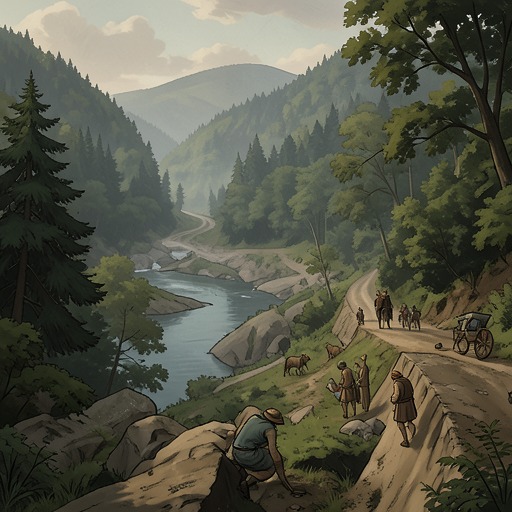
Hallazgo de los enterramientos del itxusuria de Juanitaenea
Legado en los huesosThe discovery of the itxusuria burials at Juanitaenea turns a search for disturbed ground into a confrontation with Amaia Salazar’s family history. Beneath the house’s eaves, she finds the traditional resting place of infants who died before baptism, including relatives whose graves have been disturbed. The scene gives physical form to a local burial custom, while raising the possibility that the person desecrating the church at Arizkun has also been robbing family graves.
The discovery at Juanitaenea
The alarm begins when the architect, Manolo Azpiroz, notices that earth around Juanitaenea has been dug up in several places. He had cautioned James against starting garden work because construction materials would damage the grounds; James insists that nobody in the household has been digging. After Azpiroz reports the disturbed soil, James calls Amaia. He has already found something in one of the holes and thinks it may be bones.
Amaia leaves the station with her field kit and brings Iriarte to the house. On the drive, she recognizes what she should have considered earlier: in Baztán, unbaptized children were not necessarily buried by a crossroads or beside a cemetery wall. Families had a designated place for them at home. The itxusuria, or corridor of souls, was the strip of ground beneath the eaves where rain dripped from the roof, marking a boundary between inside and outside. Amaia realizes that her own family, like other families in the valley, may have buried its dead infants there.
James waits by the vegetable garden with Ibai in his pram. Distressed and unsure whether the remains are human, he is also offended by the sudden arrival of what he sees as the sordid. Amaia kisses Ibai’s hand while he sleeps, then tells James to take the child inside and say nothing to Ros or her aunt until the remains are identified. She turns to the investigation with Iriarte.
What the ground reveals
In light rain, Amaia and Iriarte walk the perimeter, where mounds of newly turned earth are visible around the house. At the nearest one, Amaia points out a boot print whose edges are already softening in the rain. Iriarte shelters it with his umbrella and photographs it with a reference marker. They document the disturbed ground before Amaia begins to sift through the wet soil by hand.
In one opening, she uncovers a skull no larger than a small apple. Another hole has been hastily refilled but contains nothing. At the corner where the roof’s eaves meet the ground, dark infant bones protrude from the mud, their color at first making them easy to mistake for roots. Looking over the rear of the house, Amaia counts at least nine excavations on that side and as many on the other. The trail is written into the ground itself: centuries of dripping water have formed a shallow line beneath the eaves, and whoever opened the graves could follow it.
Further inspection reveals three more skeletons in two holes. The remains are broken and badly deteriorated, but one burial contains a frayed fiber. Amaia recognizes it as part of a cradle blanket. Beneath a waxed cloth, she finds the small bundle a mother had wrapped around her baby, as if covering the child for sleep could still protect it in the earth. She is shaken by the care preserved in the cloth and by the violation that has torn it open. She separates the fabric where it was ripped, sees the small bones intact beneath it, then covers the skeleton with the blanket, closes the bundle, and puts earth back over it.
Family custom and a police decision
Amaia explains to Iriarte that the burials form an itxusuria, the traditional family cemetery of Baztán. The infants were members of her family. Their mothers had placed them at home as sentinels to guard the house. The graves are not merely evidence of an old custom to her: they are the remains of generations of private mourning, and the family’s way of keeping its dead close.
Calling San Martín would bring a forensic team to excavate all the small bodies. Amaia fears that the discovery would attract reporters, photographs, and a public spectacle. She also suspects that the person behind the desecration at the church in Arizkun—not the young man already associated with the church episode—has been plundering these graves. In her view, announcing the discovery could warn that person away. She asks Iriarte to let the family cemetery remain undisturbed. He agrees that he would not allow anyone to excavate his own family’s cemetery. Their decision protects the site for the moment, even as it constrains the investigation.
The cost of recognition
The blanket makes the custom intimate rather than abstract. Kneeling in wet earth, Amaia imagines the woman who laid the child down at night and covered it carefully, perhaps an ancestor of her own. She cannot be certain whether the mother was her great-grandmother or an earlier forebear, but the uncertainty does not lessen the recognition: the bundle carries a mother’s act of care across generations. Amaia’s tears fall on the bones as she restores the covering and replaces the soil.
When she and Iriarte step back, the rain is already smoothing the small mounds. The opened graves recall the grief of generations of women in her family, but the scene also triggers a present fear: Amaia imagines having to lay Ibai in the mud. Her breath leaves her and her strength gives way; Iriarte asks whether she is all right. The discovery has exposed not only the family’s burial ground and its recent violation, but also how directly the inherited history of infant death touches Amaia’s own life as a mother.