James
Legado en los huesosJames is Amaia Salazar’s husband and Ibai’s father, and one of the novel’s clearest sources of steadiness within a family life repeatedly disrupted by danger and painful discoveries. His care is practical as well as intimate: he prepares for the baby, takes Amaia’s work seriously, and offers comfort without pretending that he can erase what she has endured. His wish to build a home in Elizondo gives that support a lasting shape, even as the discoveries at Juanitaenea bring the past directly into the household.
Identity and Background
James appears in both the social and domestic worlds of the novel. He has family connections of his own: at a restaurant he has chosen near the couple’s home on Mercaderes Street, his mother Clarice and the quiet Thomas are already seated with Martinis when Amaia arrives. James rises as soon as he sees her. The scene briefly places Amaia within his family circle, though it does not elaborate on the relationship between Thomas and the others. His artistic identity is suggested by a sculpture attributed to James Wexford, recognized in the home of Zuriñe Zabaleta. The work makes his name visible beyond the private scenes with Amaia and Ibai, while the evidence offers no further account of his career. More directly, Amaia understands him as having a clean, placid conception of life. That outlook is not simply a personality label: it shapes his response when sordid events intrude without warning, and makes the conflict between ordinary domestic hopes and the case’s brutality especially legible through him.
Marriage and Everyday Care
James is attentive to Amaia’s condition. During their meal, he notices that she seems more tired than usual and has paid little attention to the conversation and to his mother’s foolish remarks. His observation shows him watching not just what she says but how present she is. It also makes visible a strain that her work and responsibilities can leave concealed from others. His care takes the form of small, concrete acts. At home, after Engrasi sings the last notes of a lullaby, James has fallen asleep on the sofa. Amaia covers him with a red blanket; he opens his eyes long enough to send her a kiss, then returns to sleep. The tenderness is mutual and unceremonious. In another nighttime scene, he has assembled a travel cot beside the window and sleeps with one arm resting on its edge, close to Ibai. Amaia checks that the baby is settled in his warm one-piece pajamas before joining James in bed. The arrangement makes his fatherhood visible as physical proximity and watchfulness, rather than as a declaration. Their intimacy also includes the ordinary negotiations of new parenthood. James argues that extending breastfeeding imposes a schedule that does not fit well with Amaia’s work, and suggests that she seriously consider moving to bottle-feeding. The advice is practical and directed toward easing a real conflict between childcare and her job. Yet the question is emotionally charged for Amaia: she misses Ibai when she is away and fears that he may stop missing her. James’s concern for her workload therefore meets an attachment that cannot be solved by logistics alone. The exchange presents their marriage as a space where care includes both a practical argument and an effort to recognize what the argument means to the other person.
Fatherhood and a Shared Home
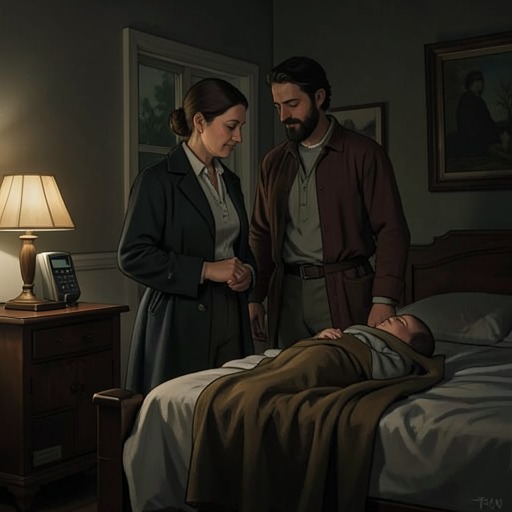
James’s tenderness toward Ibai is repeatedly shown through close attention. When Engrasi watches the sleeping child, she passes him to Amaia; Amaia kisses his head and settles him in his pram while James sleeps nearby. Later, James rocks Ibai against his shoulder as if the two were dancing. Amaia comes over in her socks and kisses the sleeping child. These quiet actions give the family scenes their own rhythm: the baby is passed between trusted adults, comforted, and watched over while the parents make room for one another. His commitment to family life extends beyond immediate care. Since Amaia became pregnant, James explains, they have visited Elizondo increasingly often; now that they have Ibai, he expects those visits to become more frequent still. He tells her that he loves Baztán and being with her family, and proposes that they consider having a house in Elizondo. The idea joins affection for the region to a concrete plan for the family’s future. It is not merely a wish to escape the city: James frames it as a way to make the place and Amaia’s family a more continuous part of their shared life. That domestic intention becomes consequential when the ground around Juanitaenea is found disturbed. An architect, Manolo Azpiroz, reports that earth has been dug up at several points around the house, though no garden work has begun. When Amaia arrives, James is waiting with Ibai’s pram at the edge of the vegetable garden. His unusually serious manner carries the sense of someone affronted by the sordid intrusion into the home he had imagined as a place of family and work. The contrast is sharp: a property considered for renovation and a future family life has become the site of concealed remains and an investigation.
Support Under Pressure
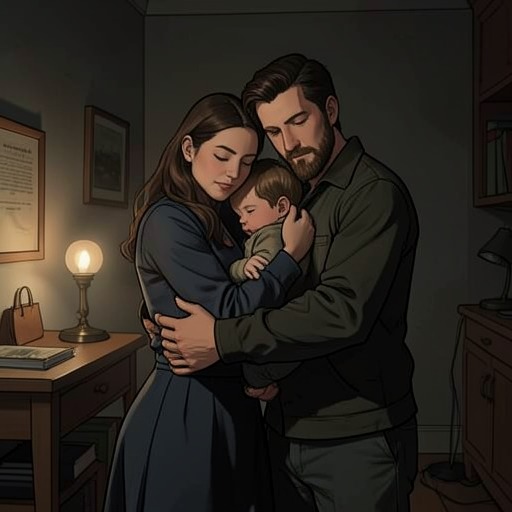
James does not need to understand every detail of Amaia’s work in order to respond to its effect on her. After learning from Ros what happened when Amaia returned, he tells her that he is sorry and acknowledges that the experience must be especially difficult for her. Later, after Amaia has showered, wrapped herself in Engrasi’s wool robe, and taken a tied bag out to the rubbish container, James waits for her on the stairs. She moves close, embraces him, and he kisses her. The scene gives comfort a physical form after an ordeal; it does not suggest that the embrace makes the danger or its consequences disappear. His reliability is also part of how Amaia experiences their marriage. After reading messages from the director of Santa María de las Nieves and closing her laptop, she wonders whether James will be waiting as he promised. She smiles because he always keeps his promises. That confidence matters in a narrative where other relationships are marked by secrecy, coercion, or failures of protection. James’s dependability is not abstract: it is established through the repeated expectation that he will be there when he says he will. But the demands of Amaia’s police work can still interrupt their plans. When she tells James she cannot accompany him, she explains that a suspect arrested the previous day is responsible for the desecrations at Arizkun, tried to kill a woman in Elizondo after holding her captive for two years, and may have raised the graves at Juanitaenea. The suspect is about to give a statement, and Amaia must attend. Her explanation exposes the pressure placed on their shared life: even time intended for the couple must yield to an investigation whose events have reached the place they hope to make home. James’s presence in these scenes does not remove that conflict; it gives Amaia a partner to whom she can explain it.
Change and Narrative Role
James’s role is defined less by a separate investigative arc than by the domestic continuity he sustains around Amaia. He helps care for Ibai, supports Amaia after distressing events, and imagines a future rooted in Elizondo. Those acts become more significant as the family home is implicated in a history of hidden burial and violence. The clean, placid life he values is not protected from the case; instead, its fragility is revealed when the earth around Juanitaenea is opened. At the end of the supplied evidence, Amaia returns to a house that, without Engrasi, feels like only a house. As she watches Ibai sleeping, she embraces James. The moment gathers the elements that define his place in the story: grief for the person whose presence made the home feel inhabited, the child they share, and the partner who remains physically close. James cannot restore what has been lost or shield Amaia from every consequence of her work. His significance lies in continuing to make care and shared life possible amid those limits.