Jonan Etxaide
Legado en los huesosJonan Etxaide is a subinspector and close investigative colleague of Amaia Salazar whose value lies in joining practical police work to careful interpretation. Across the inquiry into the Mairu-beso remains and the related killings, he helps distinguish what the evidence establishes from what it merely suggests, recognizes the significance of the bones’ arrangement, and follows clues from laboratory results to a suspected perpetrator. His partnership with Amaia is both intellectual and physical: he is a dependable point of contact during the investigation and, when she pursues a lead into the mountains, he goes with her despite the danger.
Identity and Working Partnership
Jonan works alongside Amaia as a subinspector, often at a computer or on the telephone while she pursues leads elsewhere. Their exchanges are direct and familiar. Amaia asks him what seems unusual in a piece of evidence, seeks his confirmation when a forensic explanation unsettles him, and later addresses him as her boss when speaking to him. That contrast registers their working intimacy without obscuring the professional hierarchy between them.
His reliability is conveyed through repeated, concrete moments rather than a formal account of his background. When Amaia sends him a photograph of a wall inscription, his call comes within ten seconds, and hearing his voice brings her relief in an oppressive setting. Elsewhere, he answers promptly when she calls from a corridor and asks him about the use of adult arms in rituals associated with Mairu-beso. He is not simply a remote source of information: he can read records at his computer, coordinate the circulation of evidence, and discuss what a clue means for the next stage of the case.
Bones, Ritual, and the Meaning of Arrangement
Jonan’s early work on the Mairu-beso investigation shows him alert to the difference between a general possibility and a geographically grounded lead. He explains that human bones appear in many religious rituals, but that beliefs concerning Mairu-beso are limited to the Basque Country, Navarre, and the French Basque Country. For him, that cultural range narrows the search: the bones are more likely to have been taken in Arizkun or nearby villages than from an arbitrary location. Their date of death, once established by Doctor San Martín, can further direct the inquiry.
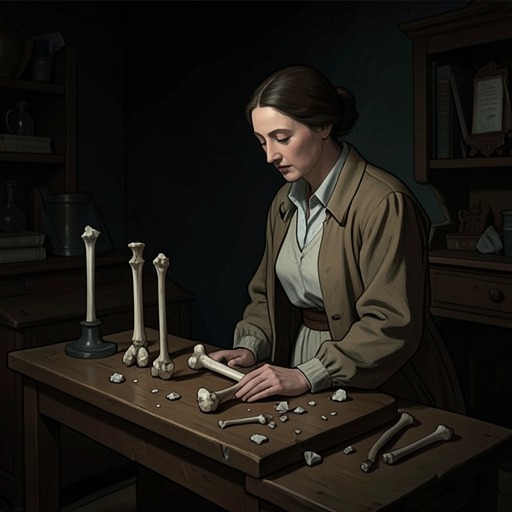
The interpretation of the remains becomes more pointed when Jonan considers the female bones found in the Arri Zahar Cave. He rejects the idea that the arms were casually discarded. In the legend he invokes, Tarttalo consumes victims and throws their bones at the entrance to its cave as a demonstration of cruelty and a warning to anyone approaching. The physical remains in this case do not simply reproduce that image: they have been arranged with care. Jonan reads that care as evidence that the bones function as trophies and as a deliberately composed message. Their placement in a remote cave, which initially seems inconsistent with the keeping of trophies, becomes intelligible if the arrangement itself is meant to communicate.
His reasoning remains attentive to the limits of what can be concluded. Doctor San Martín’s comparison between the arm cuts and the earlier Johana Márquez case identifies a possible similarity, but photographs alone cannot establish the bones’ age or sex, nor determine whether the arms resulted from surgical amputation or grave desecration. The forensic comparison would be stronger with the physical remains and the tool used to cut them. Jonan’s work takes place within that distinction between suggestive resemblance and proof: a pattern can guide the investigation, but additional samples and testing are needed to establish how the cases connect.
From Laboratory Findings to a Suspect
Jonan helps turn the accumulated clues into a more specific theory. After the authorities obtain a court order for the Guardia Civil to release samples from the Arri Zahar Cave, Amaia arranges to meet Doctor Takchenko the following night and tells Jonan to prepare. The exchange illustrates how their inquiry depends on cooperation across agencies and laboratories, not on a single striking clue. The physical samples matter because they permit testing that photographs cannot provide.
A later report on the metal analysis supplies a distinct line of evidence. Jonan tells Amaia that the scalpel sent from the Estella Sanatorium is genuinely antique, dating to the seventeenth century. The dating rests on the alloys used at the time and on the methods by which the metal was cast and forged. He presents this result as consequential because the object’s composition and manufacture give it a distinctive identity. The age of the instrument does not, by itself, identify its user; its importance emerges when considered alongside the other evidence.
That combination draws the investigation toward the visitor to Amaia’s mother and the desecrations at Arizkun. The working theory is that the visitor and the person responsible for the desecration may be the same, and that the bones were selected from burials around Amaia’s grandmother’s house. The arm belonging to Amaia’s sister is especially revealing: unlike the other remains, it was not lying in the ground, so whoever recovered it must have known where to find it. The information about the family burials was available to Amaia’s mother, making the placement of the arm a link between the visitor, the desecrator, and a source of unusually intimate knowledge. The inference is a chain built from access, location, and selection, not merely from the resemblance of cut marks.
The Instigator and the Investigation’s Wider Pattern
The inquiry also broadens beyond the apparent perpetrators. Evidence from the sanatorium rules out one suspected visitor, while the violent and disorganized men involved in the attacks appear to have served a more calculating instigator. This account describes someone who directs the men’s anger against the women around them and, when they are no longer useful, can induce them to die by suicide. The distinction changes the investigative picture: the visible aggressors may be instruments rather than the source of the pattern.
Jonan’s contribution to this developing picture is consistent with his earlier interpretation of the cave. In both cases, an apparent act of violence carries a further structure: the bones have been arranged to signify something, and the offenders’ actions may have been directed by someone else. The investigation therefore looks beyond the immediate scene and asks who had the knowledge, the means, or the influence to shape what happened. The theory does not erase the responsibility of the direct perpetrators; it adds a concealed level of organization that helps explain their repeated conduct.
Loyalty, Risk, and Narrative Role
Jonan’s partnership with Amaia is most visible when information and danger arrive together. He receives her photograph of the inscription, helps prepare for the laboratory appointment, and brings the metal-analysis results to her in person. His manner can be teasingly deliberate when he withholds the decisive part of a report, a habit Amaia dislikes, but the exchange also shows their familiarity and his confidence that the finding will hold her attention.
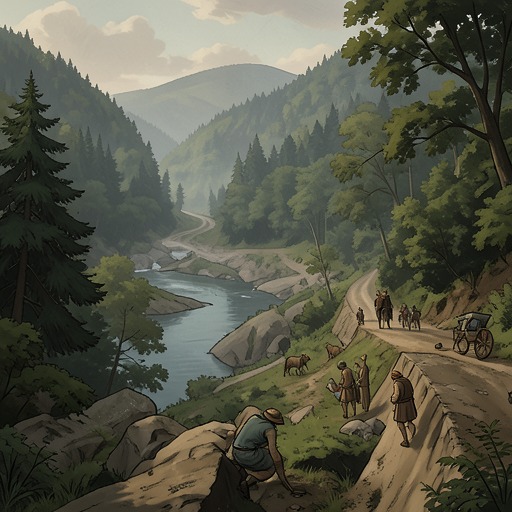
That professional closeness becomes physical on the mountain. Amaia tells Jonan she must go ahead, following a hunch, because she believes the others will take the road and then the track while she may be able to reach the destination first by another route. She does not ask him to come. As they cross the undergrowth and climb the mountainside, a fallen trunk knocks Jonan down and opens a deep cut in his ankle. Blood soaks his jeans and covers part of his shoe. The scene makes the cost of the partnership immediate: he has followed Amaia into rough terrain, and the injury delays him just as she is pressing on toward the lead. The supplied account establishes the wound and their separation in pace, while leaving its later outcome unstated.
Jonan’s narrative importance lies in the way he helps make fragments legible without making them conclusive too soon. A regional belief narrows the possible origin of a bone; a carefully arranged set of remains turns a cave into a message; a seventeenth-century instrument supplies a material connection; and the special recovery of one arm points toward privileged family knowledge. His role is to keep these clues in conversation with one another, while the partnership with Amaia carries that reasoning from desk and telephone into the dangerous landscape where the investigation’s next step may be found.