Juanitaenea
Legado en los huesosJuanitaenea is the ancestral farmhouse of Amaia Salazar’s family, a place James hopes to restore as their new home and a site where the past proves to be more than memory. Its attic, familiar from Amaia’s childhood, becomes the setting for an uncanny encounter; its ground contains an itxusuria, a traditional family burial place for unbaptized children. When graves are disturbed around the house, Juanitaenea connects intimate family history to the church desecrations and the wider murder investigation.
Setting and family history
Set behind the Trinkete inn, Juanitaenea stands alone on dark, level ground among gardens and orchards. The nearest houses are about three hundred metres away. Time and rain have darkened its stone façade, while a broad carved wooden eave projects more than a metre and a half over the upper floor. An exterior staircase leads to the first-floor entrance; below, two arched openings flank rough boarded doors, and a large square entrance retains its ironwork. Old oaks and beeches, a weeping willow remembered by Amaia from childhood, and a cultivated orchard of roughly a thousand square metres surround the house.
The farmhouse had been closed for years after Amaia’s grandmother died, when Amaia was five. Engrasi tells James that it needs extensive renovation, but that its structure, roof, and chimneys remain sound because she has kept up minimal maintenance. The family’s connection to the place reaches back through generations: when Amaia asks whether it belonged to her grandmother, she later confirms to Inspector Iriarte that the house has been in her family for generations.
The division of the estate helps explain why the house feels both inherited and emptied. Engrasi received Juanitaenea, the surrounding land, and money; Amaia’s father received the valuable handmade furniture and the bakery workshop. After reading the will, Amaia’s mother sent a moving truck and cleared out the house. Amaia cannot remember seeing her grandmother’s furniture in her parents’ home and suspects it was sold. The empty rooms therefore bear two histories at once: family possession and the removal of the objects that might have made that history tangible.
A house recovered
James first raises the possibility of making Juanitaenea their home after speaking with Engrasi. Amaia is surprised that her aunt supports his idea, and more surprised that the farmhouse is the place James has in mind. She remembers its rooms as enormous, the fireplace large enough for her to stand inside as a child, and the polished furniture and dark-red silk-satin bedcover in her grandmother’s room. These recollections arrive as fragments rather than a continuous picture: in Amaia’s childhood memories, her grandmother is in the foreground and the house is only the setting around her.
When Amaia, James, Engrasi, and Ibai visit, the building’s empty interior makes renovation seem both necessary and possible. The second floor contains four large rooms, a kitchen, and a bathroom stripped of its fittings except for a heavy claw-footed bath. Deep-set windows and wooden shutters sit within thick walls; the old kitchen’s blackened stone fireplace is twice the size of those in the other rooms. On the upper floor, sloping walls and two round roof openings frame a single undivided room. Amaia takes what appears to be Ibai’s cradle for a sign of the home they might build there.
James responds to the farmhouse with immediate enthusiasm. Amaia had anticipated that he would fall in love with it, and as he talks with Engrasi about what could be done, she walks through the rooms, opening the shutters to admit daylight. From a broad window she can see the towers of the Church of Santiago above the roofs. The damp carried by the Baztán River seems to linger in the house and in the surrounding landscape; the weak winter sun warms Ibai against her chest but cannot dispel the chill. The scene makes domestic possibility concrete: a room, a view, a child settling in his mother’s arms.
James repeatedly tours the house before they leave and plans to call Manolo Azpiroz, an architect friend in Pamplona, to assess it. Engrasi hands him the key and tells him the property is already theirs in her eyes, with the formal transfer to be arranged before a notary. James presents the key to Amaia as the key to their new home. The gesture turns a neglected inheritance into a shared future, but it also gives Amaia access to a place whose buried history neither of them yet understands.
The attic and the return of memory
Juanitaenea’s attic is not only a room to be renovated. In a frightening episode, Amaia hears a child’s voice calling her and climbs the last flight of stairs toward the sound of repeated tapping. Ibai begins to cry. In the wide room, his cradle rocks violently back and forth as if an invisible hand were driving it against its wooden stop. Amaia sees a girl in a corner: blond, wearing a nightdress like Amaia’s own, and weeping dark tears. She recognizes the child as herself, terrified and abandoned, with the stump of a missing arm. The girl points toward Ibai’s cradle and warns Amaia not to let his mother eat him as she ate her.
The vision gives the house’s private spaces an unsettling double life. During the visit, the upper room seemed to hold the promise of a nursery; in the later encounter, the cradle becomes the focus of a warning that reaches backward into Amaia’s childhood fear and forward toward her anxiety about protecting Ibai. The narrative does not reduce the episode to an ordinary memory: the moving cradle and the apparition make the remembered house an active presence in the present. Later, when Amaia encounters a similar bodily shock, she recalls that the first happened when she touched the attic cradle at Juanitaenea.
The graves beneath the eaves
The discovery begins when architect Manolo Azpiroz visits ahead of planned work and notices that the garden soil has been dug and disturbed in several places. James checks the ground himself and tells Amaia that there are holes and something inside, which he thinks may be bones. Amaia returns with Inspector Iriarte. On the drive, she realizes what she should have recognized sooner: in Baztán, children who died unbaptized were not buried beside cemetery walls or wayside crosses. They were laid in the itxusuria, the corridor of souls beneath the roof’s drip line, on the boundary between inside and outside.
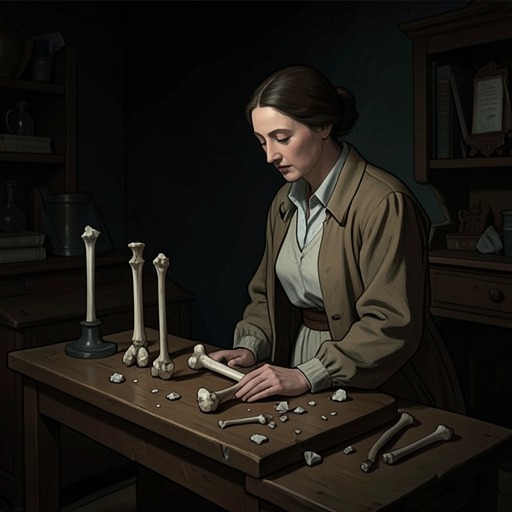
Around Juanitaenea, the slow drip of the eaves has marked that boundary in the soil over generations. The person who disturbed the graves needed only to follow it. Amaia and Iriarte find multiple excavated mounds; she spots a boot print whose edges are already blurring in the rain. At one opening, Amaia uncovers a skull no larger than a small apple. Another hole has been hurriedly refilled and contains no remains. At the corner where the eave leaves its trace on the ground, dark small bones show through the mud. Amaia counts at least nine exploratory holes on one side of the house and as many on the other.
More remains emerge as the inspection continues: three further skeletons in two holes. The bones are broken and badly deteriorated, but one burial contains a frayed fibre. Amaia uncovers the remains of a baby blanket, beneath a waxed cloth. The small bundle makes the burial legible as an act of care: someone had wrapped a child for the earth as a mother might wrap a sleeping baby. The bones in that grave are unusually intact, while the torn fabric and disturbed soil show that the burial has been violated. Amaia covers the skeleton again with the blanket and closes the bundle with earth.
The discovery is at once forensic evidence and a family cemetery. Amaia tells Iriarte that the buried children are her relatives and explains the custom of leaving them at home as guardians. She argues against calling Doctor San Martín to excavate every body, fearing a press spectacle that would expose and disrupt the burial ground. She also suspects that the person behind the Arizkun church desecrations has been looting these graves, and that public attention could drive that person away. Iriarte agrees not to have his own family cemetery excavated. His response makes their shared Baztán inheritance part of the decision: the remains are not simply a crime scene but a form of family remembrance.
Evidence, violation, and inheritance
Juanitaenea’s burial ground changes the significance of the desecrations at the Church of Arizkun. Later, Jonan reasons that the person known as Tarttalo and the church profaner may be the same person: the bones left at Arizkun belonged to Amaia’s family, and the person who placed them there needed to know about the burials around her grandmother’s house. The arm bones of Amaia’s sister were not simply among the remains buried in the ground; recovering them required information that, investigators believe, only Amaia’s mother possessed. Amaia struggles to understand what message the desecrations were meant to convey and whether the crimes were intended to draw her attention to the Tarttalo murders.
When the investigation is discussed further, Amaia explains that the bones left at Arizkun belonged to members of her family and had been placed there deliberately. She says the suspected offender obtained information by visiting her mother at the sanatorium while pretending to be one of Amaia’s brothers. These conclusions make Juanitaenea more than the setting for a discovery: the family property and its buried children supplied knowledge that someone could turn into a threat and a staged message. The house’s promised renewal thus stands beside a violation of its oldest domestic practice. Its key opens a possible home for Amaia, James, and Ibai; the disturbed earth beneath its eaves reveals how the family’s dead have already been made part of the present investigation.