La dama
Legado en los huesosLa dama is both a striking rock formation on Mari Hill and Cave and the recipient named in a series of anonymous, insistent emails. Its importance lies in the way the messages turn a real landscape into the setting for an offering ritual: Amaia Salazar arrives prepared to doubt the demand, yet leaves a stone from her own home there. The scene holds open the distinction between an ordinary act prompted by a manipulative message and an encounter with something that cannot be comfortably explained away.
The rock and the cave
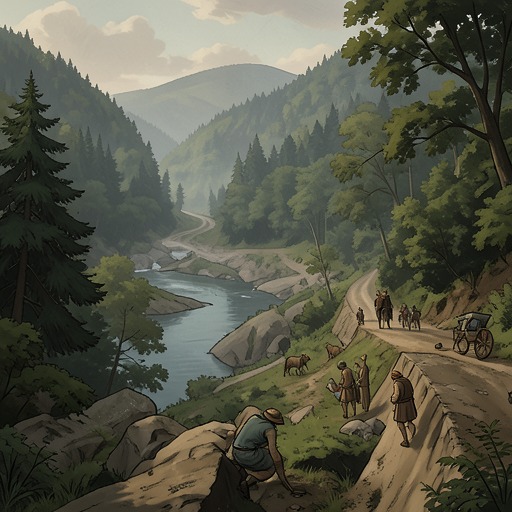
The formation stands above a stream in a clearing reached by a rising path through bracken and thorny growth. The rock called La dama rises three metres from a broad stone table, its feminine contours facing out across the valley. Nearby, the cave mouth opens at ground level; Amaia sees it as a grim smile cut into the mountain. The terrain is not an abstract backdrop to the messages: it gives their demand a specific destination and makes the stone formation appear to preside over the place.
When Amaia returns, she finds more than a dozen small stones arranged on the table in rough rows, like pieces on a primitive checkerboard. They are not stones gathered from the path; someone has carried them there as offerings. The pattern gives the site a visible history of repeated visits, although nothing identifies who made them or what they believe they are doing. The message naming La dama therefore meets an existing arrangement at the place itself, without the evidence resolving whether the arrangement began with the emails or independently of them.
The messages and the investigation
Jonan Etxaide alerts Amaia to another email, brief and demanding, which says that La dama is waiting for her offering. A Lamiak seal appears at the lower right. Amaia is exasperated by the continuing game, but asks Jonan whether he has found anything about the emails’ origin. The account uses no sender’s name and instead calls itself servidorasdeladama@hotmail.com. Its headers indicate a dynamic IP address; tracing the connection leads only to a free public internet access point of the kind found at airports or bus stations. Jonan judges it practically impossible to identify the sender, particularly if that person has already left.
The investigation thus uncovers a method designed to frustrate attribution, not a person behind the demand. Later, another cryptic email couples images of sand hidden on a beach and a stone concealed in a riverbed with the assertion that evil is governed by its own nature. These messages supply suggestive language, but no verified explanation of who sends them or what the sender intends. La dama becomes a point where an unknown correspondent’s symbolic instructions intersect with Amaia’s investigation, rather than a solved clue with a confirmed author.
Amaia’s offering
At the site, Amaia notices that the path seems recently used, though the thorns still catch at the way through. The clearing is empty. Remembering the instruction to bring a stone from home, she takes from her pocket the stone she had removed from her own doorway. A trace of cement remains on its edge from where it had been fixed there. That small residue makes the offering unusually concrete: this is not simply a pebble picked up near the cave, but part of the threshold of Amaia’s house, carried into the landscape and placed among the stones already arranged there.
She considers whether the emails might be a chain message promising good fortune or relief from a curse to those who pass it on. Amaia refuses to forward anything, and imagines how ridiculous a report about a credulous inspector performing magical rituals would sound. Still, she decides that placing one stone cannot hurt anyone, fits it into a row, and turns toward the cave. Her action is neither wholehearted belief nor simple dismissal. She declines to spread the message while complying, in a limited and personal way, with its request.
Inside, the cave is empty apart from a bowl of fresh apples and several coins thrown into it. A sweet floral scent comes from within, but Amaia sees nothing that could account for it. The fruit and money extend the evidence of offerings beyond the stones outside; the unexplained scent adds an impression without proving a supernatural cause. The scene gives the ritual objects and setting precise form while withholding any reliable account of who placed them there.
An unresolved presence
On her way down, Amaia finds the stones still in place and sees no sign of the enigmatic young woman who had approached her at the stream before. The flock remains by the water, and the shepherd’s distant presence had initially reassured her. Then the sheep abruptly stop drinking and grazing, lift their heads together, and tilt them in unison. Their bells sound once, like a single immense gong; after a deep silence, a sharp whistle crosses the field. Amaia hears the whistle but not whatever may have prompted the animals to react. The flock resumes its ordinary activity, leaving the moment unexplained.
The sequence does not establish that La dama, the cave, or the emails have a supernatural force. Instead, the physical offerings, the anonymous demand, Amaia’s reluctant participation, and the animals’ strange synchronized response accumulate without settling into one explanation. La dama is consequently more than the name in a message: it is the center of an encounter in which investigation reaches the limit of what can be traced, and skepticism coexists with an act Amaia cannot quite treat as meaningless.