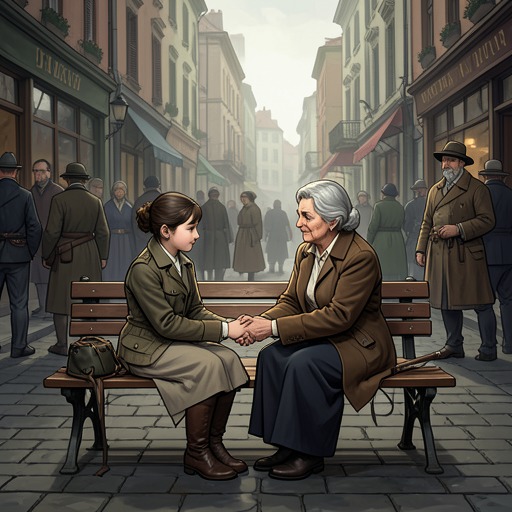
Rosario Tries to Sacrifice Ibai
Legado en los huesosRosario Tries to Sacrifice Ibai is the cave confrontation in which Amaia discovers Rosario and Doctor Berasategui preparing a ritual around Ibai, then interrupts it at the point when Rosario holds a knife above the child. The scene turns on two immediate stakes: Ibai’s physical safety and Amaia’s struggle to act while her mother’s presence revives the terror of childhood. Rosario’s insistence that the child should have been a girl makes the danger more than a threat to Ibai’s life: it reveals the mistaken expectation governing the sacrifice.
The Approach to the Cave
Amaia continues up the mountainside even though she hates leaving her injured companion behind without a flashlight. She cannot stop, and both of them understand that she must go on. When she reaches the middle of the slope and rounds the rock concealing the cave entrance, she sees light from inside. She draws her Glock and switches off her flashlight, entering without announcing herself.
At the narrow, winding entrance, Amaia hears clothes shifting and footsteps on the ground. Then she recognizes one of Ibai’s small sounds. Relief nearly brings her to her knees: the child is alive. Instead, she wipes away the tears and turns into the cave with her weapon raised. The movement from silent listening to armed entry makes her relief inseparable from the danger she is about to see.
The Ritual in the Cave
Ibai lies in the middle of an intricate pattern that appears to have been drawn with salt or white ash. Candles surround him, warming the space enough that he is not crying from the cold, although he wears only a diaper. Beside him are a wooden bowl, a glass vessel, and a metal funnel. These objects, arranged around a baby who is busy trying to catch his own feet, make the scene’s ordinary vulnerability and ritual preparation occupy the same confined space.
Rosario kneels next to Ibai, holding a dagger over his stomach as if tracing invisible designs. She wears an enormous down jacket, now open over a black sweater and trousers, with her hair pulled back into a bun. Doctor Berasategui leans beside her, absorbed and smiling as he recites something like a song Amaia does not recognize. Amaia understands the scene through the account Elena had given her; the vessels and the recitation are not neutral details, but part of the preparation she has been warned about. Yet the child remains absorbed in play, unaware of the adults’ purpose.
Amaia Confronts Her Mother
Berasategui notices Amaia first and looks at her with interest, as though an unexpected visitor has arrived. Rosario raises her eyes, and the sight of her brings Amaia back to the helplessness of being nine years old. Without speaking, Rosario seems to extend the web of control Amaia associates with her: her childhood bed, the flour trough, and her own grave return to her in a rush. Amaia has entered the cave knowing that fear will return when she faces her mother. She raises her gun anyway.
Ibai gives a small whimper, as if about to cry. The sound breaks Amaia’s absorption in the old terror and releases a fury that is both instinctive and lucid. She orders Rosario to throw down the knife and move away from her son. Berasategui ignores her and tells Rosario to continue, but Rosario has stopped, watching Amaia as she would watch an enemy before making her next move. Amaia then warns both of them that she will shoot if they do not move away from the child. Her threat changes the immediate balance: Rosario lets the knife fall beside her.
The Mistaken Sacrifice
Rather than retreat, Rosario leans over Ibai and opens the adhesive tabs of his diaper. Seeing him provokes a groan; she reaches for Berasategui and uses him to stand. She then demands to know where the girl is, accuses them of deceiving her, and asks Amaia where her daughter is. Ibai begins to cry at the shouting. The scene’s threat thus opens into a revelation: Rosario is not merely confronting Amaia over the child in front of her; she believes another child, a girl, was expected.
Amaia answers firmly that Ibai is her son, understanding as she says it that this is also a declaration of intent. She identifies him as the child of the river and recalls the earlier prediction that a boy would have to be born if she had had a boy. Rosario protests that Flora told her the baby was a girl. She insists that the child was supposed to be a little fox and the Sacrifice. Her words expose the expectation behind the ritual while making clear that it rests on information Amaia rejects as false.
The Interrupted Ceremony
Berasategui looks at Ibai with annoyance, loses interest, and backs away to the wall. That withdrawal contrasts with his earlier fascination as he recited beside Rosario: the attempted ceremony has not reached its intended conclusion, and the child before him is not the one he expected. The scene ends with Rosario’s demand and Amaia’s assertion of motherhood still opposed, rather than with a complete account of what follows. Its decisive change is narrower but concrete: Amaia’s intervention has made Rosario drop the dagger, interrupted the ritual, and forced the mistaken identity at its center into the open.