Santa María de las Nieves Psychiatric Clinic
Legado en los huesosSanta María de las Nieves Psychiatric Clinic is the institutional setting where Amaia Salazar’s investigation of Rosario Iturzaeta’s past intersects with the present reality of her mother’s psychiatric care. Its most consequential scene takes place not in a face-to-face consultation but across a one-way mirror: Rosario is watched and recorded, yet appears to recognize the unseen presence of her daughter. The clinic thus brings together clinical observation, police-like surveillance, and a family history whose records and testimony remain incomplete.
Institution and Investigative Context
The clinic enters the investigation through Amaia’s questions about how much its doctors know of Rosario’s case. A message draws her attention to Doctor Sarasola’s detailed knowledge of Rosario’s treatment and behavior, information Amaia understands to be protected by medical confidentiality. The apparent contradiction is sharpened by the fact that Sarasola has never treated Rosario. Amaia considers whether he might be the disguised visitor seen in psychiatric-clinic footage, but rejects the identification: his appearance and build do not match the estimates from the recording, and she believes he and Doctor Franz know each other too well to be fooled by false glasses and a beard. The possibility is dismissed, but the question of how Sarasola acquired his knowledge remains active.
When Amaia challenges him, she recalls that Sarasola had said at the clinic that he knew Rosario’s case. He explains that the doctors look among psychiatric cases for the particular feature present in Rosario’s. Amaia presses him on whether he means what she calls the element of evil. The exchange leaves the clinic associated not just with treatment, but with a disputed way of interpreting Rosario’s illness: the medical case is being discussed alongside a morally charged explanation. The evidence does not resolve what Sarasola knows or how he learned it, preserving that uncertainty as part of the clinic’s role in the investigation.
Rosario’s Treatment and the Family Record
The clinic’s significance is also bound to the effort to reconstruct the events around Rosario’s pregnancy and the death of one of her newborn twins. Those facts emerge through records and family recollections investigated elsewhere, rather than through a revelation that the clinic itself holds the documents. The obstetric file records a twin birth in 1980, with two girls described as apparently healthy but no names entered. Amaia then seeks a death certificate; the document identifies a newborn daughter of Juan Salazar and Rosario Iturzaeta and gives the cause as cot death. The wording does not settle the circumstances. A local doctor explains that the term was commonly used for sudden infant death syndrome and suggests that the child may have been unwell.
Family testimony adds another complication. Amaia’s uncle recalls that the relationship with Rosario continued as before for a time, and says the change came after the baby died. Amaia later emphasizes how many things remain unexplained: Rosario concealed the newborn’s existence from the family, the birth certificate contains irregularities, and bone remains found under strange circumstances may belong to the child. Her relatives say they saw a burial, but the coffin was closed and they did not see the body. These gaps make Rosario’s clinical history part of a wider inquiry into what happened to the infant, without making the clinic a proven source of the concealment or the inconsistencies.
The Observation Room
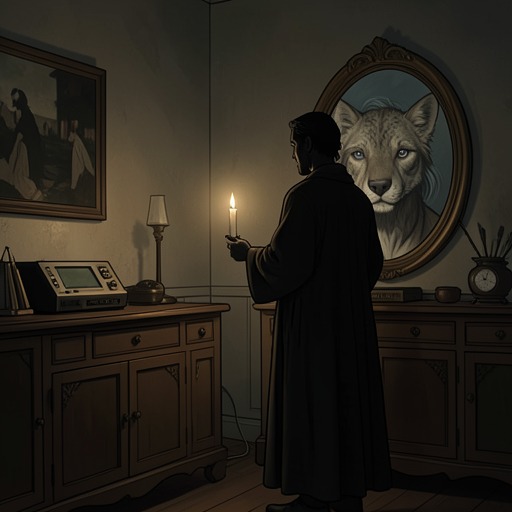
Before Amaia agrees to see her mother, she is told that Rosario is under observation behind mirror glass like that used beside police interrogation rooms. The arrangement allows Amaia to assess Rosario’s condition without being seen, or so the doctor assures her. A technician is recording events in the room through the mirrors. Rosario stands with her back to them, facing a window without curtains; the strong light blurs her profile. Amaia approaches the glass cautiously, then withdraws behind a wall when Rosario slowly turns toward it with a look of horrible satisfaction.
The scene unsettles the intended separation between observer and observed. Amaia has come to watch Rosario at a distance, but Rosario’s movement makes the hidden vantage feel exposed. Amaia believes her mother can see her, though the doctor insists that the room is completely isolated and Rosario can neither see nor hear her. The gap between that assurance and Amaia’s immediate fear gives the observation room its force: it is designed to produce controlled knowledge, yet the encounter yields no certainty about what Rosario perceives.
A Place of Watching, Not Resolution
The clinic’s contribution to the story is therefore both practical and unresolved. It provides a setting in which Rosario’s present condition can be observed and recorded, and in which Amaia can question a doctor about his prior knowledge of the case. At the same time, neither surveillance nor medical explanation closes the family’s central gaps. The file and certificate offer sharply different kinds of information from the mirror room: written records name a birth and a stated cause of death, while the encounter with Rosario produces a disturbing gesture whose meaning cannot be verified. By placing these forms of evidence alongside one another, Santa María de las Nieves Psychiatric Clinic becomes a focal point for the tension between what can be documented, what can be inferred, and what remains beyond Amaia’s certainty.