Segregation and Persecution of the Agotes
Legado en los huesosSegregation and Persecution of the Agotes is the history of a community kept apart for generations, and a suppressed past that becomes legible through the damaged objects of Arizkun Church. Jonan Etxaide explains to Amaia Salazar that agotes were denied ordinary social and religious rights, then links the desecrations under investigation to the marks of that exclusion. The connection makes the church’s physical divisions more than historical remnants: they are evidence of a remembered injustice, and of how long customs can outlast official attempts to correct them.
Origins and Settlement
The agotes’ precise origins are disputed in the account Jonan gives Amaia. Historians, he says, estimate that they arrived in Navarra across the Pyrenees during the Middle Ages, fleeing war, famine, plague, and religious persecution. One widely supported theory identifies them as Cathars, members of a religious group pursued by the Holy Office. Other accounts suggest they were deserters from the Visigoths who contracted leprosy in lazarettos in southern France, or a mixture of outcasts and pariahs brought to serve the local feudal lord, Pedro de Ursua. Jonan presents these as competing explanations, not settled fact; the last could help explain why the community established itself particularly in Bozate, now a neighborhood of Arizkun.
Their history is introduced not as distant background for its own sake but as a possible key to the present investigation. When Amaia asks what the agotes might have to do with the desecrations at Arizkun Church, Jonan answers that the relationship is substantial. He explains that the community endured exclusion in Bozate for centuries, making the geography of settlement itself part of a wider system that restricted where its members could live and how they could take part in society.
Social and Religious Exclusion
The agotes were treated as an inferior group and barred from living outside Bozate, running businesses, or marrying anyone who was not an agote. They were pushed toward woodworking and leatherworking because these trades were regarded as unclean. Their exclusion was also made visible: they had to wear an identifying mark sewn onto their clothes and, in some cases, ring a bell to announce their presence, as if they were lepers.
Their Christian faith did not protect them from religious discrimination. Jonan stresses the contradiction that the agotes observed Catholic rites yet were treated by the Church as pariahs. They had a separate baptismal font, and the holy water used for them was discarded. They could not approach the altar; they were often made to remain at the back of the nave and enter through a different, smaller door. At Arizkun Church, a grille once separated them from other worshippers. Its removal came to express the shame that the treatment still caused among the people of Arizkun.
This history is presented through concrete barriers rather than abstract prejudice alone: the font, the discarded water, the restricted route into the church, and the grille within it. Each imposed a boundary inside a religious space whose rites the agotes themselves observed. The discrimination therefore operated both in everyday civic life and at the point where the community sought inclusion in shared worship.
Acknowledgment and the Persistence of Custom
After generations of deprivation, a papal decree from Rome recognized the agotes as entitled to the same rights as other neighbors and called for discrimination to end. Jonan describes the decree as a formal response to the length and severity of their mistreatment. Its authority, however, could not undo the habits and beliefs already established. In his account, custom proved stubborn: discrimination continued for years even after Rome had called for its cessation.
That gap between a declaration of equality and lived experience gives the history its continuing force. Amaia observes that change in the Baztán Valley comes slowly. Jonan’s account makes that slowness specific: the community had been separated for centuries, while the decree could only name the injustice and demand an end to it. The removal of the grille likewise signifies a rejection of the old arrangement, but the shame attached to its history remains present for local residents.
The Desecrations and Folk Belief
Jonan identifies the damaged church objects as references to the agotes’ segregation. The baptismal font recalls the separate baptism imposed on them; a front-row pew recalls seating reserved for nobles and denied to agotes; and the altar cloths point to a place they had been forbidden to approach. These objects turn the investigation into a reading of the church’s own history: the desecrations select symbols associated with exclusion rather than pointing to an unspecified act of vandalism.
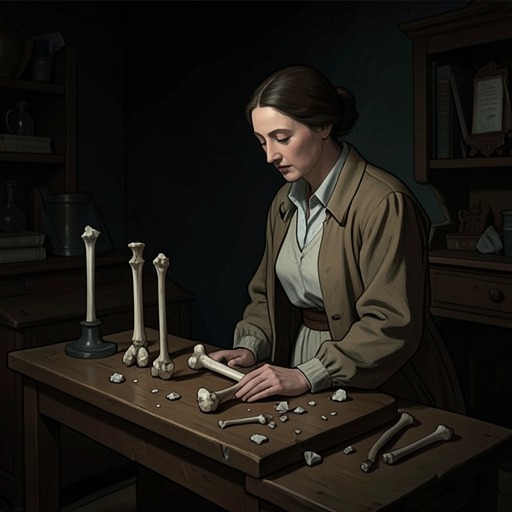
The burned infant bones found in the case introduce a related but distinct strand of belief. Jonan identifies them as a mairu-beso, understood as the arm bone of an infant who died unbaptized. According to the older belief he recounts, such a bone could be carried like a torch; its smoke was thought to have a narcotic power that could put an entire household or village to sleep while its bearers committed acts associated with witchcraft. He also says that this kind of witchcraft was associated with the agotes. The account presents the association as a cultural belief, not evidence that the agotes performed the desecrations. The distinction matters: a persecuted group’s historical association with feared practices can itself become part of the prejudice used to mark it as alien.
Jonan later rules out the use of an adult arm as a mairu-beso. Its supposed mystical power, he explains, depended not only on lack of baptism but on the age and condition of the dead: a fetus, a miscarried child, or an infant who died at birth or in the first months of life. In the belief he describes, a newborn’s soul remained in transit between worlds. Unbaptized infants were thought unable to enter heaven or hell, and some families imagined them staying in the home as protective presences. Accounts could include preserving a cradle or setting a place for the dead child at the table; giving its clothes or name to a younger sibling was feared to invite the original owner to claim the child. These details show how the investigation’s bone evidence draws on beliefs about baptism, family memory, and the boundary between the living and the dead, even as the church symbols point separately to the historical exclusion of the agotes.
Narrative Significance
The agotes’ history makes the desecrations intelligible as a confrontation with institutional memory. The symbols matter because they once governed who could be baptized, where worshippers could sit, and how close they could come to the altar. Their damage reopens a history that a decree and the removal of a grille could not simply erase. At the same time, the mairu-beso belief reveals how folk explanations and inherited stigmas can gather around marginalized people. By distinguishing the physical evidence, the history of segregation, and the folklore attached to infant remains, Jonan’s account gives Amaia several strands to interpret without treating legend as proof.