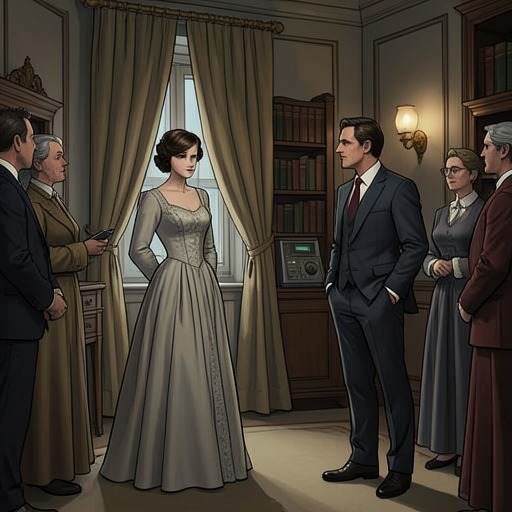
Adam Wizman
Les Choses humainesAdam Wizman is a French Jewish literature teacher whose life is reshaped by two crises that refuse to remain separate: the fear of antisemitic violence that drives his family across borders, and the desire that eventually leads him to leave his marriage. His affair with Claire Farel begins at a literary event he organized for his pupils; it becomes a test of whether personal freedom can be pursued without injury to the family and community that have defined his obligations. Later, as the father of Mila Wizman, he confronts the trial of Alexandre Farel with the anger of someone who believes his daughter’s suffering has been pushed aside.
Identity and Background
Born and raised in Paris’s twentieth arrondissement, Adam comes from a loving Jewish family whose North African parents arrived in France in the early 1960s. His father was an accountant and his mother a social worker in a child-welfare organization. They observed religious rites at home while remaining relatively secular outside it, and regarded education and what they proudly called Jewish values as central to family life. After earning a degree in modern literature at the Sorbonne, Adam became a French teacher in Toulouse.
Adam’s Jewish identity is not simply inherited belief or communal belonging. He understands it as a responsibility to preserve a people, a conviction sharpened by the possibility of disappearance. His bedside book is Georges Perec’s A Void, a novel written without the letter “e.” Adam tells Claire that Jewish tradition associates the creation of the world with letters: remove one letter from the Bible’s original text, and its meaning changes. He reads Perec’s constraint as an unconscious trace of the Jews’ ever-present possibility of disappearance. For years he had absorbed the old assurance that Jews could live happily in France; after an antisemitic attack struck the school his daughters attended, that confidence became untenable.
Migration, Fear, and Return
Adam and his wife, Valérie Berdah, enrolled their two daughters in a Jewish school. On March 19, 2012, a radical Islamist attacked it, killing three children and a father. The killer filmed the murders with a GoPro camera fixed to his chest. Adam and Valérie removed their daughters from school immediately. Like many relatives and friends, they concluded that European Jews could no longer ignore an antisemitism that killed; conversations in their circle returned to the fear that they or their children would eventually have to leave Europe.
In haste, the family moved to Ra’anana, Israel, where they rented an apartment for six months. Adam felt a profound attachment to the country, but could not imagine integrating there without distorting himself. Accustomed to the solitude of minority life, he found the constant familiarity of living among other Jews uncomfortable and felt no special complicity with those he encountered. He was also troubled by the political retreat he perceived among fellow emigrants: the Israeli-Palestinian conflict had become, in their conversations, an abstract and denied reality, accepted as a fatality in exchange for security and quiet. That bargain seemed to him a moral defeat incompatible with the humanist Judaism he claimed. The family returned to France, chastened by the failed attempt to find safety through migration.
After their return, Adam again taught French at a Jewish school, and his family lived within a close communal world. In January 2015, the killings at Charlie Hebdo and the Hyper Cacher of the Porte de Vincennes, including the deaths of two police officers, reopened the terror. Adam could not work for three days; he stayed inside with Valérie and their daughters, the shutters closed. The shared fear bound the family, even as Adam’s private life was beginning to pull him away from it.
Marriage and the Relationship with Claire
Adam had met Valérie in Toulouse, and they married six months later. She was warm, supportive, and understanding; together they had two daughters. Their marriage had lasted nearly twenty years, and Adam had remained faithful. Valérie encouraged his professional ambitions while caring for their children. At her request, every Friday evening he sang a traditional song celebrating the virtuous woman, honoring the strength of the wife who sustained the household.
After the family returned from Israel, Valérie grew more religiously observant. She gave up the name Valérie and called herself Sarah, exchanged trousers and low-cut shirts for long skirts and loose, long-sleeved sweaters, and began covering her head with a scarf. She also sought stricter observance of dietary rules, Shabbat, and family-purity laws. During menstruation and the prescribed period that followed, these rules barred physical contact between spouses; Sarah slept on a mattress on the floor, an arrangement Adam could not bear to see. He began to feel that he was living without desire or a future, beside someone who had become a stranger to him.
Adam met Claire at a literary event he had arranged for students at the Jewish school where he taught. He had written to her several times over six months, addressing her reservations about visiting a religious school by emphasizing his wish for students to encounter feminist writing, especially Simone de Beauvoir, whom Claire had written about. Claire read from her own book and from The Second Sex, answered the students’ questions, and left the school facing controversy: two pupils reported to their parents that her comments on women and marriage contradicted the Torah. Some parents feared her influence on their daughters; a petition followed, and Adam received a warning from the school. His relationship with Claire thus began under the sign of a threat, with the couple coming from radically different worlds.
At forty-two, Adam experienced with Claire a sexual and emotional intensity missing from his quiet marriage. Their affair quickly became more than an escape: he felt that her influence had changed the way he thought and might allow him to become more fully himself. Yet after two months he told her that he could not commit to her. Leaving would mean breaking up his Jewish household, losing the everyday presence of his daughters, and facing the moral and communal shame attached to abandoning his family. He wanted the security Claire could not give him. For a year, they maintained a parallel relationship, spending days together when they could and then returning to their separate homes, where desire gave way to guilt and the wish for calm.
The affair made Adam newly conscious of what his marriage had cost him, but it did not resolve his fear. Their secret correspondence was largely erotic, and the relationship had not yet faced the ordinary intimacy of shared daily life. Adam could imagine becoming more in tune with himself beside Claire; he could also imagine becoming an outcast in his community, a Jew condemned for leaving his home. His hesitation was intensified by the memory of being taught that, as a Jew, he had duties to a people whose survival he must help secure. The family’s recent experience of antisemitic violence made that obligation feel more urgent, not less.
Separation and Its Consequences
Adam’s choice was delayed partly by concern for his daughters. He feared making them share a home with Claire, a modern, atheist, secular woman who regarded mixed society as an expression of freedom, when they had grown up within a Jewish framework. He was especially worried about Mila, his older daughter, who was repeating her final year of secondary school and remained vulnerable after the attack on her school. She saw a psychiatrist, had morbid thoughts and nightmares ending in gunfire, and woke crying at night. Adam’s fear for her helped keep him immobilized even as the repeated breakups and reconciliations with Claire made their situation increasingly painful.
Eventually Claire’s desire for honesty and for a legitimate relationship brought the conflict to a decision. After months of hesitation, Adam told her he would divorce. He had imagined that Sarah might weep, throw out his belongings, insult or threaten him, or call on a rabbi, friends, relatives, or community members to reconcile them. Instead, she would not speak to him or look at him. Moving through the apartment and continuing her tasks without visible emotion, she treated him as though he had become transparent, impure, and already dead to her. The silence was not the confrontation he had prepared for; it made his departure feel like an erasure.
The next day, Sarah told the director of Adam’s school that he had left her for a non-Jewish woman with whom he had maintained an adulterous relationship. Adam was fired. He packed a suitcase and joined Claire in a Paris hotel room; a few days later, they rented a furnished apartment in Paris’s thirteenth arrondissement and began living together. Their new life was bound up with the loss of his job, his former household, and the communal place he had tried to preserve. The separation also sent the family across the Atlantic: Sarah later moved with the daughters to Brooklyn’s Crown Heights neighborhood, a strongly Orthodox Jewish community.
Fatherhood and the Trial
Adam did not initially oppose Sarah’s decision to take the girls to Brooklyn. At the height of his passion with Claire, he was consumed by the intimacy they had chosen and did not want to share his new home with his daughters every other week. Their withdrawal from friends and family gave their relationship an ecstatic privacy, but also contradicted the values they had previously embodied as attentive parents and faithful spouses. That retreat ended when Mila arrived at their apartment with a suitcase, unable to bear life in New York’s religious milieu and her mother’s increasing control over how she dressed, walked, and thought.
The family’s separation continued to shape Mila’s life. At Alexandre Farel’s trial, a psychologist described her as close to her father and distressed by her parents’ divorce. Her mother, now living in Brooklyn with a new husband from an Orthodox Jewish milieu and a young son, had little contact with Mila. Mila felt guilty because her mother told her that the assault would not have happened if she had stayed in the United States. The psychologist also connected Mila’s difficulties to the earlier attack on her school, the family’s unsuccessful move to Israel, and her sense of abandonment after her mother left. Adam’s earlier fear that the divorce would deepen his daughter’s vulnerability thus acquires a painful afterlife in the trial testimony.
During the proceedings, Adam reacts forcefully when Jean Farel argues that Alexandre is the victim of a society swept up in denunciation and describes the alleged rape as “twenty minutes of action.” Adam rushes at Jean and grabs him, shouting that his daughter is the only victim and that her life has been devastated by Jean’s son. Mila runs from the courtroom with her lawyer, while Claire covers her head with her hands. Court officers seize Adam; Jean remains impassive as he absorbs the blows, and the presiding judge orders the men apart. Adam releases Jean, then confronts him verbally over his complaints, pressure, threats, and alleged attempts to buy the family’s silence. When Jean threatens to sue him for defamation, Adam steps close and says he is not afraid. The hearing is suspended.
Later, Mila grips her father’s arm as her lawyer praises her for coming to court and speaking despite the pressure. Adam’s place beside her contrasts with the earlier rupture of the family: he has left the household that defined his communal identity, but he remains present as his daughter faces the repeated burden of recounting her experience. His anger at Jean is not a resolution of the damage caused by the separation, the attack on Mila’s school, or the assault at the center of the trial. It is, instead, the clearest public expression of his refusal to let his daughter’s suffering disappear behind the defense’s account of the case.
Narrative Significance
Adam’s story binds private desire to the pressures of collective survival. His choice to leave Sarah is not presented as simple liberation: it gives him a life with Claire but costs him his job, his household, and the security of belonging. Nor is communal obligation merely an external obstacle. The attacks that make him fear for his daughters also strengthen the idea that preserving a Jewish family is a duty, so the desire to remake his life collides with a history of vulnerability rather than escaping it.
The novel also sets Adam’s intimate decisions against the consequences borne by his children. He hesitates to leave because Mila is already traumatized, yet the eventual divorce, migration to Brooklyn, and divided family deepen her sense of instability. At the trial, the father who once feared the harm a separation might cause becomes the parent physically and emotionally beside her. His trajectory is therefore neither a clean escape from inherited roles nor a return to them: it moves from silence and delay toward a visible, imperfect defense of his daughter.