Double vie de Jean Farel
Les Choses humainesJean Farel’s double life is more than a concealed affair: it is a long attachment to Françoise Merle carried alongside marriage, fatherhood, and public success, and one whose secrecy reaches into his son Alexandre’s childhood. The relationship’s contradictions become clearest at its two ends: Françoise loves a man she recognizes as embodying what she most despises, while Jean remains beside her as illness progressively takes away her ability to recognize him.
The Affair and Its Contradiction
Françoise’s love for Jean is presented as a mystery rather than a simple reconciliation of opposites. She had loved passionately a man who embodied everything she hated in human terms. The sentence holds together the force of her attachment and her judgment of him without resolving their contradiction. Her love does not cancel her perception of Jean; the two remain side by side.
Their private farewell also makes the relationship’s intimacy and its limits audible. Françoise returns Jean’s declaration of love, calls him her love as he leaves, and adds an ironic warning: if she ever calls him “Papa,” he should have her put away. The joke anticipates the possibility that illness will alter her sense of who he is, turning tenderness into a measure of what may be lost.
A Secret Learned in Childhood
Years later, Alexandre describes the affair from the position of the child drawn into its concealment. He says that his parents were not very present because their professional lives were too demanding, and refers to his father’s double life. His account supplies the domestic history behind the phrase: Jean’s relationship was not only kept from Claire; Alexandre knew of it while still young.
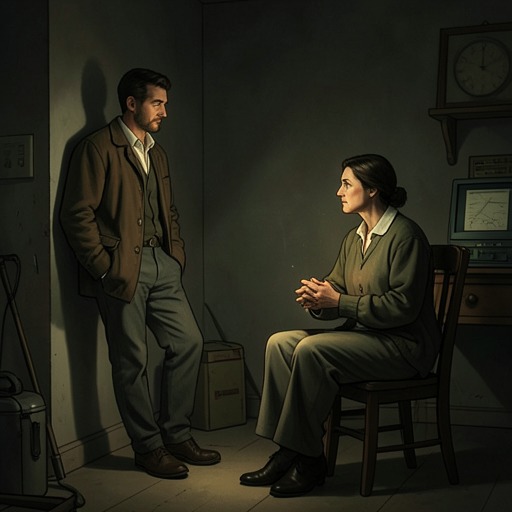
Jean once took Alexandre to his offices, where Françoise was present. He put on a cartoon for his son, but Alexandre heard the adults making love. The scene’s separation between rooms did not protect the child from what was happening; it made him an involuntary witness, left nearby with the television as cover.
Alexandre says this happened again. On those occasions, Jean told him not to tell his mother. He was asked to stay in the adjoining room and keep quiet, while Françoise did not know he was there. The secrecy therefore placed the boy between his parents and made silence part of the affair’s routine. Alexandre also says his parents had been separated for several months around the time of the later events, with Claire living with someone else while Jean expected her to return. His testimony presents the family’s separation and Jean’s other relationship as overlapping parts of the same unsettled household history.
Marriage, Public Life, and Renewed Family
By the time of Alexandre’s trial, Claire and Jean are divorced, and Claire has rebuilt her life apart from him. The divorce was settled quickly and amicably in financial terms. Jean later described Claire as having been correct: she had not left him financially ruined or made a public issue of his announcement that he would marry Quitterie Valois. His account of her restraint, however, coexists with the deeper rupture the separation caused.
Jean’s public career continues. He still hosts Grand Oral and a morning radio program, both with good audiences. Quitterie, formerly an intern, has taken the position left by Jacqueline Faux when she retired. Their relationship is visible as a conspicuous instance of the older man in power remaking his life with a woman decades younger; the narrative notes that Jean has fallen into precisely the arrangement he had always feared.
He is happy in this new family and has a baby daughter, Anita, named after his mother. On Instagram, Jean appears with Quitterie and their baby, images that present a settled public domestic life. Françoise is absent from these photographs. Yet the public picture does not contain the whole of Jean’s life: he continues to visit Françoise, maintaining a private loyalty to the woman he had loved.
Care as the Secret Continues
The later visits take place in a life radically narrowed by Françoise’s illness. She has left journalism after a suicide attempt and hospitalization, worked freelance for less prestigious publications, and then created a blog whose daily writing gave her a sense of existence. As the disease became more severe, she gave that work up. Since leaving her post, she has received neither visits nor calls from her former colleagues beyond impersonal holiday emails or text messages. A newspaper even republishes an obituary she once wrote, but when Jean shows it to her, she throws it to the floor; he recognizes in its fine, alert writing the woman he loves.
Jean remains with her through the stages of her illness, visiting and caring for her. Françoise does not know that he has remade his life: she no longer leaves home or reads, and now recognizes him only intermittently. The private relationship has thus changed form. What once depended on shared love and secrecy becomes a one-sided constancy of presence, sustained by Jean even when Françoise can no longer reliably identify him.
The double life finally signifies not a clean division between two households, but the continuing consequences of a concealed attachment. Its secrecy involved Alexandre as a child, its public counterpart is Jean’s marriage and new family, and its later remainder is his care for Françoise in isolation. The narrative leaves the contradiction intact: Jean can be publicly established and privately loyal, while the woman he continues to love is increasingly unable to know that he is there.