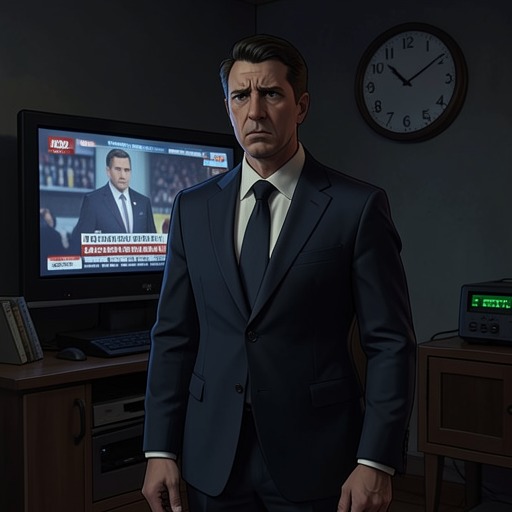
Francis Ballard
Les Choses humainesFrancis Ballard is the new director of programming at the television network where Jean Farel hosts the long-running Grand Oral. He enters Farel’s story as a gatekeeper with the authority to end the show, and his changing position makes him a measure of how quickly institutional power can shift when ratings and public standing change. He is not simply a steady antagonist: he first argues that Farel’s program has run its course, then retracts that judgment when a successful broadcast gives the network reason to keep it.
Position and First Encounter
Ballard is introduced through the corridor outside his office, where Farel waits for their appointment. There, Farel encounters Patrick Lavallier, a former television host trying to regain a place on the schedule. Farel avoids being seen with him, a small act that reveals how visibility and professional standing are guarded in this world. Ballard’s office is the destination for Lavallier’s pitch as well as Farel’s meeting, placing the new director at the point where careers can be revived or discarded.
When Ballard’s door opens, Farel rises and puts away his phone. Ballard is described as a corpulent man in his early forties whose resemblance to Rowan Atkinson’s Mr. Bean makes Farel find him difficult to take seriously. The comic impression does not diminish Ballard’s institutional authority: he controls programming decisions and is prepared to tell a star of the network that his show may be approaching its end.
Conflict over Grand Oral
Ballard begins the meeting by telling Farel that the show’s ratings are poor. Farel counters that they are acceptable for the beginning of the year and predicts that a report on the assaults in Cologne will lift them. Ballard appears not to listen. He taps at his phone with what the narration characterizes as a lewd air, then sets it down and announces that the network will soon have to consider stopping Grand Oral, which has been running for nearly thirty years. In his account, television needs renewal because viewers want change and novelty.
The disagreement becomes personal even as Ballard insists it is not. Farel asks whether he is being sidelined because of his age, invoking the letters of support and affection he receives from viewers. Ballard distinguishes the presenter from the program: he says that he knows the public loves Farel, but that it is the show he wants to stop, not Farel himself. He describes the decision as a matter of renewing French television. His language reduces a potentially humiliating professional displacement to an impersonal programming change, a simplification that infuriates Farel, who longs to correct and humiliate him in return.
Ballard’s authority is also expressed through his warning about reputational risk. When Farel says that many programming directors have come and gone while he has remained, Ballard points to a newspaper article and says that it will damage Farel and, by extension, the network. The article is a profile on page 22; Ballard identifies its force by telling Farel that being called a human piece of shit by someone he loves is painful. He frames the article not merely as private betrayal but as a threat to the broadcaster’s interests, making personal reputation another lever in their professional conflict.
Ratings and Reversal
The immediate outcome of Ballard’s threat is reversed by the audience response to a later broadcast featuring the interior minister. The program attracts nearly five million viewers, an exceptional rating. Ballard leaves a message congratulating Farel and apologizing for what he said in haste the previous day; he withdraws his position and says Grand Oral should continue. The reversal is direct: the show that Ballard had described as nearing the end becomes worth retaining once its performance demonstrates its reach.
Farel posts a photograph of himself with the minister on Twitter, edited before publication, and reports the audience figure alongside a 22.9 percent market share. Ballard amplifies the post with a congratulatory message, which has already been retweeted 120 times when Farel checks. His public praise follows his private retreat, turning a programming decision into a visible endorsement and allowing both men to present the successful broadcast as a shared institutional victory. The sequence exposes how quickly Ballard’s evaluation changes when the numbers change.
Age, Image, and Institutional Power
Ballard’s conflict with Farel takes place within a television culture preoccupied with freshness and age. After one broadcast, the minister’s communications adviser objects to Farel’s aggressive questioning, while a young network executive aligned with Ballard praises an introductory report about the President’s young advisers and adds that television itself should be rejuvenated. The room laughs. The remark echoes Ballard’s demand for novelty and sharpens the implicit threat to Farel: even when the show succeeds, the institution can frame age as a problem of image and renewal.
Yet Ballard’s eventual apology shows that the network’s rhetoric of change is conditional. A successful program can still be retained, and a star whom Ballard had warned about the show’s future can receive public congratulations once audience figures justify it. Ballard’s role is therefore less that of a fixed personal enemy than that of a programming executive who translates ratings and reputational concerns into decisions about continuity. Through him, the novel connects the precariousness of television careers to a system in which longevity offers no guarantee, but measurable success can reverse an apparent ending.