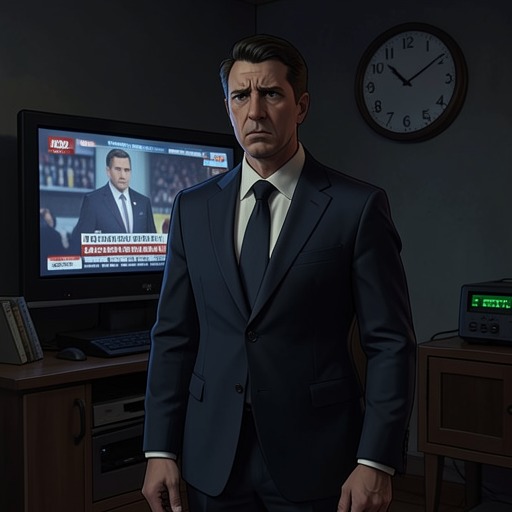
Grand Amoral Portrait Report
Les Choses humainesThe “Grand Amoral” portrait is a newspaper profile of Jean Farel whose impact comes not only from its hostile portrayal but from the intimate source behind its most damaging accusation. Published earlier than expected, it catches Jean on the day of an important broadcast and an official honor, recasts his public persona as moral hypocrisy, and makes private relationships part of a media spectacle. Its afterlife in the novel links reputational exposure to the later debate over public condemnation and judicial fairness in the case against Alexandre Farel.
Commission and Sudden Publication
Jean had agreed to meet a journalist from the newspaper where Françoise Merle worked and to sit for a photograph. The profile was supposed to appear two weeks later. Instead, the newspaper advanced its publication without informing him, and Jean learned of it from Ballard, who handed him a copy and pointed to the portrait on page 22. The revelation came just before Jean’s first broadcast of the year, on the day he was due to interview the Interior Minister and receive the insignia of Grand Officer of the Legion of Honour.
The timing turns the article into an immediate professional crisis. Jean’s team had tried to conceal its existence before the recording, and Jacqueline Faux had advised him not to read it beforehand. He ignored her, read it quickly, dismissed it as a rag, and shut himself in his dressing room to call the journalist. The profile therefore enters the story not as a neutral account encountered at leisure but as a shock delivered under pressure, when Jean is already acutely conscious of public image and career standing.
A Portrait Jean Experiences as an Attack
Jean describes the article to Jacqueline as partial, verbose, vindictive, and obscene. He resents what he sees as the mismatch between its treatment of his commitments and literary interests, which receive little space, and its attention to anecdotes and details designed to make him appear vain, vulgar, and politically compromised. The title, “Grand Amoral,” supplies the profile’s governing judgment; the photograph, taken in harsh side-light, seems to him to exaggerate his age and make him look decades older.
The article assembles a series of biographical details into a hostile account of Jean’s public identity: his supposed anorexia, his Charvet shirts, holidays at Cap-Ferret in the villas of business leaders, sexual jokes, political connections, and alleged social denial. It also revisits his teenage involvement with Occident, an extreme-right organization, and describes his father as an alcoholic metalworker who died in troubling circumstances. The profile’s effect, as Jean recounts it, lies in the way these details are arranged: signs of taste, ambition, background, and youthful association become evidence for a single moral verdict.
Jean is especially shaken by the article’s use of a phrase calling him a human piece of filth. He had expected a portrait that acknowledged his professional ability and love of his work while allowing for a few criticisms. Instead, he reads the profile as a campaign to portray him as an intriguer, a flatterer of the powerful, a depraved entertainer, and a figure in decline. His protest is therefore about more than factual fairness: the article has made the hoped-for distinction between his professional achievements and his private character impossible to maintain.
Michel Duroc’s Testimony and the Rupture of Intimacy
The most injurious element for Jean is that the phrase at the center of the profile came from Michel Duroc, his childhood friend and longtime confidant. When the journalist asked him to name someone from his private circle, Jean gave Michel’s name, believing him reliable and morally loyal. He later recognizes the irony: he had supplied the contact himself, trusting a friend whose testimony would become the article’s sharpest weapon against him.
Jean fixates on Michel’s choice to identify him by the hated nickname “Johnny Farel,” rather than as a friend or simply as Jean. The distinction makes the testimony feel like a public act of separation. Michel is not merely repeating an insult; in Jean’s account, he has stepped away from their intimacy and joined the journalist’s framing of him. Jean suspects that the journalist obtained the words through pressure or manipulation, and blames Ballard as well, but the recorded excerpt leaves him confronting the fact that Michel did say them.
The profile’s closing injury intensifies that break. Asked about threats against Jean following a report on women’s conditions in certain neighborhoods, Michel reportedly says that Jean should be shot and forgotten. Jean says he listened to the excerpt repeatedly, then demands a defamation suit, a newspaper advertisement from the television channel, and a formal right of reply. The measures he seeks are public and institutional because the harm itself has become public: a private friendship has been converted into quoted evidence, circulated as part of a national portrait.
Immediate Aftermath and Wider Media Stakes
The portrait’s publication exposes the fragility of Jean’s carefully maintained distinction between public celebrity and private life. His anger at Ballard, his call to the journalist, and his confrontation with Françoise all unfold alongside preparations for a high-profile broadcast and decoration. Françoise tells him she is sorry and says she had not seen the article before publication; the newspaper had changed its schedule without consulting her. Her explanation does not undo the injury, but it complicates Jean’s assumption that she knowingly allowed the profile to appear in that form.
The novel later places the portrait within the wider media climate surrounding the Farel case. Six months after the Weinstein revelations, public discussion of sexual abuse and the release of women’s testimony intensify scrutiny of Alexandre’s case. His lawyer argues that public opinion has already condemned his client, while the prosecution and the court proceed through their own processes. The book does not make Jean’s earlier grievance equivalent to the allegations against his son; rather, the portrait establishes how damaging it can be when a person’s identity is compressed into a public label, and how the source and circulation of testimony shape that label.
That tension returns in the trial’s aftermath. Alexandre’s lawyer invokes media judgment as a force that has damaged his client’s prospects and narrowed his future, while women demonstrate outside the courthouse and contest the verdict’s implications. Jean, after hearing the verdict, declines to comment to reporters. The contrast between his earlier demand for a counterattack and his later public silence shows how the machinery of exposure persists even when a legal proceeding reaches its decision: a profile, a recorded remark, a headline, and a search result can continue to define people beyond the moment of publication.