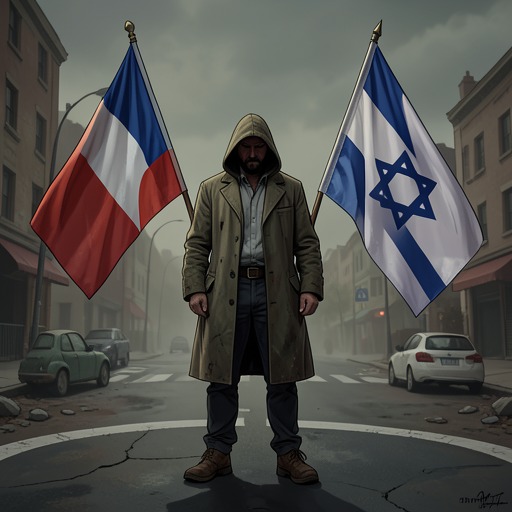
Insecurity among French Jews amid antisemitic violence
Les Choses humainesInsecurity among French Jews amid antisemitic violence is not presented as an abstract fear but as a force that reorganizes family life, migration, religious identity, and intimate loyalties. The 2012 attack on the school attended by Adam Wizman’s daughters makes the threat immediate; the attacks in Paris in January 2015 renew it. Adam and his family leave France for Israel, discover that migration does not produce an uncomplicated sense of safety or belonging, and return to a life still shadowed by the violence that prompted their departure.
The Toulouse attack and the decision to leave
Adam grew up in Paris in a loving Jewish family whose North African immigrant parents valued education and Jewish tradition. After studying modern literature at the Sorbonne, he took a teaching post in Toulouse and married Valérie Berdah, a dental technician. They had two daughters and, at Valérie’s request, enrolled them in a Jewish school. On 19 March 2012, an Islamist extremist attacked the school, killing three children and a father. The killer filmed the attack with a GoPro camera mounted on his chest. For Adam and Valérie, the event transformed antisemitism from a danger that might be discussed or deferred into a threat that had entered their children’s daily lives.
They withdrew their daughters from school immediately. In conversations with relatives and friends, the attack led to the same bleak conclusion: European Jews could no longer ignore an antisemitism capable of killing them. The family believed they might remain in France for a time, but that delay could not guarantee that they or their children would not eventually have to leave. Their anxiety was bound up not only with personal safety but with the prospect of having to tolerate what they considered unacceptable, and with fear that Jewish life in Europe might gradually disappear.
Adam’s reading of Georges Perec’s A Void gives this fear a literary image. He told Claire Farel that Jewish tradition connected creation with letters, and that removing even one letter from the original biblical text altered its meaning. He saw Perec’s decision to write without the letter “e” as unconsciously echoing the ever-present possibility of Jewish disappearance. The metaphor makes erasure more than a political abstraction: it becomes a question of what remains when a people’s place in a shared world is reduced or removed. Until 2012, Adam had accepted the old saying about living happily as a Jew in France; the attack on his daughters’ school ended that confidence.
Emigration and the limits of refuge
In haste, the family moved to Ra’anana, an Israeli city northeast of Tel Aviv with a substantial immigrant population, including French Jews. They rented an apartment for six months. Adam felt a deep attachment to the country, but did not believe he could integrate there without distorting himself. The everyday atmosphere struck him as aggressive, and the familiarity of living among other Jews unsettled him: although encounters with Jewish people abroad had often produced an immediate sense of closeness, in Israel he felt no such complicity. Safety and shared identity did not automatically become a feeling of home.
A second disillusionment was political. Adam was troubled that other French Jews who had emigrated for similar reasons seemed to treat the Israeli-Palestinian conflict as an abstract reality or an inevitable condition rather than a problem to be addressed. He felt that their pursuit of security and quiet came at the cost of a moral defeat, one at odds with the humanistic Judaism he claimed. His return to France therefore does not mean that the original danger has been disproved; it follows from the discovery that refuge carries its own compromises and that belonging in Israel would require a form of adjustment he could not accept.
The family returned to France discouraged by the failed experiment. Adam resumed work as a French teacher at a Jewish school and lived with his family in a closed communal world, with little social life outside it. The narrative holds two pressures together: the wish to preserve Jewish life in the face of antisemitic violence, and the difficulty of finding a place where that preservation does not demand political or personal compromise.
Violence, memory, and a second crisis
In January 2015, the attacks on Charlie Hebdo and the Hyper Cacher de la porte de Vincennes, along with the deaths of two police officers, revived the family’s fear. For three days, Adam could not work; he stayed at home with his wife and daughters, the shutters closed. The novel describes the family’s shared vulnerability as binding them more tightly than love alone. Earlier, after the Toulouse attack, the family had left France; now violence in Paris confirms that return has not restored the sense of security they hoped to recover.
These events also form the background to the family’s separation and to Adam’s relationship with Claire. After returning, Valérie became increasingly observant, took the name Sarah, and adopted stricter religious practices. Adam’s long marriage and their shared history remained connected to the family’s response to danger, but the couple’s life changed as religious commitments diverged. Adam delayed leaving, in part because the obligation to preserve Jewish continuity and the family’s recent experiences made separation feel like more than a private decision. The novel does not reduce their marital crisis to antisemitism; it shows how fear, communal attachment, and the need to protect children become part of the conditions under which intimate choices are made.
Migration reshapes the next generation
The family’s movements had lasting consequences for their daughters. Mila Wizman was affected by the attack on her school, followed by the hurried move to Israel and the family’s return to France. At trial, a psychologist described her difficulties as developing after the attack and her mother’s religious turn, and linked her later distress to a sequence of upheavals, including her mother’s departure. Mila’s experience makes clear that migration undertaken for safety does not leave children untouched: the move changes schools, family arrangements, and the sense of continuity on which a young person depends.
After Adam and Sarah separated, Sarah moved with the younger daughter to Brooklyn’s Crown Heights, an ultra-Orthodox Jewish neighborhood. Mila could not bear life in the religious environment there and returned to France to live with her father. Her choice brought her into a household with Claire, but her relationship with her mother remained strained. In her account to the psychologist, Mila said that her mother blamed her for returning to France and told her that the later events would not have happened had she stayed in the United States. The family’s cross-border dispersal thus extended the original security crisis into a conflict over responsibility, attachment, and where a daughter could live.
The novel presents no destination as a simple answer: France remains marked by antisemitic violence, Israel offers neither effortless integration nor political ease for Adam, and the later move to the United States produces a religious life Mila rejects. The family’s repeated departures and returns are not a clean progression from danger to safety. They expose the cost of seeking security across borders and the different meanings that parents and children attach to home.
Narrative significance
This state of insecurity links public violence to private decisions without treating migration as a single, definitive solution. The school attack first changes what Adam believes can be risked by staying in France; the Paris attacks then make that fear recur after the family has returned. Between them, the six months in Ra’anana show that physical relocation cannot by itself reconcile safety with political conviction, cultural belonging, and an individual sense of self.
The family’s story also complicates the idea of communal refuge. Jewish belonging can sustain memory and mutual attachment, yet Adam’s experience in Israel unsettles his expectation of solidarity, while Sarah’s stronger religious observance changes the terms of life at home. For Mila, the same chain of events produces different consequences: she resists the religious setting in Brooklyn and returns to France, where the psychological effects of earlier upheavals remain part of her history. In this way, insecurity is shown across generations—not as a uniform response shared by every family member, but as a pressure that reorganizes where they live, how they understand responsibility, and what forms of Jewish life they can accept.