Israel
Les Choses humainesIsrael enters the novel as a refuge sought after antisemitic violence, but the move does not provide Adam Wizman with a lasting home. His family’s six months in Ra’anana end in return to France, and that failed attempt at safety and belonging reshapes the family’s life across countries.
Flight after the Toulouse attack
Adam and his wife, Valérie Berdah, had enrolled their two daughters in a Jewish school in Toulouse. On March 19, 2012, a radical Islamist attacked the school, killing three children and a father. In the aftermath, Adam and Valérie withdrew their daughters from school and, like other traumatized relatives, decided to leave France. Their conversations returned to the fear that European Jews could no longer ignore an antisemitism capable of killing, and that their family might ultimately have to leave to protect itself.
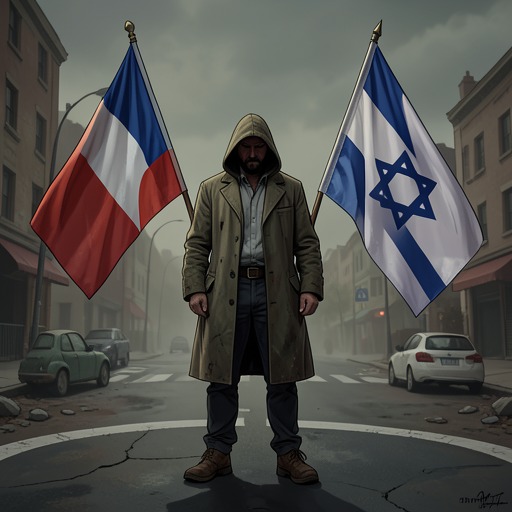
The decision was made in haste. They settled in Ra’anana, a town northeast of Tel Aviv with a large immigrant population, including many French Jews. The novel places their private flight within a wider migration: nearly twenty thousand French Jews had moved to Israel in three years. Israel was thus both a personal response to immediate fear and a destination chosen by a broader community seeking security.
A refuge that did not become home
Adam felt a deep attachment to the land, but living there confronted him with a different question: whether he could integrate without changing himself. He found the everyday atmosphere aggressive and struggled with the constant familiarity of life among other Jews. The solidarity he sometimes felt when meeting Jewish people abroad did not arise for him in Israel. The move had taken him from the loneliness of minority life into a Jewish-majority society, but majority status did not produce an easy sense of belonging.
Political disquiet compounded this unease. Adam believed that fellow migrants who had left for the same reasons were treating the Israeli-Palestinian conflict as an abstraction, or denying it as an unavoidable reality. He saw their willingness to accept this in the name of personal security and tranquillity as a moral defeat, at odds with the humanist Judaism he claimed as his own. The novel therefore distinguishes physical refuge from political and ethical resolution: safety alone could not settle the questions that mattered to him.
After six months in a rented apartment, the family returned to France, subdued by the failure of the experiment. Their return did not erase the danger that had prompted their departure; it left them to live with both the fear of antisemitic violence and the knowledge that Israel had not offered Adam a sustainable alternative.
Consequences across the family
Back in France, Adam took a post teaching French at a Jewish school, and family life narrowed into a close communal circle. During this period Valérie became more religiously observant, changed her name to Sarah, and adopted stricter religious practices. Their marriage eventually ended, and she moved with their daughters to Brooklyn, to the ultra-Orthodox Jewish neighborhood of Crown Heights. The migration to Israel belongs to the history that preceded this later transatlantic separation, rather than to a settled relocation.
The family’s movements also shape Mila Wizman’s circumstances. After the Toulouse attack, the failed move to Israel, her parents’ divorce, and her mother’s departure for Brooklyn, Mila remained close to her father and later joined him in France. At her trial, the psychologist’s account connected the instability of her adolescence to this succession of upheavals. Israel is therefore significant not only as Adam’s unsuccessful destination, but as one stage in a chain of displacement that fractured family life and preceded Mila’s later crisis.
Narrative significance
Israel occupies a deliberately unsettled place in the novel: it is a place of attachment for Adam, a chosen refuge for a family threatened by antisemitism, and a failed attempt at integration. The contrast between the promise of collective safety and Adam’s discomfort among fellow Jews prevents migration from becoming a simple resolution. His return to France leaves the underlying danger unresolved, while the conflict between security and humanist conviction makes the experience a turning point in the family’s story.