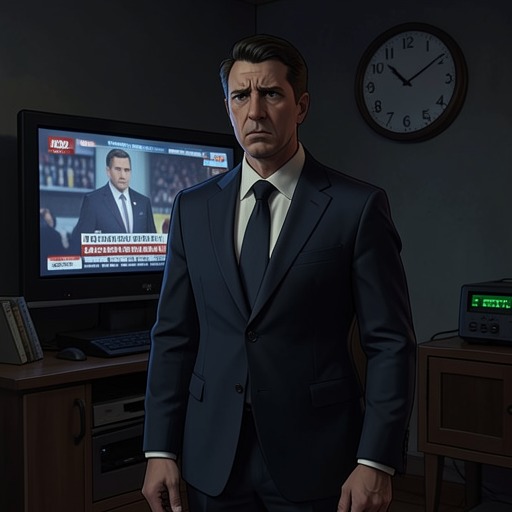
Jean Farel’s anxiety about aging and decline
Les Choses humainesJean Farel’s anxiety about aging and decline is expressed less as an admission of fear than as a system of maintenance. At seventy, after forty years on screen, he disciplines his body, curates his public image, and guards his position in broadcasting; even a minor stroke becomes a secret to contain. His routines are efforts to keep working and remain visible, but they also reveal how precariously his authority depends on a body and career that cannot be made permanent.
Identity and the fear of decline
For Jean, endurance is the organizing demand of life: staying with his wife, maintaining good health, living a long time, and leaving television as late as possible. Though his body shows some signs of weakness, he retains an alert, combative intellect. He meets younger television professionals with the tenacity of an old predator, often exposing the arrogance of those who mistake age for diminished ability. His self-description as naturally healthy sits beside the effort required to sustain that appearance: endurance is not simply a quality he possesses, but a condition he continually tries to secure.
The effort has a professional as well as a personal object. Jean entered broadcasting as an intern at twenty, without a degree or influential connections, and rose through television and radio to become a prominent interviewer and host. He devoted his life to journalism and politics, calling the work his passion. At seventy, however, the long career that made him powerful also makes its ending more immediate. He does not want to relinquish the screen, the recognition that comes with it, or the sense of command his position affords.
A body managed as a public image
Jean turns the prospect of physical decline into a regimen. He trains every morning with a coach, shares a nutritionist’s services with a French pop star, weighs his food, and avoids indulgences. He has told the press that he never misses an opportunity to skip a meal. Three weeks each year, divided between winter and summer, he goes to the mountains, where a cardiologist and naturopath oversee a restrictive fast alongside climbing and hiking. Afterward, he considers his heart rate comparable to that of an adolescent.
His maintenance also includes cosmetic procedures. Once a year he discreetly visits a clinic near his workplace on rue de Ponthieu in Paris. He has had liposuction on his neck and abdomen, eyelid surgery, a light facelift, laser treatments, and hyaluronic-acid injections. He avoids Botox because he associates it with a frozen, artificial expression; what he seeks is not merely youth, but a version of youth that can still pass as natural. The distinction exposes the tension in his project: he wants to control aging without making the control visible.
Medical monitoring gives the same effort a language of measurement. Each quarter, his general practitioner reviews his test results. Jean can recite figures such as his sedimentation rate and levels of C-reactive protein and transaminases, and he undergoes extensive tumor-marker testing, particularly since Claire Farel had breast cancer. He calls himself a hypochondriac, but the tests serve a practical purpose in his mind: he wants to hold on and remain on the air. Concern for health, fear of illness, and the demands of professional survival are difficult to separate.
The screen, the mirror, and the audience
Each year before summer, Jean agrees to pose for the cover of Paris Match, usually photographed while cycling, running, or Nordic walking. The image performs a clear argument: he is still vigorous. His planned appearance on Fort Boyard would offer viewers another demonstration of physical condition. These appearances turn fitness into public evidence, a performance addressed both to the audience and to the broadcaster whose support helps sustain his career.
The mirror makes the underlying contradiction more private. Jean watches his anticipated deterioration there each morning, even as he insists that he does not feel old. His desire to please has narrowed into lunches with female colleagues, especially those under forty, and with first-time novelists whose books he praises in admiring letters. He enjoys being seen through their attention and telling them stories, but the encounters do not go further. He sometimes imagines beginning a new life with a younger woman and having a child, yet recognizes that an exchange of youth for security would not be love. The fantasy of renewal therefore appears alongside a more guarded recognition of what such renewal would cost and mean.
Power, concealment, and the threatened ending
Jean’s authority is bound to being watched and recognized. Entering the television network’s glass building, which overlooks Paris, still gives him an inner lift—not so much because of the place itself as because of the deference he receives at the security gate. He has learned to preserve his position through control and refusal to yield, while publicly presenting his career as the result of chance. The discrepancy is revealing: a man who has built his life around mastery claims not to have sought mastery over it.
At sixty-seven, Jean suffered a minor stroke at home and briefly lost the ability to speak. He recovered without lasting effects, but concealed the episode to protect his career. He then required that Grand Oral be recorded in advance. Publicly, the change was presented as a matter of greater freedom and comfort; privately, it answered his fear of suffering another stroke live and having his career end in a humiliating clip circulated on YouTube. The incident makes the limits of his control concrete: the programme can be recorded beforehand, the body cannot be guaranteed not to fail.
Jean’s preoccupation with decline is therefore not only fear of illness or the loss of youth. It is fear of losing the conditions that make him consequential: an active career, an audience, recognition, and the power that comes with being welcomed and deferred to. His routines repeatedly promise that the end can be postponed, while his concealed stroke and daily attention to the mirror expose the fragility beneath that promise. The body he manages is at once a private vulnerability and the public instrument through which he has built his authority.