Quitterie Valois
Les Choses humainesQuitterie Valois is a twenty-four-year-old intern in Jean Farel’s newsroom, and a brief involvement with her lays bare the unequal terms on which attraction operates between a powerful older broadcaster and a young subordinate. Jean reads her deference and professional polish as signs of interest, but the encounter ends without any clear declaration from her about what it means; his regret and sudden romantic message reveal as much about his own insecurity and desire as about Quitterie herself.
Identity and Position
Quitterie comes from Pau and works as an intern in the newsroom Jean leads. He sees her as attractive, mature, and exceptionally professional. Her manner with him is deferential: she calls him the boss and accepts his invitation to meet at the Ritz after exchanging messages that began on professional grounds. The formality of their relationship matters. Jean is not simply an older man flirting with a younger woman; he is also her superior, and the attention he enjoys is bound up with his authority at work.
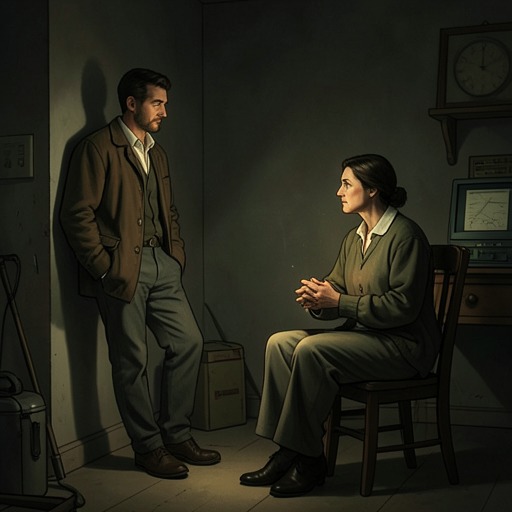
Her appearance and style are filtered through Jean’s gaze. He notices her classic clothes, her red ballet flats and scarf, and the high ponytail she wears when she arrives at the hotel. He admires the way she seems distinct from other young women and takes pleasure in her old-fashioned name. His attention turns her into a figure he can interpret: he researches the name while waiting and tells her a story about Saint Quitterie, a young woman whose life ended violently after her father tried to force her into marriage. That romantic historical tale is Jean’s discovery and projection, not a history Quitterie offers about herself.
The Ritz and the Workplace Hierarchy
At the Ritz, Quitterie orders a cocktail while Jean chooses a dry martini and recounts a story about Hemingway and the hotel bar. She responds to his reminiscences and to photographs of him with world leaders at the newsroom, asking whether he met figures such as Gorbachev, Mandela, and Obama. Jean gives her a copy of Saint-Simon’s memoirs from his library. Her interest and courteous attention flatter him; he imagines her as eager to learn and to make a good impression, as if he were assessing her.
The scene also reveals the assumptions through which Jean interprets her. He categorizes her as a young woman who works within, rather than challenges, a masculine order of power. He is attracted to her deference and to the prospect of being admired by someone at the beginning of her career. Their encounter takes place against his awareness that she is an employee and he is the boss, but that awareness does not stop him from inviting her to his office for another drink. His private view of their exchange consistently centers his own appetite and status; Quitterie’s perspective is not given an equivalent interior account.
An Encounter and an Uneasy Departure
The night does not unfold as Jean expects. He is unable to perform sexually, and the two eventually give up for the night. Later, when he wakes, he asks Quitterie to help him, and she does so without expressing reproach in the narrated scene. The next morning, seeing her care for Claude, Jean feels ill at ease: she seems too young, and he doubts he has the energy for an affair with someone who works in his newsroom. He also tells himself that the appeal of forbidden encounters has passed, recalling a past in which he had pursued a wide range of sexual experiences while keeping them from Claire and Françoise.
Jean wants Quitterie to leave. She appears to perceive his discomfort, says she has work, and departs discreetly with the book he gave her. The account does not describe a confrontation or establish what she thinks of the encounter. Its emphasis instead falls on Jean’s abrupt shift from desire to withdrawal, and on the distance between his self-image as an experienced man and his present need to escape the consequences of intimacy.
Jean’s Regret and Renewed Pursuit
After Quitterie leaves, the rumpled bed and Claude’s refusal to eat turn Jean’s thoughts toward Françoise, who is in hospital after attempting suicide. He remembers her calling Claude the son Jean gave her. He regrets the encounter, misses Françoise, and feels guilty that he was with Quitterie while Françoise was in crisis. He cancels a training session and plans to visit the hospital after his radio appearance, hoping to persuade Françoise to return.
His regret sits alongside a newly stated desire for stability and transparency. Jean decides that he no longer has the energy for the demands of love and imagines Françoise will agree to come back, partly because he assumes she has few better options at her age. That presumption exposes the possessiveness beneath his longing: even as he regrets betraying her, he measures her prospects and reassures himself that he is unlikely to lose her. Quitterie’s brief presence has not resolved his attachment to Françoise; it has made his dependence and guilt harder to ignore.
The Message and Narrative Significance
Later, after visiting Françoise in hospital, Jean passes through the corridors and encounters an older man in a wheelchair who recognizes him and asks for an autograph. Jean signs, but rejects the man’s comparison between them as near-twins of the same age. While the man continues to watch him, Jean writes Quitterie a message saying he thinks he is falling in love. He hesitates, recalling Françoise’s accusation that men become sentimental when they want sex, then sends it.
The message sharply complicates Jean’s earlier wish for Quitterie to disappear. It does not establish that he is in love, or that Quitterie reciprocates; it records his decision to turn a short, unsettled encounter into a declaration of feeling. The episode links professional authority, aging, sexual self-confidence, and romantic self-deception. Quitterie is the object of Jean’s attention, but the narrative’s evidence about her remains limited: her choices are conveyed through her messages, her departure, and her conduct as Jean remembers it. That imbalance makes the episode as revealing of the older man’s interpretations and needs as it is of the young intern herself.