
Love, Possession, and Separation
Les MisérablesThis thread contrasts Marius and Cosette’s idealized romance with Jean Valjean’s struggle to love without claiming another person as his own.
increasing Bearing strength in each event
 decreasing
Bearing strength in each eventdecreasingThe Father’s Whole World

The Father’s Whole World
A bond born from rescue
Jean Valjean’s affection for Cosette grows after he rescues her from the Thénardiers. For the first time in many years, he has a person whose happiness gives shape to his life.
Cosette’s love helps him feel that he can remain in the world. He sees her as both a child to protect and the center of his own emotional refuge.
Love’s hidden danger
Valjean’s devotion is generous, but it can become possessive because he fears losing the only family he has known. His happiness depends too heavily on Cosette’s continuing dependence.
The story does not dismiss his care. It asks whether love can remain loving when it cannot accept the other person’s freedom.
Cosette Meets Marius

Cosette Meets Marius
An awakening shared
Cosette and Marius notice each other through exchanged glances before they speak. Their attraction is mutual, though neither fully understands how quickly it will shape their days.
The garden becomes a setting for attention, expectation, and silence. Their love is real, but still formed largely by ideals and imagination.
Innocence and uncertainty
Cosette’s growing awareness of her beauty gives her a new confidence, while Marius struggles with shyness. Both read meaning into small gestures because they lack direct knowledge of each other.
The romance is presented as radiant and fragile at once. Its intensity belongs to youth, where a look can seem to contain an entire future.
The Father’s Fear

The Father’s Fear
A possible rival
Jean Valjean notices Marius’s repeated presence near Cosette and becomes uneasy. The young man threatens the exclusive intimacy that Valjean has come to rely on.
Valjean does not understand the lovers’ relationship and does not ask Cosette directly. His fear turns observation into suspicion and distance.
A separation disguised as protection
After learning that Marius has followed them, Valjean leaves the Rue de l’Ouest and later removes Cosette from the Rue Plumet Residence. He tells himself that the move is necessary to protect her.
The action demonstrates how fear can make loving care controlling. Cosette suffers the loss of contact without being told why it is happening.
A Love Tested by the Barricade

A Love Tested by the Barricade
Misread departure
Marius returns to the garden and finds Cosette gone. He assumes she has left him, unaware that Jean Valjean has moved her and that she has written to him.
His despair carries him toward the barricade. A private misunderstanding becomes entangled with the immediate threat of death.
A message survives
Éponine gives Marius Cosette’s letter as she lies dying. The note reveals that Cosette loves him and is staying at the Rue de l’Homme-Armé.
The lovers’ connection survives through a message delayed by fear and withheld affection. It gives Marius hope, but not yet a safe way to reach her.
A Final Lesson in Love
A Final Lesson in Love
The cost of withdrawal
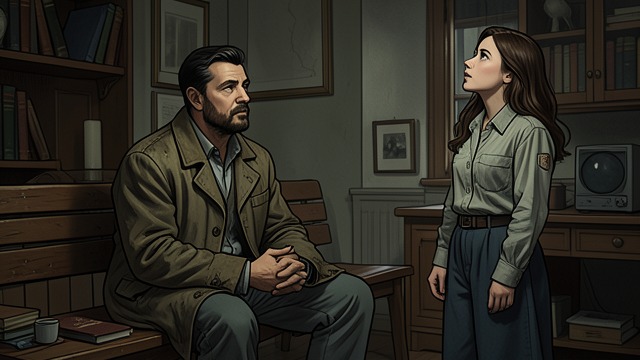
Jean Valjean confesses his convict past and withdraws from Marius and Cosette because he believes his identity will stain their happiness. His self-denial is sincere but deprives the young couple of the truth they need.
Marius initially accepts the distance, and Valjean becomes lonely and ill. The separation is therefore not purely noble; it also arises from shame and fear.
Love without possession
Marius learns that Valjean rescued him and brings Cosette back. The dying man receives affection without demanding that Cosette choose between her husband and her adoptive father.
His final words bless their life together, while his memories honor the child she once was. Love reaches maturity when it can give happiness rather than insist on being its sole source.
During Cosette’s childhood in Paris
Spring 1831, at the Luxembourg Gardens
1832, after Marius follows Cosette
June 5–6, 1832, during the uprising
February 1833, at Jean Valjean’s deathbed
