Chanvrerie Street Barricade
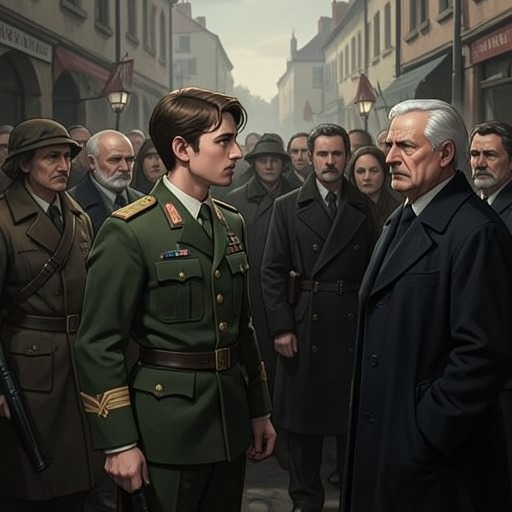
Les MisérablesThe Chanvrerie Street Barricade is the insurgents’ stronghold during the June 1832 uprising in Paris, a confined position where a small band faces the overwhelming force of the government. It draws Marius into the battle and becomes the setting for his sudden intervention, the capture of Inspector Javert, and the insurgents’ increasingly desperate effort to hold their ground.
Setting and Approach
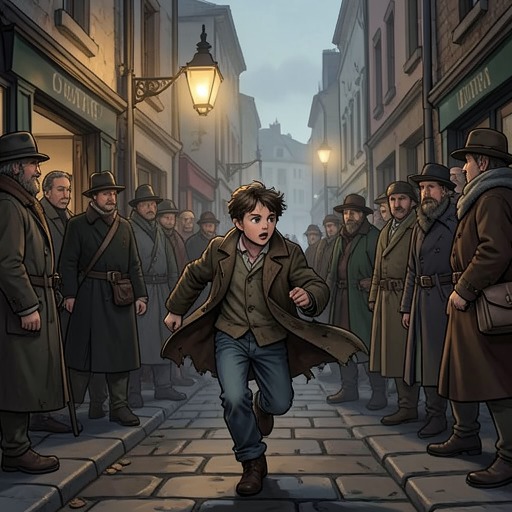
On the night of June 5, 1832, the capital is preparing for a popular uprising against the regime. Marius learns that his friends are waiting at the barricade and sets out for them. His approach takes him through Les Halles, where the streets are unusually still and dark. A red glow on the rooftops guides him toward the barricaded end of the street near Saint-Eustache.
Marius enters Rue des Prêcheurs without being seen by the insurgent lookout at the far end. He reaches the bend of Rue Mondétour, the sole passage Enjolras has kept open to the outside, and looks toward the barricade from the corner of a house. The approach makes the position feel at once near and concealed: Marius can see its interior only in fragments, through a screen of darkness and the buildings that hide the rest of the cabaret and the barricade.
The Insurgent Position
From his vantage point, Marius glimpses a little light on the paving stones, part of the cabaret, and a wavering lampion behind what appears to be an irregular wall. Men crouch behind it with rifles resting on their knees. Elsewhere in the position, insurgents keep the upper floors dark; in the lower room, two candles are set on the counter to provide light while cartridges are made. Because powder has been scattered on the tables, the candles are kept there as a precaution, and their light does not show outside.
The defensive quiet is not a sign that the danger has passed. Gunfire can be heard at a distance, but it is sparse and faint. The lull gives the insurgents time to understand the imbalance of the situation: fifty men are waiting for a force of sixty thousand. The position is therefore not simply a place of resistance but a point where the scale of the coming assault is made unmistakable.
Combat and Capture
Marius first watches the fighting from the bend in Rue Mondétour, hesitating as danger closes in. He then rushes into the mêlée with both pistols. His first shot saves Gavroche; his second frees Courfeyrac. The action changes his place in the battle: rather than remaining an observer at the edge of the position, he becomes an active defender, and the account presents his feat as the moment that marks him out as a leader among the insurgents.
The barricade is also where Enjolras’s men expose and seize Inspector Javert. When Javert gives his name, Enjolras signals four men; before Javert can turn, they seize, bring him down, bind him, and search him. They find a round identification card sealed between two panes of glass. It bears the arms of France and identifies him as a police inspector, with the signature of the prefect of police. His watch and purse are also found, but the insurgents leave both with him.
Defeat and Significance
As the assault intensifies, the defenders’ position deteriorates. Uniforms taken from dead members of the French National Guard are meant to help married men and fathers escape across enemy lines, but there are only four uniforms for five men. The detail makes the barricade’s predicament concrete: even a narrow chance of survival requires choices about who can leave, while the defense itself is nearing collapse.
The barricade is eventually stormed. The insurgents are killed one after another, and Marius is wounded. As he falls unconscious, he feels a hand seize him and supposes that he has been captured. Its narrative significance lies in this sequence of reversals: the position first gathers Marius’s friends, then draws him into action, and finally becomes the site of their defeat. Its dark approaches and fragile defenses give the uprising a physical shape, while the difference between fifty defenders and sixty thousand opponents measures the cost of holding it.