Children’s innocence and vulnerability
Les MisérablesChildren’s innocence and vulnerability are central to the moral vision of Les Misérables: the novel repeatedly places children’s dependence and exposure to harm against the failures of the adults and social arrangements meant to protect them. Cosette’s frightened labor and Little Gavroche’s precarious freedom make that contrast concrete. Their suffering is not presented as proof that children are powerless in every respect; even under severe constraint, they feel, endure, improvise, and act. The tenderness their stories elicit also gives the novel’s larger account of social suffering some of its most intimate force.
Children as the Measure of Social Cruelty
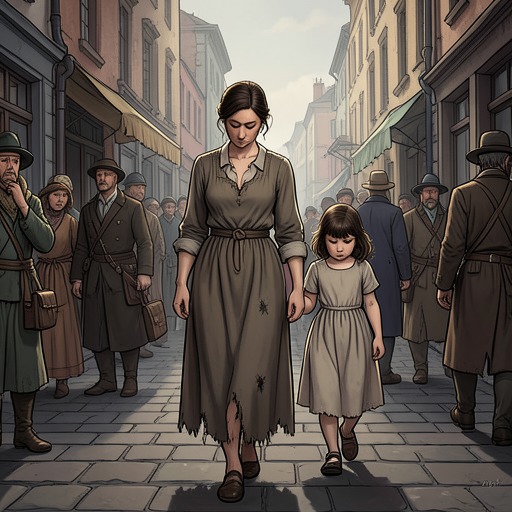
Victor Hugo’s compassion is especially directed toward figures of innocence and fragility, above all victims and children. In this perspective, a child’s treatment is more than a private matter: it exposes the moral condition of the adults and society around them. Cosette is made to work and is threatened with punishment; Little Gavroche has parents but receives neither their attention nor his mother’s love. Their different circumstances converge in abandonment, whether that abandonment takes the form of cruelty within a household or exclusion from one.
The novel makes this judgment sharply visible through the contrast between Cosette and the daughters of the Thénardiers. Éponine Thénardier and Azelma sit by the fire with a doll, turning it over and playing together, while Cosette, occupied with her knitting, watches them with a sorrowful look. They do not regard her as a companion; the narration compares their treatment of her to treating her like a dog. Their old, broken doll nevertheless appears wonderful to Cosette, who has never had a real doll of her own. The scene concentrates deprivation into an ordinary object: what the other children can handle casually becomes, for Cosette, an unreachable emblem of childhood. The girls’ own comfort and play are set beside the neglect imposed on her, making inequality legible within the same room.
Cosette’s Fear and Endurance
The episode of the water bucket gives Cosette’s vulnerability a physical scale. At eight years old, alone in a wood at night in winter, she is overwhelmed by the darkness of nature and by a terror she cannot explain. She tries to recover her sense of her surroundings by counting aloud from one to ten and starting again. The effort briefly restores ordinary perception, but fear returns, now sharpened by cold hands wet from drawing water and by the need to get back to Montfermeil before Mme Thénardier can punish her.
Cosette is afraid not only of being alone in the woods but of the consequences of failing to carry the bucket home. Even when flight seems urgent, fear of Mme Thénardier is strong enough to keep her from leaving the bucket behind. She grips its handle with both hands, manages only a dozen steps before setting it down, and repeatedly stops to rest. The iron handle numbs and chills her wet hands; cold water spilling over the rim falls onto her bare legs. She walks bent forward, her thin arms stiffened by the weight, and calculates anxiously that the journey may take more than an hour. The details do not let her hardship dissolve into abstraction: a child’s body bears the burden, step by laborious step.
Near a familiar old chestnut tree, Cosette pauses for a longer rest, gathers her remaining strength, and resumes walking. Exhausted and still in the forest, she cries out to God. The episode brings dependence and agency into the same moment: she is physically overwhelmed and afraid, yet she continues, restarting after each stop and drawing on the strength she can summon. The narrator’s attention to her mother’s imagined awareness intensifies the pathos of the scene, presenting the child’s suffering as something that should be witnessed even when no human observer is present.
Neglect, Constraint, and a Child’s Voice
Cosette’s plea for mercy when Mme Thénardier reaches for a whip reveals how thoroughly punishment has entered her expectations. She begs not to be struck and promises not to repeat whatever has provoked the threat. The moment is brief, but its imbalance is unmistakable: an adult controls the weapon, while the child’s immediate resource is to plead for restraint. Her vulnerability is not sentimental shorthand; it is shown through the practical conditions that narrow her choices, from compulsory work to fear of punishment and the need to keep carrying the bucket.
Little Gavroche’s childhood is shaped by a different kind of neglect. Eight or nine years after the earlier events, he is about eleven or twelve and lives largely in the streets around the boulevard du Temple and Château-d’Eau. His clothes are mismatched hand-me-downs given in charity: men’s trousers not supplied by his father and a woman’s bodice not supplied by his mother. He has both parents, yet his father does not think of him and his mother does not love him; he is described as orphaned despite their existence. The pavement, he feels, is less hard than his mother’s heart. Where Cosette is confined to labor under an adult’s authority, Gavroche has been cast out of domestic care altogether.
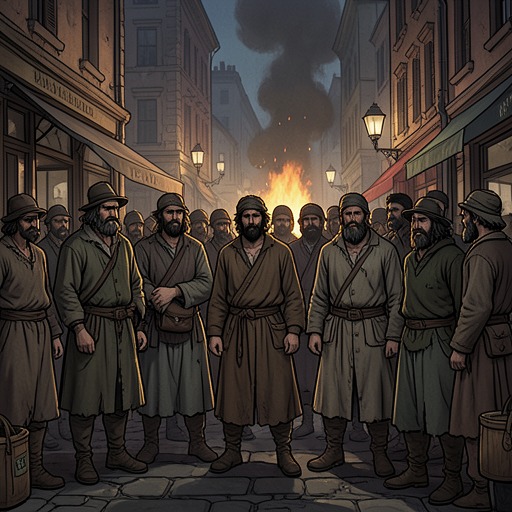
The street gives him a measure of freedom, but not security. He has no home, bread, fire, or love; he moves about, sings, plays, searches the gutters, and steals a little in the cheerful manner of cats and sparrows. That liveliness should not obscure the deprivation surrounding it. His apparent independence is the result of being left to fend for himself, not of adult protection. At intervals of two or three months he goes to see his mother at the Gorbeau House, a return that makes the persistence of family attachment visible even in a life organized around separation.
Agency, Danger, and the Novel’s Pathos
The account of Little Gavroche refuses to treat an abandoned child as merely passive. He is quick, alert, mocking, and energetic; he has learned to survive by moving through the city on his own terms. The narration contrasts children’s smallness with the crushing force of social order: adults in poverty are commonly ground down by that mill, while children can sometimes escape through a small opening because they are still small. The image acknowledges both danger and possibility. His freedom is real, but so is its precariousness; the same lack of shelter that lets him slip past authority leaves him without dependable care.
At the barricade, his resourcefulness becomes an act of conspicuous courage. While soldiers and National Guardsmen fire at him, he darts from cover to cover, taunts the gunfire, and gathers cartridges from ammunition pouches to fill his basket for the insurgents. The adults watching him follow his movements anxiously as the barricade trembles and he continues singing. His agility gives the scene a startling, almost playful motion, but the play takes place under fire. A bullet finally strikes him. He staggers and falls, then sits upright again, blood marking his face, and raises his arms toward the direction of the shot. The passage makes his daring visible without making the danger harmless: his childlike audacity and the lethal violence directed at him occupy the same scene.
The tenderness devoted to such children contributes to the work’s epic of suffering humanity. Hugo’s attention to the death of the young is also described as carrying painful autobiographical echoes: he lost a son at birth and a daughter shortly after her marriage. That context helps explain the weight attached to children’s fragility in the novel, without reducing its fictional children to personal symbols. Cosette and Little Gavroche remain distinct figures, one enduring domestic abuse and the other navigating street abandonment. Their stories show innocence not as a guarantee of safety but as a condition exposed to adult power and social hardship; their endurance and action, in turn, prevent vulnerability from being mistaken for an absence of life or will.