Enfance malheureuse
Les MisérablesEnfance malheureuse is a recurring concept in Les Misérables: childhood is a condition of dependence and innocence, yet the children most in need of care are repeatedly exposed to deprivation, neglect, and violence. Cosette and Gavroche give the theme its clearest human forms. Their stories make private family failures inseparable from wider social hardship, and show children enduring consequences created by adults and by history.
Poverty and the failure of care
The novel places childhood suffering within a world where poverty can overwhelm a household’s ability to provide. Jean Valjean works at whatever labor he can find, but his sister’s family has seven children, and a severe winter leaves him without work and the family without bread. The episode makes scarcity more than a background condition: it narrows the choices available to adults responsible for children and exposes how readily the need to survive can become entangled with punishment. In 1795, Jean Valjean breaks into a baker’s shop to take a loaf. He is caught and sentenced to five years in the galleys; after four failed escape attempts, his sentence is extended to nineteen years. His case is not itself a portrait of childhood, but it establishes the harsh economic and legal environment in which vulnerable families struggle to live.
The novel also distinguishes material provision from emotional care. Gavroche has both a father and a mother, yet his father gives him no thought and his mother does not love him. Charity supplies the mismatched adult clothes he wears; it does not repair the abandonment within his family. He is described as an orphan despite having living parents, a bitter reversal that identifies neglect as a form of social and familial dispossession. For him, the street feels less hard than his mother’s heart, and his parents have effectively cast him into life without protection.
Cosette: fear and endurance
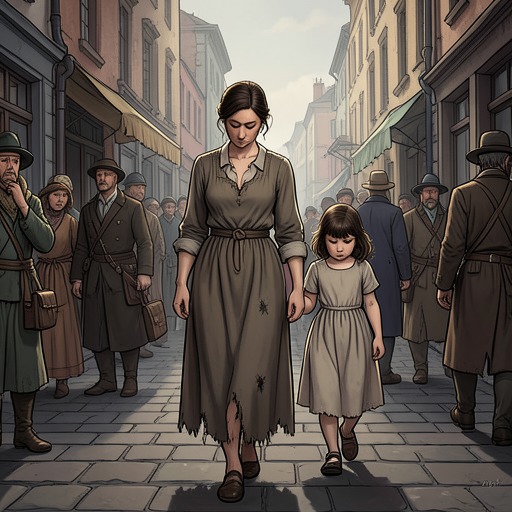
Cosette’s childhood is shaped by her dependence on the Thénardier household, where she is taken in for payment but treated as a servant and beaten by Mme Thénardier. The arrangement that should provide shelter instead makes her vulnerable to the adults charged with her care. When Mme Thénardier reaches for a whip, Cosette cries out for mercy and promises not to repeat her offense. The scene registers her fear without granting her any real power to alter the conditions that produce it.
That dependence is also visible when Cosette, eight years old, goes alone into the woods at night in winter to draw water. The darkness overwhelms her; she tries counting aloud to regain her sense of her surroundings, then starts back carrying a full, heavy bucket. She has to stop repeatedly, and the cold water spills onto her bare legs. Though frightened and exhausted, she does not dare leave the bucket behind because she fears Mme Thénardier. The episode shows both the physical burden imposed on a child and the way fear governs her decisions: even escape from the woods must be weighed against possible punishment at home.
Gavroche: independence under threat
Gavroche’s apparent ease in the streets is not evidence that he has escaped childhood suffering. He is about eleven or twelve, dressed in clothes given by strangers, and neglected by parents who remain alive. The street is the place where he feels most at home precisely because his family offers so little affection. His independence is therefore double-edged: it allows him to move through the city on his own terms, but it also records the absence of adult protection.
At the barricade, that self-reliance becomes a perilous form of action. While soldiers and National Guardsmen fire at him, Gavroche gathers cartridges from ammunition pouches to supply the insurgents. He dodges from place to place, disappears and reappears, and answers the gunfire with songs and gestures. The insurgents watch anxiously as the barricade comes under attack and the child continues his errand. A bullet finally strikes him; he falls, rises again, and is then killed. His death joins the theme of neglected childhood to the violence of political history: the child who had been left to fend for himself in ordinary life is also exposed to the lethal dangers of insurrection.
A recurring literary and social theme
The novel’s presentation of Cosette and Gavroche makes innocence coexist with hardship rather than shielding children from it. They are not harmed in the same way: Cosette’s story emphasizes household exploitation and fear, while Gavroche’s combines parental neglect, street life, and death amid public violence. Yet both are made vulnerable by failures of adult responsibility. Their circumstances give the theme its force without suggesting that hardship erases their distinct personalities or actions.
The educational discussion accompanying the novel identifies Cosette and Gavroche as figures who embody innocence and naïveté while becoming early victims of human cruelty and historical violence. It also places these characters within a wider literary tradition: later fictional and autobiographical accounts of unhappy childhoods return to absent love, mistreatment, indifference, and parental cruelty. This framing recognizes childhood suffering as a sustained concern in Hugo’s work and in later writing, not merely as an isolated episode in either character’s plot.
The theme also resonates with Victor Hugo’s public argument about poverty. Addressing the Legislative Assembly in 1849 in support of a proposed system of public assistance and provision, he distinguished suffering, which he regarded as unavoidable, from misery, which he argued society could eliminate. His appeal to legislators connects the novel’s intimate scenes of deprivation to a political demand: children’s suffering cannot be separated from the social conditions and responsibilities that surround them. In this light, Cosette’s dependence and Gavroche’s abandonment are not only personal misfortunes; they reveal what happens when care fails at home and hardship is left unaddressed in society.