Enjolras
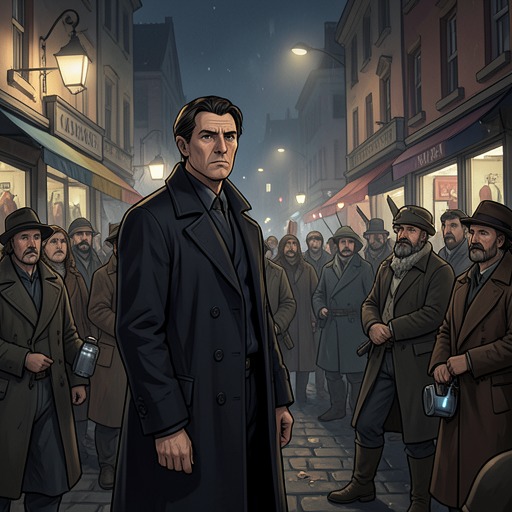
Les MisérablesEnjolras is the leader of the insurgents at the Chanvrerie Street Barricade during the uprising of June 5, 1832. His command is tested by the mismatch between the small band defending the barricade and the government forces gathering against it; within that pressure, he remains alert to both the streets beyond the barricade and the danger hidden among its defenders.
Identity and the uprising
Enjolras leads the group that includes Courfeyrac, Bossuet, Combeferre, and Gavroche. Their struggle is part of a popular rising against the regime, and the men at the barricade face the prospect of fighting government soldiers with only a handful of comrades. The narrative presents Enjolras not in isolation but at the center of this fragile collective effort: his authority shapes the group’s responses as the situation tightens.
Command under pressure
By night, the expected action has not begun. The insurgents hear confused rumors and occasional, distant gunfire, but the shots are sparse; the prolonged lull suggests that the government is taking time to gather its forces. The disparity is stark: fifty men wait for sixty thousand. Enjolras feels the impatience that comes before a grave ordeal and turns to practical reconnaissance rather than allowing the uncertainty to govern the barricade.
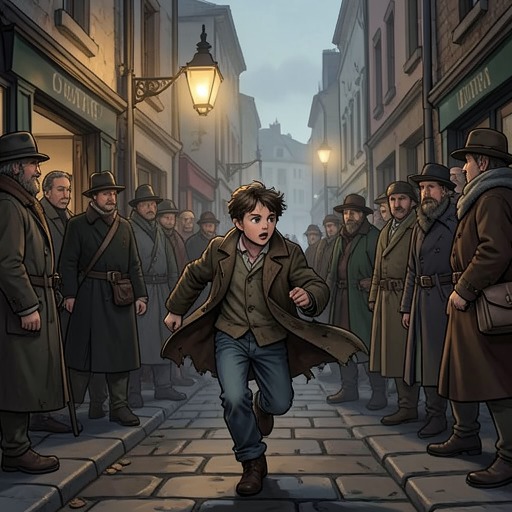
He finds Gavroche making cartridges in the lower room, where two candles sit on the counter because powder has been scattered across the tables. Their light is kept from the outside, and the upper floors are left dark. In this concealed, hazardous workspace, Enjolras gives Gavroche a specific assignment: because his small stature will make him less visible, he is to slip along the houses, move through the streets, and return with news of what is happening. The order makes the boy’s size a tactical advantage and sends the barricade’s youngest member into the city as a scout.
The discovery of Javert
The arrival of a man recruited in Rue des Billettes introduces a more immediate danger. Enjolras approaches him and asks who he is. The man gives his name as Javert; Enjolras then signals four broad-shouldered porters, who seize, knock down, bind, and search him before he can turn around. The operation is swift and coordinated, converting suspicion into custody without a fight.
The search confirms that Javert is a police inspector: he carries a round identification card bearing the French arms, the words indicating surveillance and vigilance, his name and rank, and the police prefect’s signature. His watch and purse, which contains several gold coins, are left with him. Enjolras identifies him as an informer and declares that he will be shot two minutes before the barricade is taken. Javert challenges the delay, asking why they should not shoot him at once. Enjolras’s threat is therefore conditional on the barricade’s fall; the evidence establishes his decision to hold Javert, not the eventual carrying out of the sentence.
The barricade’s narrowing choices
As the battle continues, the insurgents’ position worsens and their deaths appear certain. National Guard uniforms have been taken from corpses so that married men and fathers can escape by crossing the enemy lines. There are only four uniforms for five men. This shortage makes the group’s choices painfully concrete: even a means of escape cannot serve everyone. Enjolras’s leadership thus belongs to a collective struggle in which reconnaissance, the exposure of an infiltrator, and the possibility of withdrawal all unfold against dwindling prospects.
Narrative role
Enjolras’s actions show command as attention to immediate realities. He reads the long silence as evidence that the government is assembling strength, uses Gavroche to gather intelligence, and responds decisively when the stranger’s identity is exposed. Yet none of these measures erases the imbalance between the defenders and the force approaching them. The contrast between the two candles kept from view and the vast army assembling outside gives the episode its governing tension: the insurgents can control their light, their movements, and the man they have captured, but not the scale of the danger closing in.