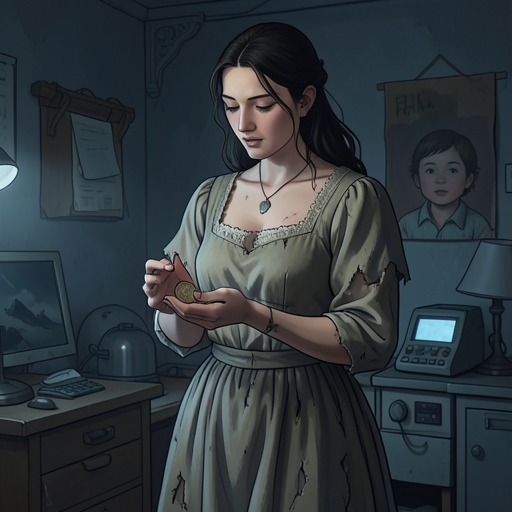
Fantine sells her hair to support Cosette
Les MisérablesFantine sells her hair to support Cosette after a demand from the Thénardiers makes her poverty newly urgent. The exchange converts part of her own appearance into clothing for her child, but the skirt does not reach the child for whom it was intended: the Thénardiers give it to Éponine. The episode’s decisive significance lies in that reversal. Fantine believes she has protected Cosette from the cold, while the people entrusted with the child redirect the gift and leave her need unanswered.
The demand and the sale
Fantine’s wages are too small to keep pace with her growing debts. The Thénardiers write repeatedly, and both their messages and the cost of receiving them add to the pressure on her. In their latest letter, they claim that Cosette has no adequate clothing for the cold and ask Fantine to send at least ten francs for a wool skirt. The demand makes the child’s immediate need the reason for Fantine’s next sacrifice, even as the mounting correspondence deepens the financial burden placed on her.
Fantine carries the letter with her through the day, crumpling it in her hands. That evening, she goes to a barber nearby and loosens her comb. Her long blond hair falls to her waist. Asked how much he would pay for it, the barber offers ten francs—the amount the Thénardiers have requested. Fantine accepts the price and has her hair cut. The quick agreement joins the letter’s stated sum to a bodily cost: she does not have the money at hand, so she turns something of her own into the requested payment.
With the proceeds, Fantine buys a knitted skirt and sends it to the Thénardiers. The direction of the money matters: she does not retain the ten francs or use them for herself, but converts them into the precise kind of clothing the letter has named. The transaction is an attempt to answer a specific need at a distance, through people who control the child’s daily care.
A gift diverted
The skirt produces the opposite of the response Fantine hopes for. The Thénardiers are furious because they wanted money, not the garment. They give the skirt to Éponine, and Cosette continues to shiver. Fantine has answered their stated appeal, but the objects sent in response to it do not secure the care she intended. The exchange exposes the gap between the Thénardiers’ claim to be soliciting help for Cosette and their actual handling of the help they receive.
Fantine does not know that the skirt has been diverted. She comforts herself with the belief that Cosette is no longer cold and imagines that she has clothed her child with her own hair. That thought gives the sacrifice a tenderness the transaction itself cannot deliver: in Fantine’s understanding, the loss has become care made tangible. For the reader, the irony is sharper. The hair has been sold and the garment sent, yet the child remains without its protection; the mother’s consoling picture and Cosette’s circumstances have already parted company.
Fantine’s changing circumstances
The sale also marks a change in Fantine’s relation to her own appearance. Afterward, she wears small round caps that cover her shorn head; the narrative notes that she remains pretty in them. The caps make the visible consequence of the sale part of her continuing life, rather than a cost confined to the moment at the barber’s. What she gives up is not only the price of an object: the alteration stays with her as she continues trying to provide for Cosette.
The passage places this sacrifice within a larger downward movement. A dark change is taking place in Fantine’s heart, and, unable to arrange her hair as before, she begins to take everything around her in hatred. She has long shared the town’s respect for Madeleine, but repeatedly tells herself that he dismissed her and caused her misfortune; in time, that account turns her resentment especially toward him. The hair sale does not alone explain this change, but it belongs to the accumulating sequence of deprivation and distress that narrows her sense of whom to blame.
Cosette’s later experience makes clear how little the promised clothing can stand for the quality of her care. In a winter wood at night, eight-year-old Cosette struggles to carry a full bucket of water, repeatedly stopping under its weight. That later scene does not arise from the sale itself, but it shows the wider conditions under which the child lives and underscores the difference between Fantine’s protective intention and the treatment Cosette receives while in the Thénardiers’ keeping.
Poverty, necessity, and the novel’s social argument
The episode gives poverty a concrete mechanism: an inadequate income, accumulating debts, costly letters, and a demand that can be met only by selling something Fantine herself possesses. Elsewhere in the novel, Jean Valjean’s family faces a winter without work and literally has no bread; he is condemned to five years in the galleys after stealing a loaf. His case and Fantine’s are distinct—one is prosecuted as theft, the other is a private sale—but together they show how the struggle to meet basic needs is shaped by social and legal consequences, not simply by individual choice.
Victor Hugo later states in the Legislative Assembly that suffering may be a divine law, but misery can be destroyed, and that what is possible remains a duty until it is done. Read alongside that public argument, Fantine’s ten-franc exchange brings the language of social misery down to a single, practical question: how a mother is to answer a child’s need when her earnings cannot meet the demand. The skirt makes the failure measurable. Fantine pays the requested sum through the sale of her hair; the intended recipient does not receive the garment, and the material hardship that prompted the sacrifice remains.