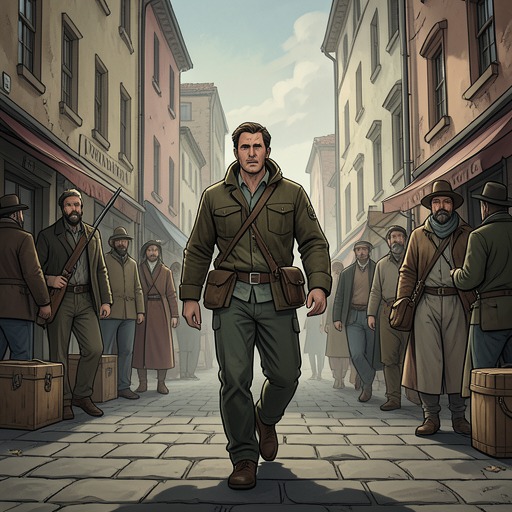
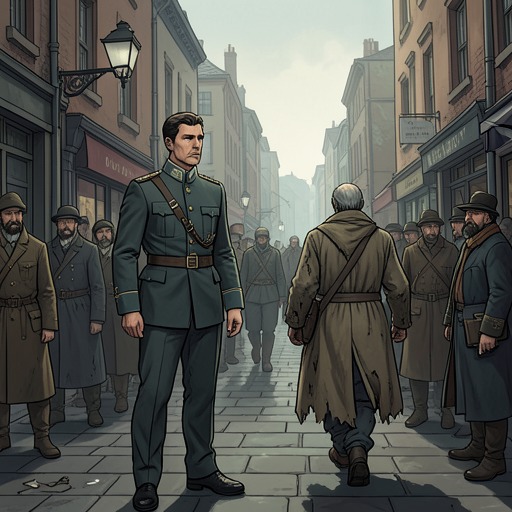
Faverolles, Jean Valjean's birthplace
Les MisérablesFaverolles, Jean Valjean's birthplace, is the rural setting of his childhood, family responsibilities, and first defining encounter with the law. A village of farm labor and precarious subsistence, it establishes the material hardship behind the bread theft that sends him into the penal system and shapes the course of his life.
Setting and Early Life
Jean Valjean was born into a poor peasant family in the Brie. He lost both parents while still young: his mother died after an illness, and his father, a tree-pruner like his son, died in a fall. Jean was raised by his older sister, who had seven children. When her husband died, Jean was twenty-five and took on the role of supporting the household that had once supported him.
He had not learned to read as a child. As an adult in Faverolles, he worked as a tree-pruner. The narrative presents him as quiet and unassuming, with little time for a life beyond labor and family duty. His years there are marked less by personal ambition than by the practical demands of keeping his sister and her children fed.
Work, Family, and Hunger
Tree-pruning brought Jean eighteen sous a day in season. He also hired himself out as a reaper, laborer, farmhand, and general worker, while his sister worked too. Their combined efforts could not reliably sustain seven children. A harsh winter left Jean without work and the family without bread, making the household's deprivation the immediate background to the theft.
The family’s hardship is shown through ordinary acts of care as well as scarcity. When the children secretly borrowed milk from Marie-Claude, a local farmer, Jean quietly paid for it behind his sister’s back so they would not be punished. The episode places his later crime within a pattern of taking responsibility for the children, even when he had little to give them.
The Bread Theft and Its Consequences
One Sunday evening in 1795, Maubert Isabeau, the baker on Faverolles’s church square, heard a blow against the barred and glazed front of his shop. A hand reached through the opening, seized a loaf, and carried it away. Isabeau pursued and caught the fleeing thief: Jean Valjean. He had taken the bread during a winter when his family had none.
Jean was tried for breaking into an inhabited house at night and stealing. The court found him guilty under the law and sentenced him to five years in the galleys. Faverolles is therefore not merely the place from which he comes; it is where a desperate act of subsistence becomes the legal beginning of a punishment that will follow him long after the original deprivation has passed.
Narrative and Social Significance
The village episode gives concrete form to the novel’s criticism of disproportionate punishment. Jean’s theft is presented against the needs of a household of seven children and a winter without bread, while the law responds with forced labor. The contrast makes the sentence appear not as a route back into society but as the start of a process that deepens the consequences of poverty.
That process extends beyond Faverolles. The novel describes the former convict’s marked passport, residence restrictions, and obligation to report to the gendarmerie when traveling; these controls expose him to suspicion and rejection. In the later Champmathieu case, the judicial system again risks sending an innocent man to the galleys through mistaken identification and an expedited proceeding. Read alongside those episodes, Jean’s prosecution in Faverolles establishes an early instance of the book’s wider concern: law can treat the conditions that produce a crime as irrelevant, while its punishment helps make exclusion and further wrongdoing more likely.