French Judicial System
Les MisérablesIn Les Misérables, the French Judicial System is more than a mechanism for trying and punishing offenders: it shapes who is believed, how punishment follows a person after release, and whether justice can correct its own errors. Victor Hugo presents it as capable of treating legal classification as a substitute for understanding, with consequences that reach from Jean Valjean’s sentence to Champmathieu’s near conviction and Javert’s crisis of conscience.
Institutional Critique
Hugo’s criticism concerns both the severity of punishment and the way legal institutions make decisions. He condemns a system that can act hastily and without sufficient attention to the person before it. Its authority is especially troubling when an error in identification is accepted as a basis for a major punishment: the machinery of law can approach an unjust outcome while following procedures that appear formally decisive.
The narrative connects this institutional failure to the social conditions surrounding punishment. Jean Valjean is sentenced after stealing bread to feed his family, whose poverty has left seven children without food. The theft involves breaking into a bakery, but the five-year sentence to the galleys places the crime within a severe penal regime. After four failed escape attempts, his sentence is extended until he has spent nineteen years in the penal system. The disparity between the original need and the prolonged punishment is central to Hugo’s challenge to the justice of the law.
Punishment Beyond the Sentence
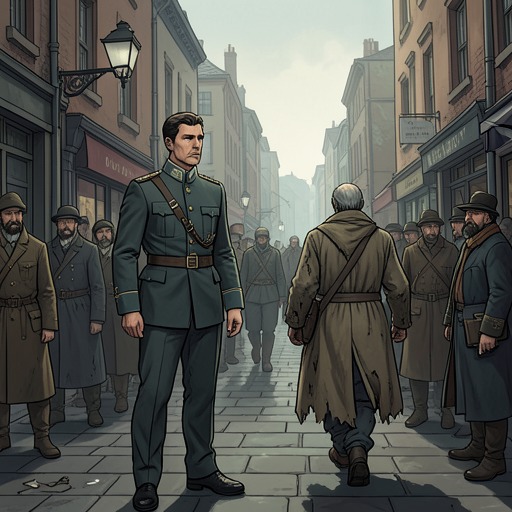
The system’s reach does not end when a prisoner is released. The novel’s account of former convicts describes a passport marked with the letter F, enforced residence restrictions, and a duty to report to the gendarmerie in each village crossed while travelling. Failure to comply makes the person liable to be pursued by the police. These controls make a former prisoner publicly identifiable and leave him exposed to rejection even after completing his sentence.
This continuing supervision turns punishment into a social condition rather than a period with a clear endpoint. In Hugo’s account, exclusion obstructs the possibility of returning to ordinary life and can help reproduce the conduct the law seeks to prevent. Jean Valjean’s early experience illustrates the point: after the penal system has marked him as an outsider, the reception he encounters makes legal status a barrier to acceptance. The institution’s effects therefore extend beyond a court’s ruling, shaping the social circumstances in which a former convict must live.
The Champmathieu Case
The case of Champmathieu makes mistaken identity the clearest test of the system’s reliability. Javert reports Jean Valjean to the authorities, while another man, arrested under the name Champmathieu, is treated as the true Jean Valjean and faces conviction. The discrepancy places two identities in direct conflict: the authorities’ identification of the accused and Jean Valjean’s knowledge that the accused is not him.
At the hearing in Arras, three former convicts testify that they recognize Jean Valjean in Champmathieu. Their identification lends apparent support to the accusation, and Champmathieu is on the verge of being condemned. Jean Valjean then reveals himself publicly. Champmathieu is acquitted, and Jean Valjean declares himself at the disposal of the police. The reversal prevents an innocent man from being punished, but it also reveals how close the court came to accepting a false identification as proof. The outcome depends not on the institution discovering its own error in time, but on the person whose identity is at stake intervening at personal cost.
Law, Authority, and Conscience
The novel also examines the law through Javert, whose understanding of authority is shaken when he releases Jean Valjean. Javert regards the act as a grave breach: he believes he has freed a repeat offender who has violated the conditions of his release and has taken from the law a man who belonged to it. His distress shows how deeply legal obedience has governed his sense of himself. Once his action contradicts that rule, the authority on which he has relied no longer gives him a stable reason for being.
These scenes distinguish institutional legality from moral judgment without making the conflict abstract. The Champmathieu hearing asks whether an official identification deserves trust when the accused is innocent; Javert’s reaction asks what happens when obedience to law no longer appears sufficient to determine the right action. Through both cases, Hugo represents justice as vulnerable to rigid categories, procedural error, and punishments whose effects outlast their stated term. The French Judicial System thus functions in the novel as both a structure of public authority and an object of sustained moral scrutiny.