Gillenormand
Les MisérablesM. Gillenormand is the fervent royalist grandfather whose decision to raise Marius apart from his father shapes the young man’s political inheritance and family loyalties. His household offers Marius an upbringing founded on principles opposed to those of George Pontmercy; when Marius finally asserts his father’s value, the disagreement becomes a personal break that sends him out of his grandfather’s home.
Identity and Family Background
M. Gillenormand is Marius’s maternal grandfather and the father-in-law of George Pontmercy. George, a hero of the Empire, had been made a colonel and baron by Napoleon, but Louis XVIII denied him those titles. After George’s wife died, M. Gillenormand took Marius from his father and raised him according to his own principles. He is identified as a fervent royalist, hostile to the political ideas of his son-in-law. The arrangement therefore separated Marius from his father while placing him in a household where the father’s politics and public reputation were resisted rather than affirmed.
This family history carries the weight of the novel’s turbulent political past. The broader account points to the consequences of the Terror for M. Gillenormand, while the conflict between him and George unfolds against the changing regimes associated with the Restoration and the Empire. The evidence does not specify the precise nature of that earlier consequence; what it makes clear is that political history is not remote background for this family. It has entered their relationships, their judgments of one another, and the terms on which Marius is raised.
Raising Marius and the Visit to Vernon
In 1827, when Marius had just reached seventeen, M. Gillenormand held a letter and told him that he would leave for Vernon the following day. The scene presents the grandfather directing the young man’s movements, but the surviving account does not state the purpose of the journey. It does establish the pattern of authority in the household: M. Gillenormand announces the decision, and Marius asks why.
The larger family arrangement explains the stakes behind that authority. M. Gillenormand has brought up Marius according to his own convictions after removing him from George’s care. Yet the father’s example remains capable of reaching the son. When Marius later learns that his father’s card identifies him as a baron, he does not treat the title as a mere social distinction. He answers that it means he is his father’s son. The inherited name becomes an assertion of kinship and allegiance, and it brings into the open the conflict that the grandfather’s upbringing had not erased.
Political Rupture
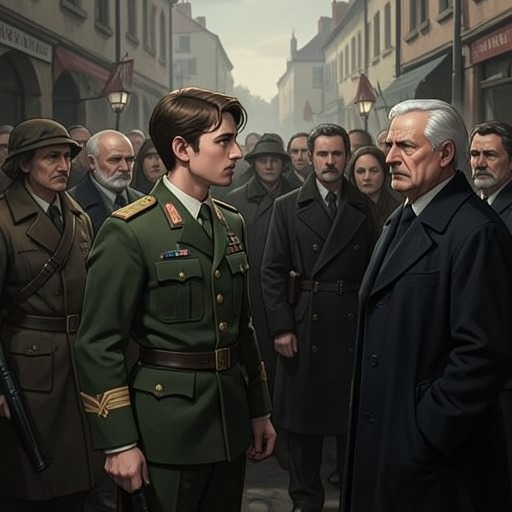
M. Gillenormand responds to Marius’s claim with a scornful greeting about his new baronial status. Once Marius begins praising George, the difference between the two men’s accounts of the past becomes irreconcilable. Marius describes his father as a humble and heroic man who served the Republic and France, endured years of military hardship, took two flags, received twenty wounds, and died forgotten and abandoned. He presents George’s one failing as having loved his country and his son too much.
M. Gillenormand refuses that portrait. He rejects Marius’s defense of the people who served the Republic, Robespierre, and Napoleon, condemns them as criminals and traitors, and accuses them of fleeing at Waterloo. His denunciation is not a measured disagreement over a title: it repudiates the political world in which George’s service acquired meaning. To Marius, that repudiation insults a dead father; to M. Gillenormand, the language of republican and imperial honor is intolerable. The argument turns a dispute over family history into a test of which loyalty Marius will defend.
Marius answers with an attack on the Bourbons and Louis XVIII. M. Gillenormand, who has first grown red with anger, turns pale and orders his grandson to go. The command ends the confrontation without reconciliation. Marius leaves the house, carrying thirty francs, his watch, and a few clothes in a travel bag. He does not know where he is going and takes a hired carriage toward the Latin Quarter at random. The practical details make the rupture concrete: political defiance costs him his home and leaves him with only what he can carry.
Narrative Role and Significance
M. Gillenormand’s role is grounded in the collision between family authority and political memory. He has raised Marius according to convictions opposed to George’s, but cannot prevent his grandson from identifying with the father he scarcely knew. The baronial card acts as the immediate prompt for that identification; Marius turns a disputed title into evidence of descent, then defends the man whose life the grandfather denounces. Their estrangement is thus not simply youthful rebellion against an elder. It is the consequence of two incompatible judgments about the same family history.
The novel’s wider treatment of social exclusion offers a contrast, not a direct episode in M. Gillenormand’s plot. Former convicts, including Jean Valjean, remain marked by their past through legal controls and public rejection; M. Gillenormand’s conflict with Marius instead turns on political allegiance, inherited reputation, and the authority of the family household. In both strands, however, a person’s place in society is shaped by labels attached to the past. M. Gillenormand’s denunciation of George’s political generation cannot settle what that history means to Marius. It drives the younger man away, and the household’s attempt to define his inheritance gives way to his choice to claim his father.