Insurgés de la barricade de la rue de la Chanvrerie
Les MisérablesThe Insurgés de la barricade de la rue de la Chanvrerie are a republican insurgent group fighting government forces in Paris during the popular uprising of June 5, 1832. Their story gives collective form to resistance under extreme military pressure: a small band holds the barricades, improvises ways to protect its members, and continues to fight as the prospect of defeat grows increasingly clear.
Formation and position
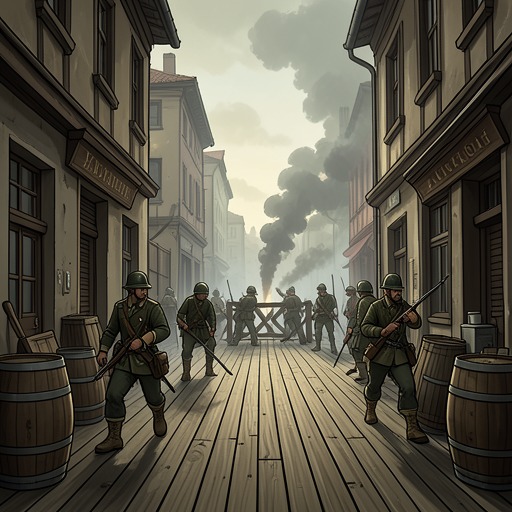
The uprising gathers force across the capital, and Marius is summoned to join his friends at the Chanvrerie Street Barricade. Among those expected to fight are Courfeyrac, Bossuet, Combeferre, and their leader, Enjolras. Gavroche is also among the insurgents. The group is presented not as a large army but as a handful of men drawn into an expanding popular revolt against the regime.
Nightfall makes the imbalance plain. The insurgents hear confused rumors and occasional, distant gunfire, but the relative quiet is not relief: it signals that the government is taking time to assemble its forces. Fifty men wait for sixty thousand. The stark disparity defines the group’s situation, turning the barricade into a position held against an enemy expected to arrive in overwhelming numbers.
Organization under pressure
The insurgents’ preparations are practical and shaped by the needs of particular people. Uniforms taken from dead National Guards are intended to let married men and fathers cross the enemy lines and escape. But there are only four uniforms for five men, leaving the group with an immediate shortage and a choice it cannot fully solve by disguise. The detail shows the defense working not only as a fighting force but also as a means of making escape possible for some of those trapped within it.
Enjolras acts as a leader in both preparation and security. When Inspector Javert is identified among those present, Enjolras signals four men, who seize, overpower, bind, and search him before he can turn around. The rapid capture exposes the danger of an infiltrator inside the insurgents’ position. Javert’s identification card confirms that he is a police inspector; the insurgents leave his watch and purse with him, but keep him tied to a post. Men from both barricades hurry over when the capture becomes known, showing how quickly news and people move through the defense.
Gavroche and the struggle for ammunition
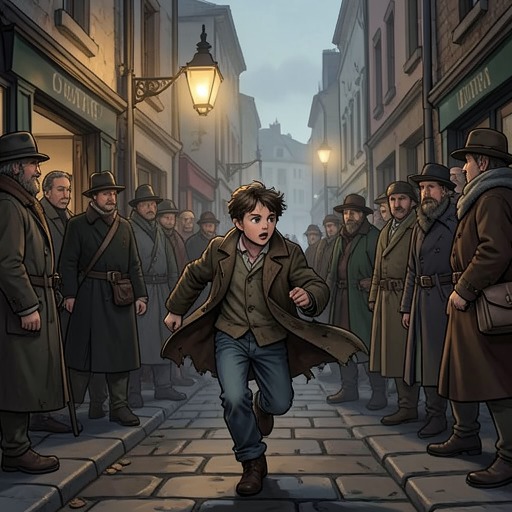
Gavroche’s presence connects the barricade’s resistance to the vulnerability of children living beyond the protection of family. About eleven or twelve years old, he has been dressed in cast-off clothing given by strangers and neglected by both parents; the street, the narrative observes, is less hard to him than his mother’s heart. At the barricade, this abandoned child becomes an active participant in the fight rather than a spectator to it.
While the insurgents wait in the dark, Gavroche makes cartridges in the lower room by the dim light of two candles, carefully kept from shining outside because powder is scattered across the tables. Later, under fire, he slips out to gather ammunition. He empties cartridge boxes and fills his basket while soldiers and National Guards repeatedly aim at him. He dodges, hides, and returns, answering the shots with songs and defiant gestures as the insurgents watch anxiously from the barricade.
The repeated evasion ends when a bullet strikes him. Gavroche staggers and falls, then manages to sit upright, blood running down his face, and raises both arms toward the direction of the shot. The barricade’s collective resistance is thus rendered through an individual act that is at once useful and perilous: the boy helps replenish the fighters’ ammunition, but his smallness and agility cannot keep him safe indefinitely.
Collective resistance and narrative significance
The group’s actions combine armed resistance, internal security, and attempts to save fellow defenders from capture. Its members respond to a rapidly worsening military situation with limited resources: a shortage of escape uniforms, a hidden workroom for making cartridges, and the capture of a police inspector within their ranks. These details make the barricade less a symbol detached from practical circumstances than a precarious organization sustained by decisions made under pressure.
The insurgents’ numerical isolation is set against the scale of the state response, while Gavroche’s movement between the defended position and the exposed street gives that imbalance a human measure. The group’s story places collective political action alongside the uneven personal costs of sustaining it: some men may escape in borrowed uniforms, Javert is bound as a suspected infiltrator, and a neglected child risks himself to bring ammunition back to the fighters.