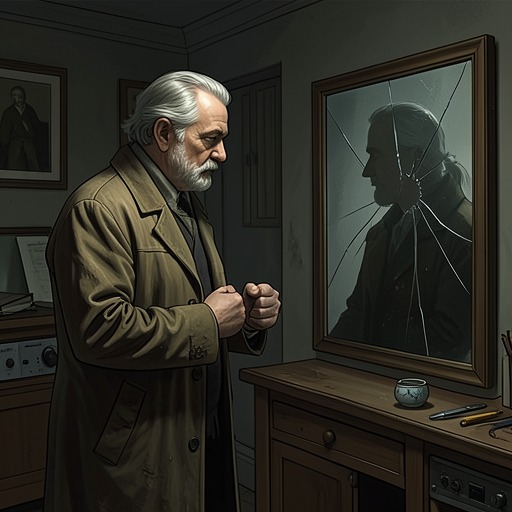
Jean Valjean
Les MisérablesJean Valjean is the central figure in a story that connects extreme poverty and punishment with the possibility of moral change. A laborer from Faverolles, he steals a loaf of bread when his sister’s seven children have nothing to eat and is sentenced to the galleys. Nineteen years of imprisonment follow. After his release, the stigma of his yellow passport makes even ordinary shelter difficult to obtain. His life thereafter is marked by a persistent tension: society identifies him with his conviction, while he struggles to act according to a conscience that the law and his past cannot define for him.
Identity and Early Life
Valjean comes from a poor peasant family in the Brie. He loses both parents young: his mother dies after an illness, and his father, a tree-pruner like him, dies in a fall. His widowed elder sister raises him alongside her seven children. When her husband dies, Valjean, then twenty-five, takes on the role of provider for the household that had once cared for him.
His work is hard and poorly paid. During the pruning season he earns eighteen sous a day; at other times he hires himself out as a reaper, laborer, farmhand, or general worker. He has little time for a life beyond labor and family duty. At meals, he silently lets his sister take the best portion from his bowl for one of her children. When the children secretly obtain milk from a neighboring farmer, he pays for it behind their mother’s back so they will not be punished. These small, unannounced acts of care precede the more consequential choices that later define him.
The household’s poverty becomes acute in a harsh winter, when Valjean cannot find work and the family has no bread. One Sunday night in 1795, he breaks the gridded window of a bakery in Faverolles, reaches inside, and takes a loaf. The baker catches him as he flees; Valjean has dropped the bread, and his arm is bleeding. He is tried for nighttime breaking and entering and theft. The account places the offense beside the family’s immediate hunger: the law names the act and imposes its penalty, while the circumstances show how deprivation narrowed his choices.
Imprisonment and the Encounter with Mercy
Valjean is initially sentenced to five years in the galleys. He attempts to escape four times; each failed attempt lengthens his punishment, until he has spent nineteen years in the Toulon Bagne. Released only four days before he reaches the town where he seeks lodging, he has walked twelve leagues that day. He explains that inns have turned him away because of his yellow passport, the prison gatekeeper has refused him, and even a dog’s shelter has not offered refuge. He has money saved from his labor in prison, but payment cannot overcome the rejection attached to his identity as a former convict.
Bishop Myriel responds to this account by ordering an additional place set at the table. The contrast is decisive: Valjean has described a sequence of doors closed against him, and the bishop answers with hospitality rather than another demand that he prove himself. Later, when gendarmes bring Valjean back with the bishop’s silver, Bishop Myriel claims that the silver was given to him and asks why he did not also take the silver candlesticks. Valjean looks at him in stunned silence. The bishop’s action does more than avert an immediate arrest; it offers Valjean a form of trust he has not received from the institutions and strangers he has encountered.
After this encounter, Valjean tries to become an honest man. His effort does not erase the past or allow him to live openly under his original identity. He assumes other names, among them M. Madeleine and Ultime Fauchelevent. The names allow him to move through society, but his concealed identity remains a source of moral pressure rather than a settled escape from his history.
Public Life and the Crisis of Conscience
Under the name M. Madeleine, Valjean arrives in a small town with little more than a worker’s clothes, manner, and speech. On the evening of his arrival, a fire breaks out at the town hall. He enters the burning building and saves two children, who happen to be the children of the captain of gendarmes. In the confusion, no one asks for his passport. The incident precedes the discovery of his name and his public identity as Father Madeleine. His later prosperity, built from a modest capital through ingenuity, order, and thought, becomes connected not only to his own fortunes but to those of the town.
That public life eventually collides with the danger of an innocent man being accused in his place. Valjean spends a night wrestling with whether to disclose who he is, knowing that doing so will undo his life as M. Madeleine and may leave the ailing Fantine without the help he has promised. At first he burns his old convict belongings and considers destroying the silver candlesticks. The objects associated with his past therefore carry opposite meanings: they recall the convict he was, but also the mercy that set his attempt at change in motion. His crisis is not simply whether to preserve a disguise; it is whether self-protection can be reconciled with responsibility for another person.
When Inspector Javert comes to Fantine’s bedside, Valjean rises and calmly tells her that the inspector has not come for her. The reassurance places her immediate fear beside the danger closing around Valjean himself. He does not let that danger prevent him from acting to protect her. In this scene, his changed conduct is expressed through a quiet gesture of care, not through a claim that his past has disappeared.
Cosette and the Practice of Care
Valjean’s relationship with Cosette gives his life a sustained personal bond. He encounters her as a child carrying a heavy bucket through the woods at night. Without speaking, he takes the handle and carries it beside her; she does not fear him. The intervention begins as practical help, but it leads into a larger change in his emotional life. The morning after she comes into his care, he waits beside her bed and watches her wake. The narrative presents this as something new entering his soul: before Cosette, he had not been a father, lover, husband, or friend, and even the memories of his sister’s family had faded.
Valjean later makes a home for Cosette under the name M. Fauchelevent. In October 1829 he rents a secluded house on Rue Plumet, restoring its passageway and making repairs before moving in quietly with Cosette and Toussaint, an elderly servant whom he has rescued from the hospital and poverty. His assumed name and discreet arrival show how carefully he protects the life he has made, but the household also gives that life a concrete purpose: he provides Cosette with a home and remains her adoptive father.
Rescue, Disclosure, and Narrative Significance
At the barricade, Valjean does not distinguish himself through attacks. He tends the wounded, carries those who fall to a lower room for care, and repairs the barricade between periods of fighting. When Marius is struck down, Valjean catches him and carries him away; Marius becomes, in effect, Valjean’s prisoner because the rescuer has taken charge of his unconscious body. Valjean then bears him through the sewers. Marius later understands the scale of this rescue and recognizes that Valjean also freed Inspector Javert. His gratitude reframes Valjean not as an obstacle to his life with Cosette but as the person who made that life possible.
The day after Cosette’s wedding, Valjean tells Marius directly that he is a former convict. Marius initially cannot absorb the admission and sees the pallor and frightening appearance of the man before him. The disclosure puts the concealed identity, which Valjean has managed through successive names, into the open at a moment when he might have continued to withhold it. Later, Marius connects the missing letter sent through Little Gavroche with Valjean’s arrival at the barricade, his rescue of Inspector Javert, and the journey through the sewer. He concludes that Valjean carried him through danger so that he could return to Cosette, and insists that they must go to him.
Valjean’s trajectory is built from reversals that do not cancel one another: the bread theft is both a crime and the outcome of a family’s hunger; the former convict becomes a benefactor without escaping the stigma of conviction; and the man who once found every door closed becomes a source of shelter and rescue for others. His care is repeatedly practical—food, a place at the table, a hand on a bucket, a home, a carried wounded man. Those acts give moral change its measure, while his eventual confession shows that responsibility includes telling the truth about the identity he has spent years concealing.