Jean Valjean dies after reconciling with Marius and Cosette
Les MisérablesJean Valjean dies after a long-awaited reconciliation with Cosette and Marius Pontmercy, turning his final hours into an act of recognition, forgiveness, and farewell. His death gathers the private bonds that have shaped his life: Cosette returns as the child he raised, Marius comes to accept him, and Jean Valjean, at last able to speak to both, gives them his blessing and asks that they remember the woman who gave Cosette life.
Return and reconciliation
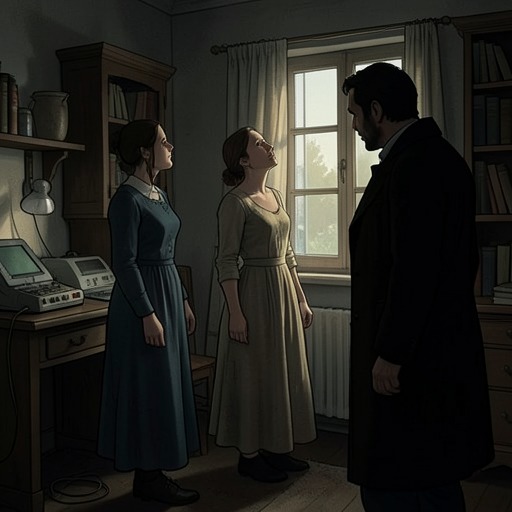
Cosette rushes into the room, while Marius remains at the threshold, standing against the doorframe. Jean Valjean rises from his chair with his arms open and trembling. His face is pallid and bewildered, but immense joy shines in his eyes. Cosette, overcome, falls against his chest and calls him father. He clings to her and asks whether she forgives him. The question makes their reunion more than a return to affection: it shows that he has felt her absence as a wound and fears that he has lost his place in her life.
Marius steps forward with tears he struggles to hold back and addresses Jean Valjean as his father. Jean Valjean understands that this, too, is forgiveness. He thanks Marius, receiving the recognition he had long been denied. The emotional reversal is immediate: the two people he most loves are present together, and the distance between them has given way to a family bond acknowledged aloud.
Cosette tries to restore a future around him. She describes the room waiting for him at their home and the garden, where the paths are covered with river sand and small violet shells. She promises him strawberries from the plants she waters and a plot of his own to cultivate. Her cheerful plans include ordinary domestic pleasures and a teasing new equality in the household. Jean Valjean listens less to the sense of her words than to the music of her voice. A tear slowly gathers in his eye; to him, her presence is proof that God is good.
The last practical concerns
The reunion does not conceal Jean Valjean’s condition. He tells Cosette and Marius that he is about to die, and both recoil at the news. During a later lull in his agony, he briefly regains his composure and kisses a fold of Cosette’s sleeve. He then explains what had troubled him: Marius had refused to touch the money Jean Valjean regards as Cosette’s. His explanation is specific, not merely a declaration that the fortune is honest. Black jet came from England, white jet from Norway, and a paper among his belongings records the details. He describes improving the construction of the bracelets’ clasps, replacing one method of soldering with a cheaper and better one. He wants Marius to understand that Cosette’s wealth came from work and trade, and that she may accept it without misgiving.
Even at the edge of death, he attends to the future he will not share. He urges Cosette and Marius to live happily, to receive friends, and to enjoy the comforts their money can provide. He also leaves Cosette the two silver candlesticks on the mantelpiece. Their material is silver, but their value to him is immeasurably greater: the candles placed in them seem to him like votive lights. His bequest carries his gratitude for the mercy once shown to him and passes that memory into the home Cosette and Marius will share.
Memory, kinship, and forgiveness
Jean Valjean’s final speech moves between practical advice and remembered scenes. He asks for a plain burial beneath a stone without his name, and says that he would be glad if Cosette or Marius occasionally came to visit. He acknowledges that he did not always love Marius, then asks his pardon; now, he says, Cosette and Marius are one to him. Marius has made Cosette happy, and that happiness has become Jean Valjean’s own measure of contentment.
He turns to Cosette’s childhood, recalling Montfermeil, where she had been frightened in the woods and he first took the handle of her water bucket. He remembers her cold little hand, the large doll she called Catherine, the straw boats she launched in streams after rain, and a racket and shuttlecock he gave her. These details make the loss he faces inseparable from the life they built together: the child he once protected has grown beyond his care, but those shared moments remain his to give back to her in words. He recognizes that he had mistakenly imagined the woods, walks, games, and laughter belonged to him. His farewell accepts that love does not make another person one’s possession.
He also tells Cosette her mother’s name for the first time in this final reckoning: Fantine. He asks Cosette to remember the name and honor it, explaining that Fantine suffered greatly and loved her deeply. He frames their unequal lives—Fantine’s suffering and Cosette’s happiness—as part of a providential order, while making clear that Cosette’s good fortune rests on a mother’s sacrifice. He asks the couple to forgive the Thénardiers for their cruelty, extending mercy even toward those who mistreated Cosette.
Death and final image
As his strength ebbs, Jean Valjean tells Cosette and Marius that he will not be far away and asks them to think of him sometimes. He speaks of light, asks them to bring their beloved heads close, and blesses them with his hands. Cosette and Marius kneel, overcome with tears, each beside one of his hands. They cover those hands with kisses, but the hands no longer move.
The two candlesticks illuminate Jean Valjean’s pale face as he lies back, looking toward the sky. He dies with Cosette and Marius beside him, the objects he leaves behind still shining in the room. His requested anonymity contrasts with the intimacy of this final scene: he seeks no name on his grave, yet his last hours preserve his identity through the forgiveness he gives, the memories he shares, and the family that gathers around him.