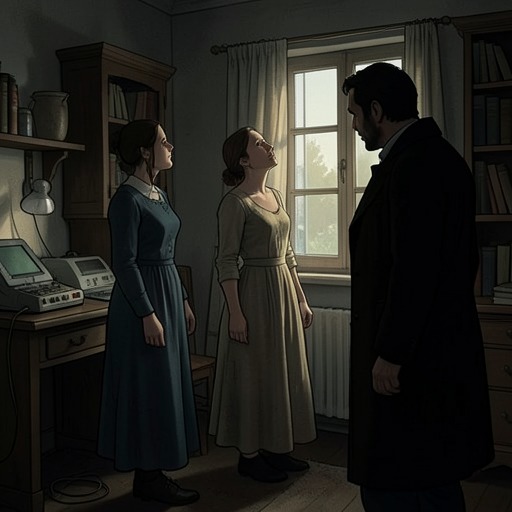
Jean Valjean rescues Cosette from the Thénardiers
Les MisérablesJean Valjean rescues Ursule from the Jondrettes by meeting her at her most exposed: alone in a winter wood, carrying water under threat of punishment, and unable to imagine that an adult might help without demanding something in return. His intervention unfolds through small, material acts—a hand taking the pail, money substituted for a missing coin, and a great doll placed before her—before becoming a departure from Montfermeil. The rescue is decisive not because Ursule can immediately understand where she is going, but because someone finally acts against the conditions that have made fear and obedience the limits of her world.
The child alone in the winter wood
Ursule is eight years old and far from human company when the scene begins. The darkness of the forest overwhelms her with a fear she can scarcely name; for a moment, she feels drawn to return there at the same hour the next day. She counts aloud to ten, then begins again. The counting restores her awareness of ordinary things, including the cold in her wet hands, but it cannot remove her fear. She thinks only of fleeing toward houses, windows, and lit candles.
Even escape is constrained by the Jondrettes’ power over her. Ursule will not run without the water pail because she fears what La Thénardier will do if she returns without it. The full pail is so heavy that she can carry it only in stages. Its iron handle numbs and freezes her wet hands; water spilling over the rim runs down her bare legs whenever she stops. Bent forward under the weight, she looks like an old woman, although she is a child of eight, alone in the woods at night in winter. The narration fixes the ordeal in these concrete details: carrying out an assigned task is not protection from punishment, but the condition she must satisfy even while terrified.
She is exhausted and still has not left the forest. Near a familiar old chestnut tree, she rests longer than before, gathers her strength, lifts the pail again, and cries out to God. At that instant, the weight disappears. A large hand has seized the handle and raised it; a tall, dark figure walks beside her. The abrupt easing of the load changes the encounter before she knows who the stranger is. Though she had been terrified by the darkness around her, she is not afraid of this man.
Help tested against the threat of punishment
The stranger speaks quietly and observes that the pail is too heavy for her. When he offers to carry it, Ursule lets go, and he walks alongside her with the burden. His help is practical and immediate, but it does not erase the danger governing her choices. He asks who sent her into the woods for water at that hour, and she answers that La Thénardier did. The answer identifies the authority behind the errand and makes plain why a simple act of assistance cannot be separated from the prospect of retaliation.
Near the inn, Ursule asks to take the pail back. Her reason is precise: if La Thénardier sees someone else carrying it, she will beat her. Jean Valjean returns it, and they continue to the door. That decision respects the child’s knowledge of the danger inside the house. He does not insist that accepting help has made her safe; Ursule must still face the woman who can punish her. The episode shows how completely fear has shaped her practical judgment: even kindness must be concealed if it is to avoid provoking further violence.
Inside, another accusation brings the threat into the open. La Thénardier claims Ursule has lost a fifteen-sous coin and reaches for the whip hanging by the fireplace. Ursule cries for mercy, while the other travelers drink or play cards and pay no attention. Jean Valjean has quietly searched his waistcoat pocket. He intervenes by saying that he saw something fall from the child’s apron and roll on the floor, then bends as though to look for it. He presents La Thénardier with a silver coin worth twenty sous. It is not the missing coin, but she accepts it because it benefits her, puts it in her pocket, and limits herself to a fierce warning. The substitution turns money into an instrument of protection: it interrupts the threatened beating without requiring Ursule to challenge the accusation herself.
The doll and the first experience of being chosen
The rescue reaches beyond the immediate danger of the whip when Ursule touches the great doll displayed in the inn. She sets it gently on the ground, looking at it with reverence and despair; then she clasps and twists her hands and begins to sob. The day’s earlier ordeals—the run through the wood, the pail, the missing money, the whip, and La Thénardier’s harsh words—have not made her cry. The doll does. Her response registers the depth of a deprivation that punishment alone cannot explain: the sight of a beautiful toy brings into view what she has been denied.
La Thénardier treats the child’s touch as an offence, calling attention to Ursule’s dirty hands and the doll as the supposed object of her wrongdoing. Jean Valjean challenges the disproportion of the accusation, asking in effect what harm there would be if the child played with it. La Thénardier orders Ursule to be quiet. Jean Valjean then goes out through the street door. His absence gives La Thénardier the chance to kick Ursule under the table, making the violence that has been threatened at the fireside an immediate fact.
He returns carrying the splendid doll in both hands and sets it upright before Ursule, giving it to her. The doll had been visible through the inn’s window from a brightly lit toy shop, whose lamps and candles made it stand out like an illumination. For Ursule, the gift arrives with almost incomprehensible force: she looks from the man to the doll, then retreats beneath the table and hides in the corner. Her recoil does not cancel the gift’s importance. It shows how unfamiliar generosity is to a child accustomed to punishment, and how difficult it is for her to trust that something desirable can truly be hers.
Departure from Montfermeil
The following morning, Jean Valjean offers to take Ursule away, and the Jondrettes agree in exchange for money. At daybreak, people opening their doors in Montfermeil see a poorly dressed man leading a little girl dressed in mourning, the pink doll in her arms. They are heading toward Livry. The girl, no longer in rags, is scarcely recognized by many of those who see her. The contrast between her worn former clothing and her changed appearance makes the departure visible to the town, even as the child herself has little information about what it means.
Ursule does not know who the man is or where he is taking her. What she understands is that she is leaving the Jondrette inn behind. No one has thought to say goodbye to her, and she has not said goodbye to anyone there; the departure is from a household in which, as the narration puts it, she has been both hated and made to hate. The rescue therefore does not close with a tender farewell or an explanation. Its first promise is simply that she will no longer remain under that roof.
As she walks, Ursule looks solemnly at the sky. A louis lies in the pocket of her new apron, and she glances at it from time to time before looking at Jean Valjean. The money, the new clothes, the doll, and the man leading her are tangible signs of a change she cannot yet fully interpret. The story associates her feeling with being near God, but preserves her uncertainty about the destination. The rescue is at once material and relational: Jean Valjean has paid to take her away, but the decisive change is that the child who carried a heavy pail through the dark is now walking beside someone who has chosen to carry part of her burden.