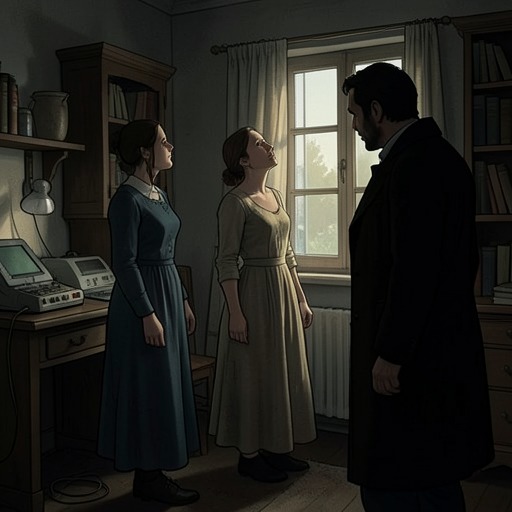
Jondrette
Les MisérablesJondrette, also known as Thénardier, is a tavern keeper and criminal patriarch whose apparently separate connections to Cosette and Marius become parts of the same plot. His family takes Cosette in for money and mistreats her; later, under the name Jondrette, the family plots against Jean Valjean. Marius becomes a witness to that scheme while seeking the man he believes saved his father. The revelation that these strands lead back to Thénardier turns a seemingly marginal family into a hinge of the novel’s interlocking narrative.
Identity and Background
In 1818, Jondrette and his wife keep an inn in Montfermeil, in the lane called ruelle du Boulanger. Its sign depicts a man carrying a wounded figure in a general’s uniform, amid painted blood and smoke, and identifies the establishment as the Sergeant of Waterloo. The sign gives the inn a public identity built around a battlefield image; later, Waterloo will also matter to Marius, who is searching for the former soldier he believes rescued his father there.
Jondrette’s identity is not confined to the innkeeper’s name. When his family later lives in severe poverty, he rents a room under the name Jondrette and tells the building’s caretaker that anyone asking for a Polish, Italian, or Spanish man should be directed to him. These proposed national identities make concealment part of his ordinary dealings. The contrast between the named inn and the shifting identities of the later lodger marks the distance between his public presentation and the evasions through which he operates.
Cosette and the Inn at Montfermeil
Cosette’s mother, unable to take her daughter with her while looking for work, sees Jondrette’s young daughters at the inn and asks the couple to board the child for payment. Jondrette and his wife agree. The arrangement is presented as care, but the family mistreats Cosette and forces her, despite her very young age, to do exhausting work. Their acceptance of the arrangement therefore becomes the start of a sustained exploitation, not a temporary refuge.
The financial arrangement reaches beyond the initial agreement. Cosette’s mother earns too little, her debts mount, and the Thénardiers repeatedly send letters that distress her and cost her money to receive. One demand says that Cosette needs a wool skirt against the cold and asks for ten francs. In response, her mother sells her long blond hair. The letter gives a precise measure of the pressure exerted by the household: the child’s supposed needs are used to extract money, while the mother bears the cost through successive sacrifices.
The relationship changes when a poorly dressed man offers to take Cosette away. Jondrette accepts compensation. At daybreak, the man leaves Montfermeil holding the hand of the small, mourning-clad girl, who carries a pink doll. This departure ends the Thénardiers’ direct custody of Cosette, but it does not erase the harm or the financial demands that preceded it. The contrast between her black clothing and the doll’s bright color makes the child’s vulnerability visible at the moment she leaves their care.
The Jondrette Household and Criminal Plot
Later, the family appears under the name Jondrette in a state of extreme destitution. The father, mother, and two daughters share a cramped attic room. The family’s poverty is not presented as evidence of innocence: the same household is also associated with a gang of criminals and a trap planned against Jean Valjean, then known to the family as M. Leblanc. The scheme makes the name Jondrette more than a disguise; it is the identity under which the family’s criminal activity reaches the novel’s central plot.
Marius is the neighbor who witnesses the attempt against Jean Valjean. He is also looking for Thénardier, the former soldier he wants to thank for saving his father. The two motives pull him in opposite directions: he may try to help the apparent victim, but doing so risks exposing the man he believes owes him a debt of gratitude. Jondrette’s concealed identity makes that conflict possible. What first seems to be an isolated crime in a poor lodging brings together Marius’s family history and Jean Valjean’s continuing effort to evade pursuit.
Family Ties and Narrative Function
Jondrette’s household is important not only because it shelters a criminal scheme, but because its members affect Marius in sharply different ways. His daughter Éponine loves Marius without telling him. She helps him find the woman he loves and ultimately sacrifices herself for his happiness, both by giving up the hope of being loved in return and by dying in his place. Her actions stand in stark contrast to the exploitative conduct associated with her family: where the household turns relationships into opportunities for money or criminal advantage, Éponine gives up what she wants for another person.
The novel gradually reveals how these parts fit together. Jondrette’s family, the plot against Jean Valjean, Éponine’s devotion, and Marius’s search for his father’s supposed rescuer are not disconnected episodes. The reader and Marius discover that Jondrette is Thénardier, the man Marius has been seeking. By distributing this information before bringing the strands together, the narrative makes recognition itself consequential: Marius must confront the conflict between helping Jean Valjean and declining to denounce the man he believes saved his father.
Jondrette consequently links the domestic exploitation of Cosette to the criminal intrigue witnessed by Marius, while the aliases and delayed recognition give those connections their force. His part in the novel is less a single, isolated episode than a chain of returns: the inn at Montfermeil, the letters that drain Cosette’s mother, the family’s impoverished lodging, and the trap for Jean Valjean all disclose different aspects of the same household. What appears incidental at first becomes essential as the plots converge.