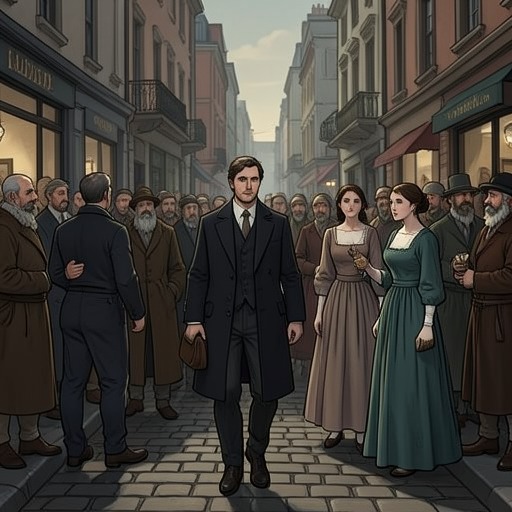
La lettre d’adieu de Marius à Cosette
Les MisérablesLa lettre d’adieu de Marius à Cosette is a farewell written under the pressure of a mistaken finality: Marius believes that marriage is impossible, that Cosette is leaving, and that he has no future with her. Intended to explain his death to Cosette, the folded, unsealed note instead reaches Jean Valjean, whose reading turns it into a test of whether he will put his own possessive hopes above Cosette’s knowledge and grief.
Composition and Intended Message
Marius writes the letter after reading Cosette’s message that her father wants them to leave immediately: they will be at Rue de l’Homme-Armé, number 7, that evening, and in London eight days later. The news briefly gives him reason to think he should live. But he returns to despair, reasoning that Cosette is departing and that his grandfather refuses their marriage. He concludes that two duties remain: to tell Cosette he is going to die, and to send a final farewell.
The note is written in pencil on a sheet torn from the portfolio that had held Marius’s notebook of thoughts about Cosette. Its message gives the reasons he thinks their marriage cannot happen: his grandfather has refused, and neither he nor Cosette has a fortune. He says he went to find her but did not find her, recalls the promise he had made, and declares that he is keeping it by dying. He assures her of his love and imagines that, when she reads the note, his soul will be near her and smile. The tender promise of spiritual closeness is thus inseparable from the letter’s devastating claim that he will no longer be alive.
An Unsealed Farewell
Marius has nothing with which to seal the paper. He folds it into four and addresses it to Mlle Cosette Fauchelevent at M. Fauchelevent’s house, Rue de l’Homme-Armé, number 7. The precise address makes the note a practical message as well as a declaration: it is meant to find Cosette at the place where her father has taken her. Yet its folded, unsealed form leaves the farewell exposed to interception, and the text shows Jean Valjean reading it instead of Cosette.
After writing the letter, Marius pauses, opens his portfolio again, and adds another message on its first page. This separate note identifies him as Marius Pontmercy and asks that his body be taken to his grandfather, M. Gillenormand, at Rue des Filles-du-Calvaire, number 6, in the Marais. The two writings have different intended tasks: the folded sheet is an intimate farewell to Cosette, while the words in the portfolio give instructions for his corpse. Together they show how completely Marius has begun to organize the aftermath of a death he expects, even as the farewell addresses the person he loves.
Jean Valjean’s Reading
Jean Valjean returns with Marius’s letter and reads it alone at home. He moves quietly through the dark, checks that Cosette and Toussaint appear to be asleep, and struggles to light a candle because his hand is trembling. The scene places the note within a clandestine act of reading: before he knows its contents, Jean Valjean is already aware that what he has done carries the quality of theft.
The narration describes how violent emotion can overwhelm ordinary reading: the reader clutches and wrinkles the paper, rushes between its ending and beginning, and grasps only the essential. Jean Valjean fixes on Marius’s declaration that he is dying and that his soul will be near Cosette. The lines produce an abrupt reversal in him. He experiences Marius’s death as the disappearance of the man who obstructs his own future with Cosette, and briefly exults that the rival may be removing himself without Jean Valjean having caused it.
His reaction depends on reading the letter selectively. Marius’s words are a farewell shaped by love and despair; Jean Valjean first receives them as news that Cosette may again be his alone. He calculates that Marius is probably not yet dead, but reasons that the young man is caught up in the fighting at the barricade and is unlikely to escape. The letter therefore does more than report Marius’s intention: in Jean Valjean’s fevered interpretation, it offers the possibility that events will accomplish what he has not done himself.
Concealment and Consequence
Jean Valjean considers keeping the note in his pocket so Cosette will never learn what became of Marius. That decision would suppress both the farewell and the knowledge that Marius loved her and believed himself about to die. The letter’s intended intimacy is consequently placed in direct conflict with Jean Valjean’s wish to preserve his exclusive life with Cosette. His first response is not to deliver the message but to imagine a future in which she remains ignorant.
The exultation does not hold. Jean Valjean becomes sombre, wakes the porter, and, about an hour later, leaves in a complete National Guard uniform with a loaded rifle and a cartridge box. The letter thus marks a turning point in his immediate conduct: after contemplating concealment and the benefit of Marius’s possible death, he goes out armed toward Les Halles. The evidence establishes that change of direction, but does not show the note being delivered to Cosette. Its dramatic force lies in the gap between the farewell Marius carefully composed for her and the secret, self-interested meaning Jean Valjean first imposes upon it.