Ursule
Les MisérablesUrsule’s story turns on a passage from abandonment to attachment: treated as a burden in childhood, she is rescued by Jean Valjean and discovers in him the first person she can love. The contrast between her fear in the forest, her delight in a doll, and her later appearance as a fifteen-year-old makes her changing capacity for happiness visible in small, concrete scenes.
Identity and Early Life
Ursule is not yet three when her name and age are discussed, and the narrative later shows her growing up under the authority of Jondrette and La Thénardier. Her mother has left her while she is so young that she cannot remember her. In the household where she is raised, the adults, their children, and other children all reject her attempts to love them. She does love a dog, but it dies; after that loss, no one seems willing to accept her affection. By eight, she has what the narrative calls a cold heart—not through any lack of capacity for love, but because she has been denied the conditions in which love could take root.
That deprivation is made physical in the Christmas episode. Sent out after dark to fetch water and bread, Ursule is entrusted with a fifteen-sou coin for the baker. She goes to a spring in a dark, frightening forest, where the coin falls into the water without her noticing. Tired and afraid of both the woods and the beating she expects from La Thénardier, she struggles onward with the bucket, pausing to recover her strength. Her distress is so great that she calls on God, yet she still forces herself to continue.
Rescue and a New Attachment
As Ursule walks, an unfamiliar man silently takes the bucket’s handle and carries it beside her. The decisive gesture precedes any explanation: the weight she has been struggling with suddenly disappears, and the stranger does not first demand anything from her. When he asks her name and hears that she is Ursule, he reacts with a visible shock, then takes up the bucket again. The recognition suggested by that response is not explained in this scene, but it marks the moment when her name connects her to the man who will take responsibility for her.
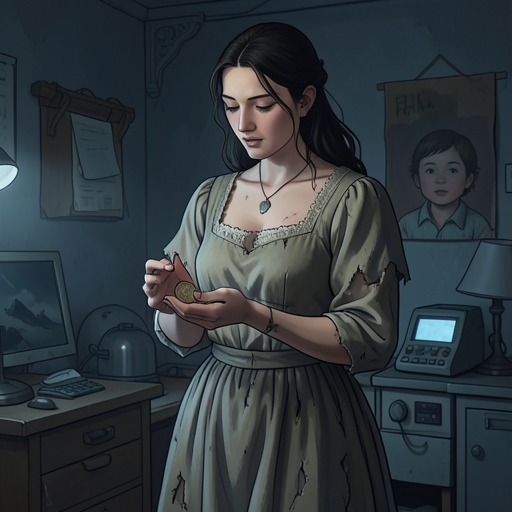
At the inn, the child remains vulnerable even in the stranger’s presence. When he leaves the room, La Thénardier uses his absence to kick Ursule beneath the table, making her cry out. The man returns carrying the remarkable doll that children in the village had been admiring all day and sets it before her as a gift. The doll gives the rescue a form Ursule can understand: a possession of her own, offered freely rather than withheld or used to control her. In the days that follow, she is absorbed in the new wonder of it.
Her bond with Jean Valjean develops from this welcome into a relationship she can name. She calls him father and knows him by no other name. She had tried to love before and been repeatedly rebuffed; now, for the first time, she experiences an inward opening. Jean Valjean, in turn, spends hours watching her dress and undress the doll and listening to her chatter. Her presence makes the future seem worth living through to old age, and he imagines that his life will be illuminated by her. His attachment is not presented as entirely selfless: he sometimes takes a private, almost guilty pleasure in imagining that she may grow up plain, so that he need not fear losing her to the world.
Protection and Concealment
Jean Valjean’s effort to protect Ursule also places their new family under pressure. When he suspects that Inspector Javert is watching him, he flees with her. Their flight ends at the Petit-Picpus Convent, where the gardener, Old Fauchelevent, recognizes Jean Valjean and conceals him by presenting him as his brother. Ursule enters the sisters’ school. The convent therefore offers more than a hiding place: it gives the child a protected setting after the violence and neglect of her earlier home, while making her safety dependent on the secrecy surrounding Jean Valjean’s identity.
This refuge belongs to a larger pattern in her life: security arrives through acts of care, but it must be defended against the danger that follows Jean Valjean. Ursule herself is not shown planning their escape or understanding the pursuit. Her position is that of a child carried from one precarious world into another by an adult who assumes the risks on her behalf. The contrast between being sent alone into the forest and being admitted to the convent school measures how radically her circumstances have changed.
From the Child to Mlle Lanoire
Years later, Ursule appears with Jean Valjean on a bench in the Luxembourg Gardens. The people who see them do not know their names. Courfeyrac, noticing the girl’s dark dress and the old man’s white hair, gives them the nicknames Mlle Lanoire and M. Leblanc; the students adopt these labels because they have no names of their own for the pair. The nicknames reduce them to visible contrasts, but they also register the shared, private life they present to the outside world: an older man and a girl who recur together at the same place and time.
Marius Pontmercy sees them frequently during the first year, usually walking back and forth along the avenue without exchanging greetings with them. He finds the man agreeable and initially considers the girl rather plain. After an absence of nearly six months, he returns to the same avenue and recognizes the man, but the girl beside him seems entirely changed. She is now fifteen: a young woman whose beauty retains, in the narrator’s description, the unaffected grace of childhood. Her hair is chestnut with golden strands, and her lowered eyes are shaded by long lashes. The transformation is not only one of appearance. The child once defined by fear and the absence of affection is now seen in public as a young woman, though the narrative keeps her inward life distinct from Marius’s first impression of her. Her arc in these scenes is marked by the contrast between the isolation imposed on her as a child and the attachment that lets her grow into a protected, recognizable presence beside Jean Valjean.