Cécile Volanges's Pregnancy and Symptoms
Les liaisons dangereusesCécile Volanges's pregnancy comes to light through a nighttime accident and a confidential medical response, not through a deliberate disclosure to her family. The episode exposes the consequences of Vicomte de Valmont's secret relationship with Cécile, while his account to Marquise de Merteuil shows how the lovers' circumstances, Cécile's vulnerability, and the need for secrecy intersect. A later reference by Marquise de Merteuil indicates that the pregnancy is lost, though the account does not describe how that happens.
Background and Circumstances
Cécile's situation is shaped by plans made for her future before the pregnancy is revealed. Marquise de Merteuil had learned that Madame de Volanges intended Cécile to marry Comte de Gercourt, a match that would benefit him and offer Cécile a substantial fortune. Merteuil, who resented Gercourt, treated the proposed marriage as an opportunity for revenge and encouraged Vicomte de Valmont to take an interest in the young woman. She described Cécile as fifteen, attractive, and inexperienced after her convent education. These details establish the unequal circumstances surrounding Cécile's entry into the secret affair.
Cécile also had a relationship with Chevalier Danceny, whose letters she valued and with whom she hoped to meet again. When Vicomte de Valmont proposed that she take a duplicate key to enable secret access, she refused: she feared discovery by her mother and worried that she would bear the blame for the deception. Her refusal shows that she understood the risks and did not freely agree to the plan Valmont wanted. He subsequently obtained access by persuading Chevalier Danceny to press her to provide the key. The pregnancy episode therefore follows an intimacy that Valmont's account presents as a secret, but whose circumstances also reveal pressure and restricted choice.
The Accident and Discovery
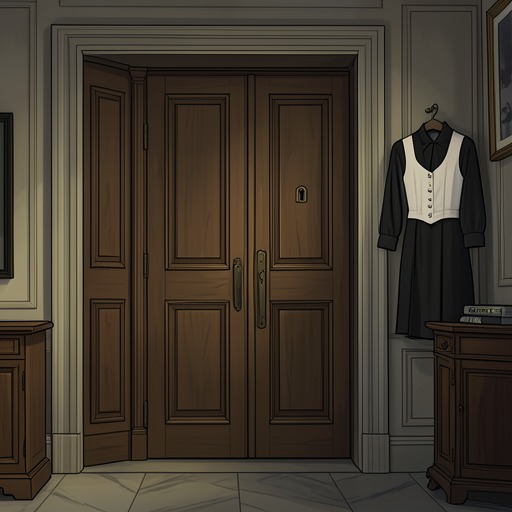
By the time of the incident, Vicomte de Valmont says he had become more attentive to Cécile, while Madame de Tourvel had ceased to occupy him for several days. An accommodating porter had removed obstacles to his visits, and he describes the arrangement as having settled into a regular routine. Familiarity, he admits, had weakened their precautions. On the night in question, after the pair had been together, a door opened unexpectedly. Valmont reached for his sword, then found no one there; he concluded that the door, left unlatched or only partly closed, had opened by itself.
When he went back to reassure Cécile, she was no longer in bed. He found her unconscious in a narrow recess beside it, with strong convulsions. He carried her back to bed and managed to revive her, but she had been hurt in the fall and soon suffered its effects. The unexpected opening of the door thus turned a lapse in their secrecy into a medical emergency. The account does not identify an intruder: Valmont attributes the opening to their forgotten precautions.
Medical Response and Concealment
Valmont says that pain in Cécile's lower back, severe abdominal cramps, and other symptoms made her condition clear to him. Cécile herself had not recognized it. He first had to explain her prior state before telling her what the symptoms meant. His letter thus presents the discovery as abrupt and mediated by Valmont's interpretation, rather than as something Cécile had already understood or disclosed.
They agreed on a plan to seek help without waking Madame de Volanges. Valmont went to the household physician and surgeon, telling them the circumstances in confidence. Cécile was to summon her maid and could choose whether to confide in her; she was also to make sure help was sent for without alerting her mother. Valmont emphasizes that avoiding alarm was a natural concern for a daughter, but the arrangement also kept the person with authority over Cécile unaware of the pregnancy.
The surgeon later reported on the patient's condition. Valmont says that the doctor had supplied a name for the illness and that the household might not discover what had happened if no further complication arose. The maid and medical attendants were, according to his report, keeping the secret. His remark that the affair might be useful to discuss later makes clear that concealment served not only to protect Cécile from immediate exposure but also remained available as material within the correspondence between the conspirators.
Consequences and Narrative Significance
The account gives no full medical history or independent testimony from Cécile. It is a letter from Vicomte de Valmont to Marquise de Merteuil, and he controls both the description of the emergency and the explanation of what followed. His focus on the forgotten precautions, the medical confidences, and the possibility of secrecy reveals a self-interested narrator reporting an event that has consequences for others. The contrast between Cécile's unconsciousness and Valmont's management of the response is especially stark: he speaks for her, arranges care, and determines what her mother will not be told.
The event also casts the planned marriage to Comte de Gercourt in a different light. Madame de Volanges had begun to question whether she should insist on that match when she learned of her daughter's attachment to Chevalier Danceny. She considered withdrawing her promise rather than forcing Cécile to marry one man while loving another. The pregnancy, however, is handled in secret rather than brought into that family decision. It makes the difference between the mother's protective deliberation and Valmont's concealed intervention consequential, without establishing what Madame de Volanges eventually learns.
A later letter from Marquise de Merteuil refers to the loss of Valmont's posterity, indicating that the pregnancy did not continue. That brief, mocking acknowledgment supplies an outcome absent from Valmont's report, but not the medical details of the loss. The episode therefore leaves Cécile's experience largely filtered through other people's interests: Valmont's account to his accomplice and Merteuil's later response. Pregnancy becomes at once a physical crisis, a dangerous secret, and another element in the correspondence through which the novel's characters manage one another.