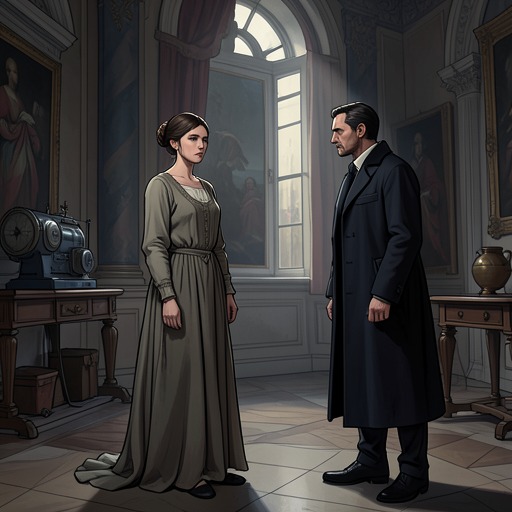
Chevalier Danceny
Les liaisons dangereusesChevalier Danceny is a young knight, singer, and composer whose courtship of Cécile Volanges begins in music and develops through secret correspondence into a declared mutual attachment. His gentle attentiveness contrasts with the intrigues around them: although he treats love as a serious commitment, Marquise de Merteuil regards his reserve and affection as opportunities to redirect him. By the end, the letters that once sustained his love become evidence of Cécile’s vulnerability and the harm done to her; he relinquishes the relationship without turning his grief into vengeance and prepares to leave Paris for Malta.
Identity and Introduction
Danceny enters Cécile’s account as a visitor who comes to her home every day to sing with her. She has been studying voice and harp, and comes to prefer him as a teacher to her former instructor: he sings beautifully, composes airs and their words, and corrects her music and other faults with interest and humor. His criticism therefore feels companionable rather than severe. Cécile also notices that he can flatter without seeming to offer a conventional compliment, and that his attentive manner makes his presence a welcome relief from the boredom she feels when no one speaks to her.
His musical companionship is already charged with affection before either character names it. Cécile imagines that a future wife of his would be fortunate, while regretting that he is a Knight of Malta. When he chooses to stay with her and her mother rather than attend a concert, she takes his preference as a particular kindness. Her account gives the reader access to a growing attachment that she herself has not yet explained or acted upon openly.
Courtship Through Music and Letters
The correspondence turns Danceny’s attentive behavior into a direct declaration. He asks Cécile to hear him out and presents his feelings as the consequence of having seen and admired her. He understands that she may refuse him, but makes her answer the determining condition of his happiness. His letter is emotionally exposed and rhetorically polished: he describes himself as having lost his former tranquility and entrusts his prospects to her response.
When Cécile hesitates to reply, Danceny presses for some sign that their friendship means more than a polite bond. His next letter conveys the pain of waiting and the mismatch, as he sees it, between his love and the friendship she is willing to acknowledge. He says he will try to master his feelings and even consider seeing her less, though he presents that withdrawal as difficult rather than desirable. The exchange makes their early courtship a negotiation over what Cécile can safely admit and what Danceny believes her silence means.
The uncertainty gives way to reciprocity. In a later letter, Danceny recalls that Cécile has written and spoken her love, and describes her affection as grounds for confidence in their shared happiness. He pledges his life to hers and remembers the tenderness of their recent meeting. Yet the joy of that declaration is qualified by the prospect of constraint: he longs to remain close to her, while their opportunities to meet depend in part on Marquise de Merteuil’s interventions in the household. Their love is mutual, but not free to develop without concealment or mediation.
Marriage Plans and Merteuil’s Designs
Danceny’s relationship with Cécile stands against her mother’s promised match with Comte de Gercourt. Madame de Volanges eventually recognizes that her daughter’s attachment to Danceny is serious and reconsiders her authority over the marriage. She reasons that Danceny belongs to as good a family as Gercourt, has comparable personal qualities, and possesses the decisive advantage of loving Cécile and being loved in return. Because Cécile is wealthy, Madame de Volanges questions whether the difference in Danceny’s fortune should outweigh their attachment. She resolves that forcing the arranged marriage could place her daughter between a husband she does not love and the man she does.
Marquise de Merteuil, however, treats Danceny’s attachment as something to exploit. While planning a country retreat to end her liaison with Belleroche, she identifies Danceny as the next man she intends to draw toward herself. She describes herself as his confidante and believes he has a strong inclination toward her, while disparaging Cécile and asking Valmont to prevent Danceny from seeing her during her absence. Her stated concern that Cécile’s first attachment might retain its hold reveals the threat she sees in their reunion. Danceny’s reserve in company, which helps keep suspicion away, also makes his private attentions more valuable to Merteuil’s plans.
Letters, Betrayal, and Departure
At the end of the correspondence, Danceny sends Madame de Rosemonde a packet containing Cécile’s letters. Reading them again, he is struck by the combination of innocence and wrongdoing in her conduct, but his strongest indignation is directed at Merteuil, whose efforts to exploit Cécile’s inexperience he regards as deliberate and cruel. He does not excuse Cécile’s faults; he refuses, instead, to let them become grounds for revenge. Having ceased to love her, he still says that hating her would cost him too much, and asks that whatever concerns her and could harm her remain unknown to others.
His decision to protect Cécile’s privacy is also presented as a matter of principle. He explains to Madame de Rosemonde that he delayed agreeing to her wishes until he was sure he would not be troubled by the consequences of his own affair. He did not want his discretion to appear to purchase her indulgence or esteem. Once satisfied on that point, he asks whether he has fulfilled the duties imposed by his circumstances and declares that he has decided to depart for Malta, where he intends to keep vows that will separate him from the world.
A later report confirms that Danceny has left Paris, with Malta as his reported destination and intended home. His departure closes the arc that began with daily music lessons and the hope of shared happiness. The letters survive where the relationship does not: first as the means through which love was declared, and finally as a record that allows Danceny to distinguish Cécile’s susceptibility from Merteuil’s calculated manipulation.
Narrative Role
Danceny’s story is largely disclosed through letters, so the reader encounters his character in two complementary ways: through Cécile’s early admiration and through his own declarations and final judgments. The form makes correspondence both the medium of intimacy and the means by which intimacy can later be examined as evidence. His musical visits establish a tender, ordinary courtship; his letters expose its emotional stakes; and the packet he sends to Madame de Rosemonde turns private writing toward protection and moral reckoning.
His final response also complicates a simple division between innocence and guilt. He acknowledges that Cécile has done wrong without treating her as beyond sympathy, and he condemns the deliberate abuse of her inexperience without claiming that love can restore their former bond. The ending leaves him neither reconciled with Cécile nor vindictive toward her: he chooses secrecy on her behalf and withdrawal for himself, carrying the correspondence away from the world in which it first promised happiness.